Commentary Prepared by Dr. Julia Lenaghan, Ashmolean Museum
C 033
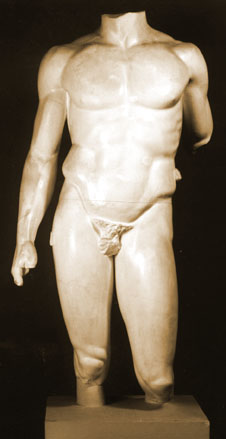
Torso of Polykleitos’ Doryphoros ("Pourtales Torso"). Berlin
A Roman version of a nude male in the Doryphoros Type (ca.445 BC), preserved from the knees to the neck.
Marble (Pentelic)
Statue
1.31
From Rome. Found on the Palatine. A copy of the head of the Doryphoros was also found on the Palatine and may belong to this statue.
Germany, Berlin, Staatliche Museen, Antikesammlung, Inv.Sk. 1789
Early Imperial (Tiberian?) Copy of a Bronze Original dated between 450-440 BCE
Preservation:The torso is preserved from the neck to the bottom of the knees. The head, the left arm from above the elbow down, the lower legs, and most of the fingers of the right hand (the knuckle of the index finger is preserved) are missing. The genitals are broken. The right arm is broken at the elbow and above the wrist. The struts, at the outer right thigh and above the left hip have broken off. On the back of the right leg above the knee is a large area of broken surface where a support was once attached. During World War I, the torso lost the left knee with the beginning of shin, an inner back part of the right knee, and some of the right index finger. Also, the left thigh, now reattached, was broken off. Moreover, from having been dragged, the surface of the pectorals, the right shoulder blade, and the right gluteus are scratched. The knee and breast muscles have been restored in plaster and surface scratches have been lightly colored.
Description:The torso represents a naked male whose weight rests on his right leg. The right hip is raised and the left leg is not taut. The right arm rests by the side. The surface of a broken strut, which would have been connected the right wrist to the right thigh, is visible on the outside of the upper right thigh. The left upper arm is lowered. The remnant of another strut, that supporting the left forearm, protrudes on the left side above the hip. The neck shows that the head was turned to the right.
The torso is heavily muscled and the details are defined. The sinews of the throat, the clavicle, the pectorals, the ribs, and the abdominal muscles are all distinctly articulated. The illiac furrow is sharp and separates the torso from the legs. The overall effect is that of a lean well-balanced body.
Discussion:This torso, which is frequently referred to as the Pourtales torso (after a previous owner) is with doubt a copy of the “Doryphoros” of Polykleitos (see cat.no.32). It is generally accepted as a Tiberian copy (Zanker, Heres, Kreikenbom). A fragmentary head of the “Doryphoros”, which was also found on the Palatine (now Museo Nazionale Romano), quite plausibly goes with this statue and might also date to the Tiberian period.
For many years this torso was considered the best and truest copy of the “Doryphoros” because of its seeming attention to detail and fine articulation of all aspects of the torso. It was, in fact, used in the plaster reconstruction of the statue in the early part of the twentieth century. In the early 1970s both Lorenz and von Steuben objected to this. Because of the heavy articulation of the muscles and because of the slightly different position of the right arm, von Steuben considered it to be a less organic, less harmonious, and thus, less Polykleitan work than the statue in Naples (cat.no.C 32). Zanker, however, and Heres and Hallet after him return to the earlier opinion that the articulation does derive from the fifth century bronze original and is, in fact, closer to the original than the smooth softness of the Naples statue. Kreikenbom, moreover, finds the details of the Berlin torso to be less well-defined than those of the Minnesota statue with which it has in common the position of the right arm. Furthermore, on the basis of the proportions and the forms, Kreikenbom believes the statue is better considered a work of the early imperial workshops than an entirely true copy.
Bibliography:C. Blümel,
Staatliche Museen zu Berlin. Katalog der Sammlung antiker Skulpturen: Römische Kopien Griechischer Skulpturen des funften Jahrhunderts v. Chr (Berlin 1931) p.19 K 151 pls.35-36
descriptionT. Lorenz,
Polyklet (Wiesbaden 1972)
H. von Steuben,
Der Kanon des Polyklet: Doryphoros und Amazone (Tubingen 1973) pp.53-55 pls.34-36
believes the torso is less closely related to the original than the Naples statueP. Zanker,
Klassizistische Statuen (Mainz 1974) pp.7-8
considers it to be possibly Tiberian on account of the handling which is similar to the statue from PompeiiD. Kreikenbom,
Bildwerke nach Polyklet (Berlin 1990) pp.68-70, 165 no.III.9
notes general plasticity, in comparison with the Minnesota statue is less sharply articulated, dates to the Tiberian period(H. Heres),
Polyklet: Der Bildhauer der griechischen Klassik (Mainz am Rhein
Mainz am Rhein 1990) pp.539-540 no.43 pl.5
remarks on precision of copy, dates to the Tiberian eraW. Moon (ed.),
Polykleitos, the Doryphoros, and Tradition (Wisconsin 1995)
articles on various aspects of the DoryphorosC. Hallett,
"Kopienkritik and the Works of Polykleitos" in Polykleitos, the Doryphoros, and Tradition (Wisconsin 1995) pp.128-136
believes the torso to be closer to the original bronze than the Naples statue