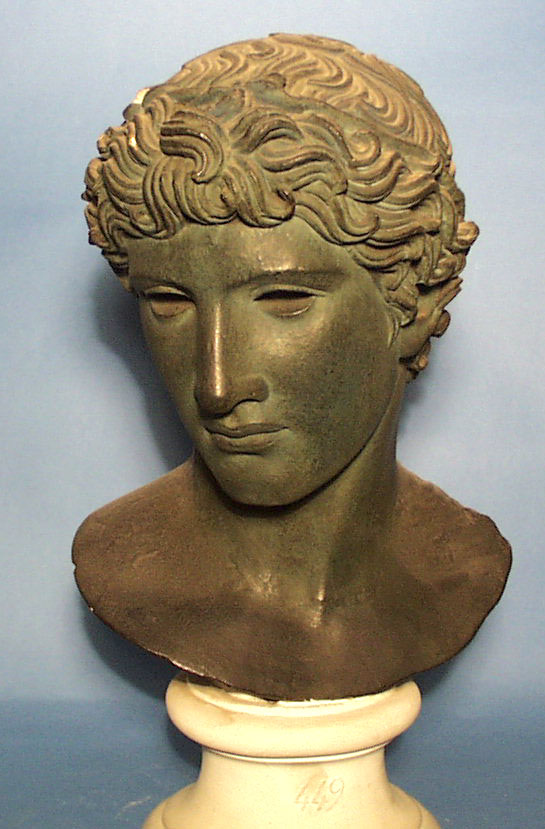
Head of a youth.
Commentary Prepared by Dr. Julia Lenaghan, Ashmolean Museum
C 031
Bronze Bust of a Youth from Herculaneum ("from Benevento"). Louvre
Bronze
Bust
33 cm, head 22 cm
From Herculaneum. It was mistakenly thought to have come from Benevento.
France, Paris, Louvre, Br. 4
Preservation:The bust is nicely cut between the beginning of one shoulder and the beginning of the other. There are traces of gilding still on the lips. The eyebrows are encrusted.
Description:The bust depicts a beardless young male who looks to his right and slightly downwards. The face has an oval shape which tapers to an almost receding chin. The brow is low and the eyebrows are slightly arched. The eyes are almond-shaped and the upper lid continues beyond the lower lid. The nose is straight, long, and thick. The lips below it are full. The “bows” of the bow-shaped upper lip are particularly high and the center dip of the upper lip hangs noticeably down over the lower lip.
The hair, which seems to overwhelm the head, is divided into two distinctly different areas below and above the fillet. At the top of the head the hair, rendered with deeply engraved grooves between the strands, falls in tiers of wavy locks which lie against the skull. At the crown the hair the hair sits in a “star-fish” pattern. The ends of each lock come together in small spits which point in various directions.
The hair over the brow and around the temples is voluminous and springs energetically away from the head. Above the center of the brow is the focal point of a swirling group of locks. Beyond this whirl, the locks are combed generally backwards. Curling sometimes into the ears, these locks mainly cover the tops of the ears
Discussion:The head, which exists in no other replicas, was once thought to be an original of the fifth century BCE (Furtwangler) and perhaps even came from a statue. Scholars now generally recognize that it is a work of the mid to late first century BCE and that the smooth edge of the bust as well as its shape indicate it was most likely a herm.
There is still some dispute about whether it is a copy of an original of the fifth century BCE or is actually a new creation of the first century BCE, one based upon various classical models. Two discrepancies alert the viewer to the latter possibility which is convincingly argued by Zanker. The first discrepancy is that between the hair on the crown which clings to the head and features parallel grooves between the strands and the hair on the brow which tumbles forward voluminously. Second, the big features of the face seem oddly juxtaposed to the glorified and feminine aspect of the hair.
Zanker points out that the “star-fish” at the crown and the rendition of the hair at the top of the head, which remind one immediately of Polykleitos’ Doryphoros, actually copy exactly the hair of the “Idolino” and a basalt head in the Vatican (of the same type as the “Idolino”). Yet, neither the brow nor even the hair at the nape continue to copy the hair of the “Idolino”, though the brow hair is in structure and pattern Polykleitan. About the face Zanker notes that the nose, mouth, and overall structure are similar to Polykleitan works, yet the inclination of the head, the structure of the brow and eyes, as well as the brow hair produce a feminine un-Polykleitan aspect.
Zanker interestingly introduces the Terme Boxer as an example of similarly classicizing Polykleitan treatment of the hair. The Boxer is intended, thus, to justify his dating of the Louvre head to about 50 BCE.
The head indeed looks strikingly eclectic. Moreover, the evidence that the top of the head is copied from a model from which the brow and nape hair are not speaks convincingly for a new creation of the Roman period, which may well be late Republican or even Augustan.
Bibliography:A. Furtwängler,
Masterpieces of Greek Sculpture (Lodon 1895) pp.290-291 pl.14
considers the bust to be an original work of Classical GreeceA. de Ridder,
Les Bronzes Antiques du Louvre I (Paris 1913) p.8 no.3 pl.1
notes the similarity to the Athena Lemnia,
Encyclopédie Photographique de l'Art III: Le Musée du Louvre: Le sculpture grecque (Paris 1938) pp.84-85
J. Charbonneaux,
Les Bronzes Grecs (Paris 1958) pp.111-112
considers it an example of the neo-classical style of the 1st c. BCE based on a model of the second half of the 5th c. BCEP. Zanker,
Klassizistische Statuen (Mainz 1974) pp.32-33 no.29 pls.34.1, 36.1,4, and 7
believes that the bust dates to about 50 BCE and uses Polykleitan heads as models(C. Maderna-Lauter),
Polyklet: Der Bildhauer der griechischen Klassik (Mainz am Main 1990) pp.646-647 no.177
repeats ZankerK. Stemmer (ed.),
Standorte: Kontext und Funktion antiken Skulptur (Berlin 1995) pp.453-454 D 41
summarizes the research, especially Zanker