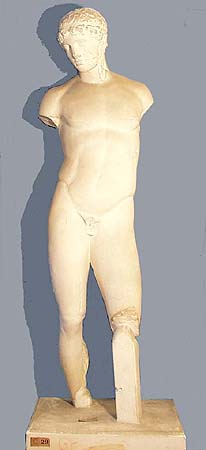
Boy athlete.
Commentary Prepared by Dr. Julia Lenaghan, Ashmolean Museum
C 029
Youth of the "New York-Berlin" Type. New York
Marble
Statue
1.162 m, head 17.8 cm
The statue was formerly in the collection of Count Ugo Cahen d’Anvers of Paris. The provenance is unknown
United States, New York, Metropolitan Museum of Art, 26.60.2
Preservation:The statue is missing both arms from just below the shoulders down, the right foot and ankle, a piece of the inner part of the right leg, the left leg from the knee down, and the greater part of the genitals which were worked separately and dowelled on; a piece of the dowel remains. On the back of the right thigh is a large indentation which has been smoothed down in the modern era. Also the arm fractures have been smoothed down in the modern era. On the left side of the face and running down the neck are chips.
Description:The statue depicts a nude youth who stands with his weight on his right leg. The right hip curves outward and the left leg comes forward. The head turns to the right and slightly downward. The shoulders are lowered but the arms are not preserved and there are no traces of struts to indicate their exact position.
The head has a high dome which is covered by short, closely-adhering, curly locks. Above the ears and encircling the entire head is a fillet. Underneath the fillet, the hair crosses the brow in a triangular path which peaks at the center. The face has an oval form which tapers to the chin. The eyes have narrow openings and the upper lid appears to pass slightly over the lower lid; at the corners of both eyes the surface is damaged. The lips are broad and droop at the corners. The chin is strong and solid.
Discussion:The head of the statue is known in two other replicas, now in the Ny Carlsberg Glyptotek. All three heads correspond closely. The body of the statue has a variant in a statue of Hermes in the Conservatori Museum and is also connected to a statuette of the second century CE in Berlin.
The Hermes in the Conservatori and the statuette in Berlin have different arm positions (Richter, 1955 figs.144 and 143). In the Berlin statuette the left hand is connected to the thigh by a strut and perhaps held a fillet. The Conservatori Hermes, wearing a cap and a chalyms and cradling a kerykeion, holds the left hand farther away from the thigh and in addition, has a strut on the upper right leg which indicates that its right arm was lowered by the side. In contrast, in both the Berlin and the New York statues, neither of which have supports on the right leg, the right arm seems to have been bent and the forearm to have extended forward. The majority of scholars (Richter cites Modonna, Lippold, and Mustilli) agree that the differences in the Conservatori statue were attributable to its adaptation to Hermes. Richter, however, questions whether the Conservatori Hermes is actually following the same type since she believes it likely that many Greek originals were actually tightly related. Zanker, most recently, affirms that the New York and Conservatori statues have more in common that the New York and Berlin renditions. The Berlin statuette he considers to be looser and less true to the original.
Zanker notes that Amelung, Lippold, and Schweitzer have all seen similarities between the type of the New York statue and the Kassel Apollo and the Athena Lemnia. Therefore, these scholars have placed the original of the New York statue among the works of Phidias or his circle. V. Poulsen, on account of what he saw as a reliance on the Athena Lemnia, determined that the type of the New York statue was classicizing. Richter assumes that the statue is a copy of a classical original and Zanker, who cannot find any evidence of a mixing of styles, accepts the type as an original of the fifth century.
There is no reason to believe that the New York statue, the Copenhagen heads, the Conservatori Hermes, and the Berlin statuette do not replicate a Greek original of the mid to late fifth century. It is, furthermore, clear that the Berlin statue is the least reliable of the replicas. It is small-scale and portrays a sensuous slightly built youth whose body lacks definition and whose stance has been smoothed.
Bibliography:G. Lippold,
Die griechische Plastik. Handbuch der Archaeologie (Munich 1950) p.145 footnote 9
compares the brow hair of the statue to that of the Kassel ApolloG.M.A. Richter,
Catalogue of Greek Sculptures in the Metropolitan Museum of Art (Oxford 1954) p.27 no.31 pl.31
dates the original to 450 or later, suggests that the Conservatori Hermes reproduces another Greek originalG.M.A. Richter,
Ancient Italy (Ann Arbor 1955) pp.45-46 fig.142
enlarges upon the ideas which she put forth in 1954P. Zanker,
Klassizistische Statuen (Mainz 1974) p.108 footnote 95
believes that the heads of the type correspond well, that the Conservatori and New York statues are related, that the statuette in Berlin is less reliable, all are copies of a Classical work