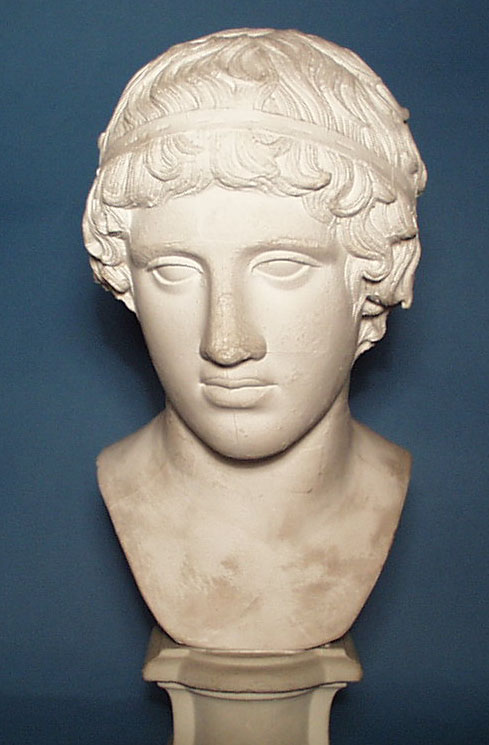
Head of youth.
Commentary Prepared by Dr. Julia Lenaghan, Ashmolean Museum
C 028
Bronze Head of a Youth with Fillet. Munich
Bronze
Head
26.3 cm
In 1730 the head was in the Kingdom of Naples. It is uncertain whether the head came from one of the cities around Vesuvius.
Germany, Munich, Glyptothek, 457
Preservation:The head is preserved from the bottom of the neck upwards. The edges around the neck have been smoothed down to fit the head into a modern bust (now removed). There are five different sized fillings in the neck and on the left side there is a crack. The head has barely any traces of corrosion on the face and not one lock of hair is damaged. Even the eye-holes are intact; the eyes themselves, described as silver with granite pupils, have been lost in the modern era. The lips and the eyebrows have traces of gilding.
Description:The head portrays a young man with long hair. The hair, which has no part, comes forward and to the sides from the part in voluminous wavy locks, the individual strands of which are denoted by engraved lines. At the crown, the uppermost locks which are too short to reach the sides or the back, rest in a “starfish pattern” on top of the longer locks. The longer locks cover the ears, except for a small piece of the lower lobe, and frame the brow in a horizontal path. Over the brow and at the back of the neck the locks have a central parting which is more pronounced at the back of the head. At the back and around the ears, especially on the right side, individual locks escape from the mass and lie directly on the skin. A flat band, running above the ears, encircles the entire head. It is knotted at the center of the back of the head and has rectangular indentations all the way around for the insertion of gold or silver inlays.
The face has a broad oval shape with a low flat brow, full cheeks, and a round chin. The eyebrows, which have a slight arch, are delineated by short engraved lines. The eyes, which have a long shape, are marked by the upper lid which extends well beyond its intersection with the lower lid. The nose is straight without a dip at the bridge. The bow-shaped lips are defined by a line around the exterior. The groove between the lips is broad and dips down at the center which gives the upper lip a central projection. he head itself turns slightly to the right.
Discussion:The head repeats details of face and hair which are repeated loosely by several other heads. Zanker considers the Munich head to have four variants: 1) the head of a bronze lamp-holder (lychnouchos) from Volubis, 2) a small marble head in the Vatican, 3) a marble head in Liebieghaus, Frankfurt, and 4) a marble head in the Museo Nazionale in Rome. Vierneisel-Schlorb, in contrast, considers the head to exist in two other replicas: 1) the head of the lychnouchos from Volubis and 2) the Frankfurt head.
Associated with the Munich head are bronze genitals which have inscribed on their back Greek letters. Because the genitals are separately cast and of a poorer quality than the head, most scholars believe that the head and genitals did not belong to a statue but rather to a marble herm. Structurally similar bronze busts and genitals attached to marble herms have been found at Pompeii; the best example, that of L. Caelius Iucundus, shows the same discrepancy between a finely worked head and cursorily mass produced genitals.
The main issue of academic controversy in regard to the Munich head is its artistic lineage. It has been considered a Greek fifth century original (Furtwangler), a cast from the Greek original (Brunn), and an entirely Roman creation of ideal statuary (Rumpf). This latter judgment relied in great part on the idea that the head was associated with the “family” of Roman lychnouchoi. Yet, since the head seems to have been a herm and not a statue, this has been dismissed.
More recently, Zanker deemed the head to be more likely a classicizing work than a classical work To support his argument, he noted the similarities of the “star fish” pattern of the hair at the crown which recalls the Diadoumenos and the softened features that are typical of classicizing works, (for example the lychnouchos of Via dell’Abbondanza, the Idolino, and the Basalt Youth (cat.no. C 27) in Rome.) He suggested that even if the Munich head and the head of the Lychnouchos of Volubilis did go back to a classical model, they had more in common with the taste of the period of their erection than with their original model. Vierneisel-Schlorb, who is opposed to Zanker’s assignment of numerous statues to Roman classicizing trends, believes that the Munich head and the Volubilis lamp-holder (as well as the Frankfurt head) do derive from an original of the late fifth century BCE. Yet she agrees with Zanker that these renditions of the original are heavily influenced by the taste of the period in which they were erected. Both Zanker and Vierneisel-Schlorb are of the opinion that the Munich head is early imperial.
Given the number of heads related to the Munich head, it seems likely that they all did depend at least loosely on a Greek original. It seems also to be the case that they were generally fashionable in the early imperial period, particularly for the “decorative arts”.
Bibliography:P. Zanker,
Klassizistische Statuen (Mainz 1974) pp.33-34 no.30 pls.35.1 and 3, 36.2 and 5, 37.6
cites four variants of the head, considers it to be late Augustan or Tiberian, notes similarity to Polykleitos’ Diadoumenos, believes it to be classicizingB. Vierneisel-Schlörb,
Katalog der Skulpturen Band II: Klassische Skulpturen des 5 und 4 Jahrhunderts v. Chr. (Munich 1979) pp.490-497 no.44 figs.237-241
disagrees with Zanker in that considers it to depend upon classical original and to belong to a replica seriesK. Stemmer (ed.),
Standorte: Kontext und Funktion antiken Skulptur (Berlin 1995) p.453 D 40
dates to the late Augustan-early Tiberian period