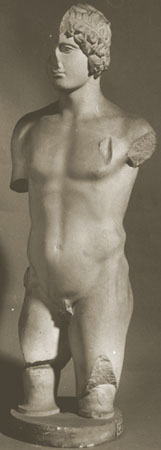
Statue of a boy victor.
Commentary Prepared by Dr. Julia Lenaghan, Ashmolean Museum
C 027
Basalt Statue of a Youth. Museo Nazionale Romano
Green Basalt
Statue
82 cm, if restored ca. 1.35 cm
From Rome. Found on the Palatine in a cryptoporticus near the Temple of Jupiter Victor
Preservation:The statue is missing about one third of the right side of the head, the nose, the right arm from the biceps downwards, the left arm, and the legs from the mid thighs downwards. There are abrasions on the left breast and various chips on the head. There is a broken strut at the right hip and on the upper part of the left pectoral.
Description:The statue depicts a naked youth with long hair. The figure stands with its weight over the left leg; the left hip is consequently raised. The bent right leg is withdrawn. The movement of the hips is barely reflected in the rigid torso; the left shoulder is just slightly lowered. The position of the arms can be determined by the struts. The left upper arm rested by the side and the forearm seems to have been raised over and in front of the breast. The right arm was lowered and rested by the side. The torso itself is modelled but has very little indication of musculature.
The head turns slightly to the right. The face has a round shape. The brow is low, the cheeks are full and fleshy, and the chin is strong and rounded. The locks of hair, with individual strands rendered by incised lines, are long and wavy and cover the ears completely. Running around the entire head above the ears is a band. It is placed over the hair and is, thus, entirely visible. The ends of the band are twisted “together like twigs” (Zanker) at the back of the head.
Discussion:The head type of this basalt youth exists in one other replica, another basalt head in the Museo Nazionale Romano collection which allows us to reconstruct a central part in the hair over the brow. There is also a variant of the type in the Vatican collection. The green basalt statue has been dated to the early imperial period, perhaps Claudian, by Zanker who is led to this conclusion by the polished surface, the full and articulated lower face, and the modelling of the hair.
The head is most often compared to a bronze head of a victorious youth in Munich. Although its face is slightly broader than that of the Munich bronze, the two works share the same form of the eyes, chin, the flat surface of the flesh, the mouth, the full chin, and the rendering and organization of the hair. The statue has also been compared to the “Villa Albani-Copenhagen Youth”, the “Idolino”, the “Spinario”, and even the “Munich Orpheus”, all of which are related.
The head had been long accepted as a copy of an original of the late fifth century, 420-400 BCE, with some discussion as to whether it related to an attic or peloponnesian school. Enrico Paribeni, who considered it to be attic, for instance compared it to the child of the so called “Cat Stele” from Aegina. Zanker, however, has questioned the supposed fifth century date of the model and suggested that the basalt statue may be a copy of a classicizing work of the first century BCE. His argument is based on the following points. 1) He considers the head to resemble a late fifth century original; yet it is inorganically placed on the body and it looks away from the viewer in a way that is typical of works of the “Severe Style”, the early fifth century. 2) The upper body is stiff and unrelated to the lower body. Moreover, the torso is unmuscled which cannot be due to the hardness of the stone since the details of the face are carefully rendered. 3) The arrangement of the hair with its central part and the hair band twisted around itself at the back are classicizing details. 4) The head resembles an entire group of works, the “Villa Albani-Copenhagen Youth”, the “Idolino”, the “Spinario”, the “Munich Orpheus”, and especially the bronze head of a victorious youth in Munich, all of which he considers to be classicizing. Zanker, thus, concludes that the statue is either a classicizing work of the second half of the first century BCE or that the artist has reworked a classical model.
The statue certainly has a number of classicizing details and it is without doubt related to the bronze head in Munich. It seems likely to me that these heads were all loosely based on a famous work of the late fifth century.
Bibliography:Emanuela Paribeni,
"Statua di Fanciullo (inv.1059)" Museo Nazionale Romano: Le Sculture I (Rome 1979) (0) pp.61-62 no.51
summary of the research to dateE. Paribeni,
Sculture greche del V secolo (Rome 1953) p.31 no.36
cites the other replica, compares the head to the Villa Albani-Copenhagen Youth and the bronze head of a boy victor in Munich, suggests that it might be AtticP. Zanker,
Klassizistische Statuen (Mainz 1974) pp.35-37 no.32 pls.33.4, 34.2, and 36.9
compares the head to the bronze head of a boy victor in Munich as well as other works which he considers to be classicizing, dates the original to the 1st c. BCE, considers the basalt head to be imperial, perhaps Claudian