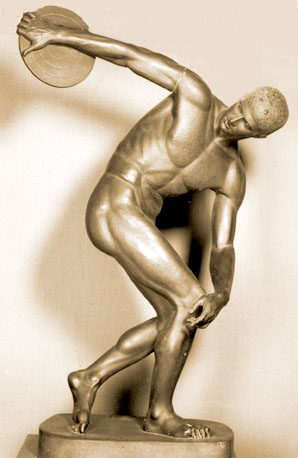
Athlete throwing a discus.
Commentary Prepared by Dr. Julia Lenaghan, Ashmolean Museum
C 025
Composite Cast of the Diskobolos of Myron Consisting of the Vatican Body and the Museo Nazionale Romano ("Lancellotti") Head
Marble
Statue with Non-Pertinent Head
of Vatican Diskobolus, without plinth to restored head is 1.33 m
The Vatican statue was found in 1791 at Hadrian’s Villa in Tivoli with another copy of the diskobolus now in the British Museum. The Museo Nazionale Romano head was found with its body in Villa Palombara on the Esquiline in 1781. It was in Munich until 1948.
The Vatican statue was found in 1791 at Hadrian’s Villa in Tivoli with another copy of the diskobolus now in the British Museum. The Museo Nazionale Romano head was found with its body in Villa Palombara on the Esquiline in 1781. It was in Munich until 1948.
Vatican, Vatican City, Sala della Biga, 618
Preservation:The body is preserved without a head. The head on the Ashmolean Cast has been taken from another replica of the statue. Restorations in the body include small areas around the breaks at the socket and the forearm of the right arm; most of the diskos above and below the hand (the size of the diskos is, however, ascertained by the three engraved parallel circles); the left arm and hand; the right lower leg from and including a piece of the right knee; the right foot; small pieces in the left thigh and knee as well as the tree trunk support (not preserved in the cast); and the big toe of the left foot. The right arm is broken twice, once near the shoulder socket and once at the forearm. The left leg is broken under the knee and the tree trunk support (not depicted in the cast) is broken near the left thigh.
Description:The statue depicts a naked male in the act of throwing a diskos. The right side of the statue is intended to be the primary view. The weight rests on the right foot which faces forward. The right lower leg rises in a vertical line to the knee which is bent. The right thigh moves in a 45 degree angle back and up from the knee. The upper body comes forward from the hip and forms a right angle with the right thigh. The shoulders and pectorals are turned and face the viewer frontally. The right arm is raised and extends backwards. The right hand holds a diskos which has three inscribed circles. The left arm rests at the side in an almost vertical position; the left hand comes loosely across the right knee. The left leg drags behind the right. The foot is raised so that only the toes touch the ground; the lower leg creates a diagonal line which is virtually at a right angle with the right thigh and is parallel to the inclination of the upper body.
The head of the statue, which depicts a short-haired young man, turns back and up toward the right hand. The face has a full oval shape with a broad, flat, and low brow. The eyebrows arch normally and the eyes are almond shape. The cheeks and the lips are full. The groove between the lips rises from the corners and dips at the center so that the center of the upper lip hangs down. The outer edge of the lower lip is carefully outlined and it comes up at the center. The chin is round and solid.
The hair is rendered in short locks which are delineated by incised lines and adhere tightly to the head. The hair line moves up from the temple and then more or less straight across the brow. It has a an upward parting in the center of the brow. The ears are left completely uncovered. Two knobs, reference points for the copyist, project above the hair line and in line with the eyes.
Discussion:The statue type of this modern pastiche (the Vatican body with the Museo Nazionale Romano “Lancellotti” head) is well known. Paribeni listed nineteen replicas, twelve of which were statues and seven of which were heads. To this list a torso in Side and a statue in Toulouse can be added (see Emanuela Paribeni). The structure and the motion of the statue, which require an awkward tree-trunk suppport, indicate clearly that the original model must have been made in bronze rather than marble. The play of patterns and geometric forms as well as the style of the head suggest that the original model dated to the end of the “Severe Style.” A passage in Lucian’s Philopseudes (18) as well as one in Quintilian (II.13.8) allow us to identify the original model precisely as work by Myron.
The Museo Nazionale Romano “Lancelloti” head has been dated to the early Antonine period (Zanker and Emanuela Paribeni). The hair is rendered like the beards on Antonine portrait statues and the cheeks have an intense plasticity which is also typical of Antonine works. The Vatican body has been dated by Lippold to the Hadrianic period; this dating, which may or may not be correct, appears to be in large part due to its find spot in Hadrian’s Villa.
Some discussion has arisen about the subject of the original model. A gem which features the type is inscribed Hyacinthos, a youth beloved of Apollo who accidentally was killed while training. Lippold has, thus, suggested that Myron’s diskobolos was intended to be Hyacinthos. Others (Fuchs) maintain that the young man represented is an ordinary mortal athlete.
One can say without doubt that the diskobolos represents an original bronze statue by Myron and made around the middle of the fifth century BCE. Compared to the works of the circle of Polykleitos, the diskobolos has more emphasis on a physical activity and movement than on the details and contemplation. Myron is said by to have been “numerosior”, more various, having more poses, than other artists and the diskobolos supports such a judgement.
Bibliography:Emanuela Paribeni,
"La statua di Discobolo c.d. Discobolo Lancellotti (inv.n. 126371)" Museo Nazionale Romano: Le Sculture I (Rome 1979) pp.184-186 no.120
E. Paribeni,
Sculture greche del V secolo (Rome 1953) pp.22-23 no.20
G. Lippold,
Die Skulpturen des vaticanischen Museums III, 2 (Berlin 1956) pp.88-91 no.618 pl.44
B. S. Ridgway,
The Severe Style in Greek Sculpture (Princeton 1970) p.85
P. Zanker,
Klassizistische Statuen (Mainz 1974) p.92 pl.73
M. Robertson,
A History of Greek Art (Cambridge 1975) pp.340-341