Commentary Prepared by Dr. Julia Lenaghan, Ashmolean Museum
C 024
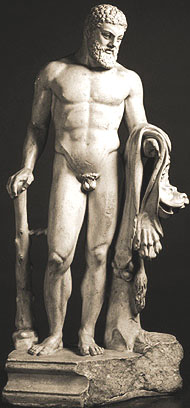
Statuette of Herakles in the "Boston-Oxford" Type. Boston
Marble
Statuette
57 cm
Allegedly found between the Aventine Hill and the Tiber in Rome. The statue was acquired from a Bavarian collection.
United States, Boston, Museum of Fine Arts, 14.733
Preservation:The statuette is missing the left forearm and hand, the front left corner of the plinth, and the tip of the nose. The surface, once heavily encrusted, has been acid washed.
Description:The statuette depicts a nude male who has short curly hair and a short curly beard. He stands frontally with his weight over the left leg. The right leg, which is bent, comes forward and the right foot turns outward to the right. The torso is robust with particularly heavily muscled pectorals, shoulders, and neck. The right arm, resting by the side, pulls slightly away to the right and the hand sits on top of a club which extends down toward the ground. The club is connected by a strut to the right thigh and rests on a stone. The left arm, also resting by the side, is bent and forms an approximately 90 degree angle. The left forearm projects out and forward from the body. A lion skin is draped over the left forearm. Below the lion skin and to the left of the left leg is a tree trunk support. To the left of tree trunk on the ground is a raised area with engraved swirling lines; because of the break in the plinth, it is only partially preserved.
The head follows the direction of the left arm; it looks down and to the left. The hair sits on top of the head in a cap of short curls. The beard, also in short curls, sticks to the cheeks but comes down off the chin. The brow is broad and convex under the hair. The eyebrows arch, the cheeks are modelled, and the lips are full.
Discussion:The statuette clearly represents Herakles and has been dated to the Hadrianic or early Antonine period on account of the plinth (Vermeule). The type exists in two other small-scale replicas, one in Oxford and one in Madrid. Fragments in Gottingen and Corinth have been also been associated with the type and rejected. A fragment of a cast in Baiae is considered to be loosely related.
Arndt connected the statuette with the "Munich King" and thought both were copies of works by Myron. Bulle, continuing the same line of thought, associated the statue with a dedication made at the Heraion on Samos by Myron. The dedication, described by Strabo, featured statues of Herakles, Zeus, and Athena. All three of the statues were removed to Rome by M. Antony; Augustus, then, returned all but the Zeus, which is represented by a torso found at the Theater of Marcellus, to the Samians. On the grounds of the base still in Samos Buschor was able convincingly to date Myron’s dedication to 439 BCE or shortly thereafter. This date is, however, too late for the style of the statuette. Moreover, Berger pointed out that thematically and compositionally the statuette did not correspond well with the "Munich King". For these reasons, Vierneisel-Schlorb, who believes the Herakles statuette to resemble Myron’s Marsyas, suggests that perhaps the Herakles statuette represents another work of Myron erected in the same general area. She points out that Eastern Greek coins show a single Herakles (without any other statues) with the same attributes and in a pose similar to that of the statuette. She believes that the type of the statuette cannot be considered a later eclectic work (the brow, the eyebrows, the eyes, and the cheeks are stylistically too similar to the Marsyas), and insists that the small format of the replicas is not relevant to the original.
Thus, the only conclusive statement that can be made about the statuette is that it is probably a a copy of an original of the mid fifth century. In spite of Verneisel-Schlorb’s dismissal, I find it interesting that the statuette is preserved only in small-scale replicas.
Bibliography:J. Boardman and O. Palagia,
"Herakles", Lexicon Iconographicum Mythologiae Classicae IV, 1 (Zurich 1988) pp.751-752
B. S. Ridgway,
The Severe Style in Greek Sculpture (Princeton 1970) pp.130-131 and 146
B. Vierneisel-Schlörb,
Katalog der Skulpturen Band II: Klassische Skulpturen des 5 und 4 Jahrhunderts v. Chr. (Munich 1979) p.123