Commentary Prepared by Dr. Julia Lenaghan, Ashmolean Museum
C 021
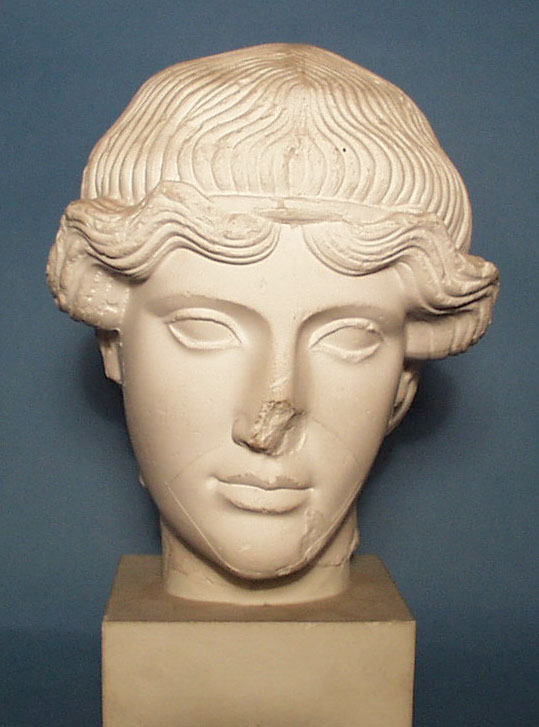
Basalt Head of "Orpheus". Munich
Basalt
Head
21.1 cm
Bought in Geneva in 1926. Probably from Cumae
Germany, Munich, Glyptothek, 523
Preservation:The statue is broken through the throat at the level of the chin. The end and the left nostril of the nose are missing. The extreme end of the hair on the neck was broken in antiquity and repaired. The remains of the dowel are visible in a circular hole. The eyelids and some strands of hair are worn and chipped. Below the left hand corner of the mouth is a bipartite raised break surface; the shorter part goes in the direction of the corner of the mouth and the longer part extends upward to the level of the nostril.
Description:The head is under life-size and represents a young person with long hair. The hair, rendered in thick undulating parallel lines, is combed from a central part toward the sides of the head. A round band runs around the head above the level of the ears and keeps the hair in place. At the back of the head, the hair, coming out from under the band, is collected in a knot or pony tail. On the nape itself hairs, that are too small to have been collected in the knot, are indicated by short engraved lines. At the front of the head the hair is divided by the part into two equal sections. Each section is pulled loosely backward over the temple and the ear. Behind the ear the section of hair goes under the band, comes back out from the band, and then is pulled back under the band.
The face features a low brow, eye brows that arch, and smooth softly modelled cheeks. The eyes have a high arching upper lid and a straighter lower lid. The lower part of the face is small and is dominated by a tender mouth with shapely lips. The groove between the lips is small and straight; the upper lip, which is relatively small, has a sensual dip at the center.
The entire head is assymetrical. The hair on the left side of the part features features broader spaces between the locks of hair, the left cheek is abbreviated, and the left side of the chin hangs lower than the right side. These features suggest that the head was turned toward the left and intended to be seen from the right. The trace of a raised element on the left chin supports this.
Discussion:The head is known in six other replicas (Bologna, Vatican Magazzino, Copenhagen, Torlonia, art market, and Naples) as well as in seven variants (Berlin, San Antonio, Vatican, Vatican Magazzino, Florence, art market, and Villa Albani); see Zanker p.84 for the replica list. Above all, the "Severe" hairstyle suggests that the replicas copy an original dated around 460 BCE.
Zanker has classified the head as the work of an early imperial classicist that is based on an original which has details in common with the "Aspasia/Sosandra" type. This judgement, partially affirmed by Vierniesel-Schlorb, rests primarily on the discrepancy between the early classical hairstyle and the sentimentalizing face and the ambivalent sexuality of the head. The replica in the Vatican Magazzino, which has a broader lower face and a less sweet appearance, is considered to be closer to the original. Although this now appears to be the accepted opinion and the head is considered of more interest for studies of early imperial art than for studies of early classical art, the head was once viewed as a perfect interpretation of classical art (Sieveking).
In 1926 Sieveking associated the Munich head with a seated statuette in the Hermitage which depicted a youth playing a lyre. For this reason, the head became known as Orpheus and was connected to a multi-figured dedication made by Mikythos at the Temple of Zeus in Olympia after 467 BCE. Among the figures of this dedication was supposedly that of Orpheus (Pausanias 5.24.6 and 5.26.2-5). The raised surface on the Munich head’s left chin and cheek, which is repeated also on the Bologna replica, would have corresponded to the lyre of Orpheus. The head has also been associated with another entirely different original. Langlotz thought the type belonged to a non-existant peplos statue, known as the “Angerona” Type. This latter suggestion has, however, been generally dismissed.
Sieveking’s connection to the Hermitage statuette has been rejected most recently by Zanker who considers the statue an eclectic composition of the first century BCE which features a female head type. Vierneisel-Schlorb in the latest publication of the head adamantly supports Sieveking’s position and objects to Zanker’s dismissal of the Hermitage statuette. She points out that given the provenance of the statuette a late Hellenistic date is improbable, that the head and body seem to belong stylistically together, and the lyre marks on the face of the Munich and Bologna heads are too convincingly appropriate. Moreover, she believes the Vatican Magazzino replica, the closest to the original, and the bronze Hermitage statuette to have similarities to the sculptures of the Olympia pediments which are chronologically near the dedication of Mikythos. Finally, she considers the base of the dedication of Mikythos and the possible placement of Orpheus on its left side.
In my opinion the head is certainly a Roman interpretation of an early classical original. Certainly the sappy sentimental quality of the head points to this; whether or not the androgenous aspect belongs to the copyist (Zanker) or to the original (Vierneisel-Schlorb) is unclear. The head type is, I think, related to that of the Hermitage bronze statuette; whether the statuette replicates an original of the fifth century or is a late Hellenistic creation is equally unclear. The Munich and Bologna heads surely did feature a lyre against the left cheek; whether they are replicating a fifth century original or a Hellenistic pastiche that uses a fifth century original must remain open.
Bibliography:J. Sieveking,
"Neuerwerbung der Munchner Glyptothek" AA 1926 pp.334-341
B. S. Ridgway,
The Severe Style in Greek Sculpture (Princeton 1970) pp.140 and 148
P. Zanker,
Klassizistische Statuen (Mainz 1974) pp.84-86 no.1 pls.64-65
B. Vierneisel-Schlörb,
Katalog der Skulpturen Band II: Klassische Skulpturen des 5 und 4 Jahrhunderts v. Chr. (Munich 1979) pp.23-35 no.4 figs.13-18