Commentary Prepared by Dr. Julia Lenaghan, Ashmolean Museum
C 020
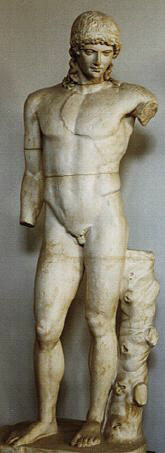
"Tiber Apollo". Rome
Marble
Statue
2.04 m
From Rome. Found on the banks of the Tiber, between the Ponte Palatino and the "Bagni di Donna Olimpia"
Italy, Rome, Museo Nazionale Romano, 608
Preservation:The statue is missing the left arm from the shoulder downwards, the right hand from the wrist down, and the ends of some curls. The chin, lower lip, and nose have been battered and broken. The surface, especially of the torso, is corroded. The left leg has been reattached and there are plaster sections between the original pieces. Restorations include the right shoulder; the upper part of the left thigh; the right leg and foot excluding the toes and a small area of the plinth; the left foot and lower calf; and the lower part of the tree-trunk support.
Description:The statue depicts a naked male. He stands frontally with his body weight on his left leg. The left arm, no longer extant, seems to have been lowered and to have pulled away from the body. The right arm remains loosely at the side. The right leg is slightly bent and the foot turns outward. Along the outer side of the straight left leg is a tree-trunk support. The shoulders are broad and remain parallel to the ground. The hips swing upward and outward on the left side. The torso is fully developed and defined.
The frontality of the statue is interrupted only by the head which looks down and turns to the left. The hair of the head, rendered in undulating engraved lines, is combed without a part from the crown to the sides. Above the ears a thin band encircles the head and keeps the hair close to the skull. Behind the ears, the hair falls in long wavy locks onto the shoulders; because of the turn of the head, these shoulder locks are particularly visible on the right side. In front of the ears and over the brow, the locks of hair are shorter. They are rendered in doughy curls.
The face is wide and triangular. The brow is flat; the eyebrows do not have a significant arch; the cheeks come together at the chin. The eyes have an oval form and a heavy upper lid. The nose is not especially long nor are the lips especially full. The channel dividing the lips rises, falls, rises, and falls which gives the upper lip a central dip. The chin is small and not broad.
Discussion:The “Tiber Apollo” is a copy of an original that is known in five statues [Terme 608, Cherchel, formerly Villa Borghese (now art market), a torso in Bonn, and a statue in Tunisia (not cited by Dorig)], two statuettes (Vienna and Louvre), and two heads (Capitoline and Terme); see Dorig footnote 401. Because the Cherchel statue has a quiver at its right foot and a laurel branch to its left, the identification of the type as Apollo is seemingly certain. The body and the hairstyle of the replicas suggest that the original belonged to the mid-fifth century BCE.
The “Tiber Apollo” itself has been compared to other copies, especially the Cherchel statue, by Zanker. Between the Tiber statue and the Cherchel statue, he observes slight differences in the position of the head and right arm; he judges the position of the head of Tiber statue to be the result of a copyist who infuses the statue with sentimentality. More significantly, Zanker notes substantial differences in the proportions. The “Tiber Apollo”, unlike any other copy and probably, therefore, unlike the original, has a slight, slim build. Its face is less broad than the Cherchel face, its chin is pointier, and there is less emphasis on the contrast of the smooth brow and the curly hair. Zanker dates the manufacture of the Tiber statue to the Hadrianic or early Antonine period.
Two artists, Phidias and Kalamis, are repeatedly discussed in conjunction with the type. Phidias is introduced as the possible artist since chronologically he is appropriate and since the “Tiber Apollo” type resembles the Athena Lemnia in Lemnia. Moreover, Phidias is said by Pausanias (X.10) to be responsible for a dedication at Delphi made from the tithe of Marathon in which not only Apollo but other figures also were depicted.
Other scholars (especially Dorig) reject the Phidian connection on two grounds. First, the face of the “Tiber Apollo” is not at all like the long oval of either the Athena Lemnia or the Athena Parthenos. Second, one cannot accept that both the “Tiber Apollo” and the “Kassel Apollo” (see cat.no. C 16) are by the same artist; details of the hair, face, and stance make this impossible.
Having rejected the attribution to Phidias, these scholars propose Kalamis as the artist of the “Tiber Apollo” type for primarily two reasons. Kalamis was known to have made an Apollo Alexikakos which stood in front of the Temple of Apollo Patroos in Athens. Also coins from Apollonia, depicting the colossal Apollo in Apollonia made by Kalamis, resemble vaguely the “Tiber Apollo.” These same coins, however, have been used to identify the “Kassel Apollo” with Kalamis (see cat.no. C 16).
The original of the “Tiber Apollo” type certainly does seem to belong to the mid-fifth century. The statue from the Tiber shows distinct alterations of a copyist and may well have been made in the Hadrianic period. In regard to the discussion of the original artist, I would prefer to associate the “Kassel Apollo” type with Kalamis’ Alexikakos; it bears a greater resemblance to the coins of Apollonia and, stringing a bow, it has a clear association with “the warding off of evil.” Thus, I would rule out Kalamis as the artist of the “Tiber Apollo”. This is, however, pure speculation.
Bibliography:E. Paribeni,
Sculture greche del V secolo (Rome 1953) pp.18-19 no.13
summarizes state of research and gives replica list to dateJ. Dorig,
"Kalamis-Studien" (JdI 80 1965) pp.230-236
replica list, believes the statue to be a work of KalamisB. S. Ridgway,
The Severe Style in Greek Sculpture (Princeton 1970) p.71 no.2
the Tiber statue is not faithful to the originalP. Zanker,
Klassizistische Statuen (Mainz 1974) pp.91-92 no.6
considers it to be a Hadrianic or early Antonine copy, thinks that it is difficult to reconstruct the original from the evidenceM. Robertson,
A History of Greek Art (Cambridge 1975) p.329
mid fifth century(O. Vasari),
Museo Nazionale Romano: Le Sculture I, 1 (Rome 1979) pp.208-213 no.130
summarizes the state of current research