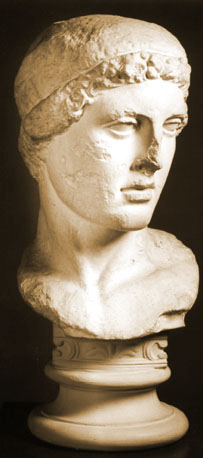
Commentary Prepared by Dr. Julia Lenaghan, Ashmolean Museum
C 019
Head in the London-Rome "Perseus" or "Hermes" Type. London
Marble
Head
1' 3"
The head was bought in 1879 from Castellani. Thus, it probably comes from Italy.
United Kingdom, London, British Museum, 1743
Roman Copy of an Original dated either to Early Classical or the early Fourth Century
Preservation:The head is broken around the neck; the beginnings of both shoulders are preserved. The tip of the nose and the separately worked left wing of the cap are missing. The entire right side of the head is battered. The right cheek has several knicks. The right side of the front hair, the right ear, the hair behind the right ear, and the hair at the back right side of the head are chipped and badly worn. Elsewhere the hair is merely worn. The top of the head has two adjacent cuttings. The one on the right side is deeper and more regular. It appears to be a rectangular dowel hole. The other is rounded and less regular.
Description:The head depicts a beardless male who turns toward his left and wears a cap with wings. The bottom edge of the cap runs around the head at a level just above the ears and is distinctly rendered as an engraved groove. On the cap itself in the area above the right ear is a wing that projects slightly. In the area above the left ear a section in the shape of a wing—that is, rounded near the front and tapering towards the back— has been cut out. The rounded front section of this cut out is markedly deeper. Thus a wing with a pin or dowel near the front was likely to have been inserted here. Traces of inscribed overlapping rounded scales or feathers are visible on the cap over the left eye and at the back right side of the head.
Out from below the cap underneath the engraved groove of its bottom edge springs thick bunches of hair. The hair is especially voluminous around the ears, the front of which are covered. The hair is rendered in small irregular clumps and only in a few places are individual locks delineated. There appears to be a small central part over the brow.
The face is a long oval which is widest at the cheek bones. The brow is convex in both the horizontal and vertical sense. Above the root of the nose there is a particular triangular bulge, the apex of which points downwards towards the nose. The eyebrows are a projecting line that continues around to the side of a head. They bulge outwards at the side of the face and beyond their ends at the temples there is a depression in the skull. Between the eyebrows and the eyes is a very short space which slants backwards and has its greatest height at the outer side of the eyes. The upper eye lids are tucked under this space and they continue beyond the intersection with the lower eye lid. The lower lids are on a plane which is even further stepped back than that of the upper lid. They are defined only with one line since they blend into the skin under the eyes. A fully defined tear duct is visible in the left eye. The cheeks are long and continue to slant backwards. The nose has flat ridge and the naso-labial folds are rendered as gentle furrows. The lips are short from side to side and parted by a thick groove the ends and center of which dip downwards. The center of the upper lip, therefore, hangs down over the lower lip. The lower lip projects outwards- there is a hollow below it—and the lower line of the upper lip rises at the center. The chin is strong and rounded but on plane which is considerably stepped back from that of the forehead.
The head turns to the left. The tendons at the base of the neck bulge outward in a V shape and on the right side of the neck one sees a hollow between tendons. At the base of the right side of the neck there is a hollow around the collar bone which suggests that the right shoulder was raised.
Discussion:The type of the British Museum head is preserved in one other copy which is now in the Conservatori Collection in Rome. The two heads, which are undeniably replicas of the same model, are actually quite different in appearance. The head in the British Museum has a more “Severe” appearance whereas the head in the Conservatori features more naturalistic details.
Both heads, however, feature the cap with wings. Because of the feathers or scales on the British Museum cap, the cap was associated with the cap of Hades which was lent to Perseus and the head type identified as Perseus. This identification allowed scholars to associate the head with three passages in ancient literature. Pliny the Elder (NH 34.57) lists a statue of Perseus among the works of Myron. Pausanias (1.23.7), corroborating Pliny’s account, mentions a statue on the Athenian Akropolis made by Myron and depicting Perseus who has beheaded Medusa. Dio Chrysostum (37.10), a less reliable source, mentions that Pythagoras made a statue of Perseus. Thus, modern scholars have often attributed the London-Rome Perseus type to Myron or Pythagoras and generally date it to ca.450.
The identification of the head as Perseus, however, is not entirely secure. Carpenter and Fuchs both question it and point out that Hermes may also wear a similar cap. Furthermore, the stylistic analysis of the original on which both copies are based is made difficult by the fact that the two copies are so different. The Rome head features carefully worked out hair that follows an irregular pattern. Because this is a detail almost assuredly derived from the original model, Carpenter chooses to base his evaluation of the head type on the Rome example. Ridgway, giving other examples of such occurences, suggests that the Early Classical traits of the British Museum head are inventions of a copyist. The ambiguity of the subject and the stylistic inconsistencies between the two copies have led scholars to propose very different theories.
Many scholars discuss the head type as either evidence for the style of Myron or the style of Pythagoras because they believe it to represent Perseus. Yet the head makes a compelling comparison to neither the Diskobolos nor the Athena and Marsyas group which are almost assuredly works of Myron. As for Pythagoras we have no works assuredly made by him and, in addition, Dio Chrysostum is not an entirely reliable source.
In the 1960s Fuchs presented another possibility. He considered the structure of the face of the head type to be very similar to the Kassel Apollo. Although he was writing about the head in Rome, this observation is true for the British Museum head as well. The lower face of the two types is similar. The long cheeks which slope slightly backward, the down turned mouth with widely parted lips, and the strong rounded chin that is on a plane behind that of the plane of the forehead are certainly alike. Because Fuchs believed the Kassel Apollo to be an early work of Pheidias, he suggested that also the London-Rome type head was by Pheidias. He then went on to propose that the London-Rome head type represented a statue of Hermes made by Pheidias and located at Thebes (Pausanias 9.10.2).
This theory has several flaws. Above all, though the head type has some structural similarity to the Kassel Apollo type, one must note that the supposedly best replica of the Kassel type (the Florence head, cat. C 17) is particularly cubic in form and does not relate even to the square more massive head of the London-Rome type in Rome. The Kassel Apollo, in addition, features a flat forehead and a face that is widest at the eye brows rather than at the cheek bones. Finally, the hair of the Kassel Apollo, though again structurally similar (that is, more or less the same volume around the face), features long interwoven locks with curled ends rather than short tousled tufts. In addition, there are other statues of Hermes assigned to Pheidias.
Carpenter, who looked only but very thoroughly at the Rome head, concluded that the London-Rome type was not fifth century at all. He cited the following stylistic details as impossible for a head of the early fifth century: The greatest width of the face was at the cheek bones, not at the eyes; the convex surface of the forehead; the contracting muscles of the brow which form a bulge over the nose; the complex and very natural adjustment or shift from the front to the profile planes; the small and receding space between the eye brow and the upper lid; the lower eye lid which blends into the cheek; and finally the tufted hair which recalls the “Aberdeen” head of the “Genzano Herakles”. He compared the London-Rome type and again the Rome head in particular to the Palatine head of the Hope Hygieia which can be dated by its statue type to the early fourth century. He added that statues of Hermes were more common than statues of Perseus and that a statue of Hermes would not have been beardless until after ca. 435 BC. He, therefore, concluded the London-Rome type was a copy of a “Hermes” statue datable around the beginning of the fourth century.
In conclusion, on the basis of only the two heads in London and Rome it is difficult to ascertain either the subject or the date of the statue from which they are copied. A comparison of the casts of the Florence copy of the Kassel Apollo (cat. C 17) and the British Museum Perseus/Hermes head certainly validates Carpenter’s careful stylistic argument. It seems unlikely to me that the Perseus/Hermes head dates to ca.460 BC; it should probably be placed at the end of the fifth century or the beginning of the fourth.
Bibliography:A.H. Smith,
A Catalogue of Sculpture in the Department of Greek and Roman Antiquities, British Museum III (London 1904) no.1743
catalogue entryR. Horn,
"The 'Perseus' Head" (MAAR 18 1941) pp.18-25 pls.7-8
argues that the head type is
better represented by the head in Rome and that the type most likely dates to the early 4th century and perhaps is more suitably identified as HermesW. Helbig (H. von Steuben),
Führer durch die öffentlichen Sammlungen klassischer Altertumer in Rom II (4th edition) (Tübingen 1966) pp.544-545 no.1771
questions the identification of the head type as Perseus, suggests that it is an early work of PheidiasB. S. Ridgway,
The Severe Style in Greek Sculpture (Princeton 1970) pp.84 and 91 and 119 fn.10
mentions it in discussion of both Pythagoras and Myron, is not convinced of either attribution(L. Roccos),
"Perseus" Lexicon Iconographicum Mythologiae Classicae VII (Zurich 1994) p.334 no.26
shows Conservatori head and refers to it as Perseus by Myron