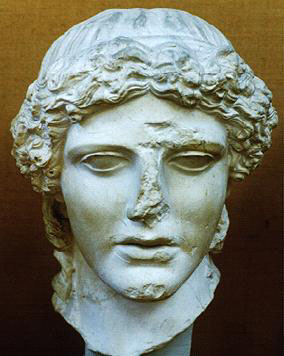
Cast Gallery catalogue number: C018
Head of Apollo.
For other versions of the same original see C016 and C017.
- Plaster cast: Height: 47cm.
- Copy of a marble head.
- The head:
- is of the type known as Kassel.
- is a Roman version of a Greek original of about 450 BC.
- was found in Rome on the Esquiline in 1879.
- is now in Rome, Museo Barracco, inv. 92.
Detailed Record
Commentary Prepared by Dr. Julia Lenaghan, Ashmolean Museum
C 018
Head of "Kassel Apollo" Type. Barracco, Rome
Marble
Head
36.6 cm
The head was found in 1879 on the Esquiline in the excavations for the Opera House in the area of a large Roman villa
Italy, Rome, Museo Barracco
Preservation:The entire chin and mouth, a part of the left cheek, and the inner part of the left eyebrow with a piece of the upper lid and eyeball are restorations. The lower lid and inner eye seems also to be restoration but it is difficult to distinguish the plaster from the marble. The glabella is also restoration. The nose but for the right edge, the left shoulder locks, the right shoulder locks but for the first curl, and the hair on the neck are no longer preserved. The locks of the front ring of hair and the left forehead are battered. The throat, however, is preserved with traces of the beginnings of both shoulders.
Description:The head depicts a long-haired male. The complex arrangement of the hair immediately engages the viewer who notes four distinct sections. 1) On the top of the head the hair is combed downwards without a part from the crown. A ringlet passing around the head above the ears keeps this hair, which is rendered in undulating lines, tightly pressed against the skull. 2) From ear to ear over the brow, the hair is rendered as a raised mass of short curly locks that give the impression of a crown. These short locks have a central part. 3) At the back of the head the hair is long and gathered in two braids. The braids beginning behind the left ear are pulled around to the right ear and then pass to the front of the head; the right braids follow the same pattern in reverse. Presumably the braids were tied together at the front of the head but this is concealed from our view by the tousled front bangs. Where the braids cross over each at the center of the back of the head, they are bound vertically by a broad band. 4) Two corkscrew locks directly behind the ears are separated from the braids and allowed to fall loose on to the shoulders.
The face itself is badly damaged. It has a long oval shape and a frontal view which seems to intersect the profile in a sharp bend. The brow is flat and the eyebrows are virtually horizontal. The eyes themselves are almond shape and have a sharply defined and protruding upper lid.
Discussion:The head follows a well-known type which belonged to a statue known as the “Kassel Apollo.” The original model of the type was a famous work of the mid-fifth century by a famous artist . Scholars have proposed several identifications, the most popular of which are Phidias’ Apollo Parnopios and Kalamis’ Apollo Alexikakos. (For a full discussion of the “Kassel Apollo”, see C 16).
Before the discovery of the Florence head in the “Kassel Apollo” type (see C 17) the Barrocco head was considered the best copy of the type. Yet it is considerably restored and until those restorations are removed, it is difficult to judge. Notwithstanding this, Schmidt compares it to the Florence head to which it is related and to the Ince Blundel version of the type, which has similarly long and flat head.
The date of manufacture of the head has generally been placed between the Claudian and Flavian periods. Schmidt considers it to be Hadrianic. She notes both that its “impressionistic” look has been compared to that of the portraits of Antinoos and moreover, she considers it to resemble portraits of Sabina; she uses the Terme Sabina (inv.727) as a comparison.
In my opinion, apart from further evidence for the popularity of the type, this head adds little to the discussion of the “Kassel Apollo” type. The discussion of whether the head belongs to the middle of the first century, late first century, or early second century CE is of interest but is unfortunately difficult to establish. Pertinent also for the evaluation of the head is the date of the restoration and which copies the restorer knew.
Bibliography:E. Schmidt,
"Der Kassel Apollon und seine Repliken" (AntPl 5 1966) pp.29-30 pls.39-41, 49 d
M. Robertson,
A History of Greek Art (Cambridge 1975) p.337
compares the sharp cutting and heavy modelling of the eyelids of Kresilas’ Perikles, considers it a “chilly” piece of “daunting academicism” that “says nothing to meB. Vierneisel-Schlörb,
Katalog der Skulpturen Band II: Klassische Skulpturen des 5 und 4 Jahrhunderts v. Chr. (Munich 1979) p.13 no.2
in discussion of “Omphalos Apollo”, mentions it with point that we know nothing of young works of PhidiasW. Fuchs,
Die Skulptur der Griechen (Munich 1993) pp.78a-80 no.72
72 dates to ca. 450, considers it to be Phidias’ Apollo Parnopios, points out Polykleitos and chiastic structure have not influenced Phidias