Commentary Prepared by Dr. Julia Lenaghan, Ashmolean Museum
C 017
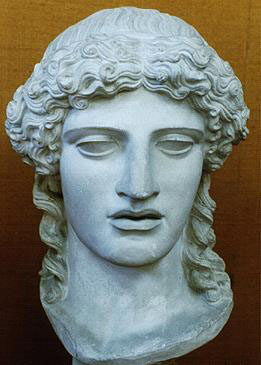
Head of "Kassel Apollo" Type. Florence
Marble
Head
38 cn
Head seems to be one that Dutschke saw in Villa Panciatichi in Florence. That Villa belonged to the Medici and thus, the head would have also belonged to the Medici. The Medici collection came mainly from Rome.
Italy, Florence, Palazzo Vecchio, Sala d'Ester
Preservation:The head was once set on a cuirassed bust which is the reason for the smooth cutting around the neck. On the left side the beginning of the shoulder has even been included within the perimeter of the cutting. The locks, falling from behind the ears to the shoulders, have been restored on both sides from their point of origin. On the left side, however, part of the hair lying on the shoulder is still preserved. The nose is probably not ancient though Curtius claims it to be. There are traces of red paint in the front crown of hair, on the top, and on the right side of the hair braid as well as on the lower lip. The face appears to have been gone over in the modern era.
Description:The head depicts a long-haired male who turns to the left. The complex arrangement of the hair immediately engages the viewer who notes four distinct sections. 1) On the top of the head the hair is combed downwards without a part from the crown. A ringlet passing around the head above the ears keeps this hair, which is rendered in undulating lines, tightly pressed against the skull. 2) From ear to ear over the brow, the hair is rendered as a raised mass of short curly locks that give the impression of a crown. These short locks have a central part. 3) At the back of the head the hair is long and gathered in two braids. The braids beginning behind the left ear are pulled around to the right ear and then pass to the front of the head; the right braids follow the same pattern in reverse. Presumably the braids were tied together at the front of the head but this is concealed from our view by the tousled front bangs. Where the braids cross over each at the center of the back of the head, they are bound vertically by a broad band. 4) Two corkscrew locks directly behind the ears are separated from the braids and allowed to fall loose on to the shoulders.
The face itself has a long oval shape and a frontal appearance which seems to intersect the profile in a sharp bend. The brow is flat and the eyebrows are virtually horizontal. The eyes themselves are almond shape and have a sharply defined and protruding upper lid. The lips are full and open so that the upper teeth can be seen. The chin is almost square. The lower part of the face seems to recede and the brow to project.
Discussion:The head follows a well-known type which belonged to a statue known as the “Kassel Apollo.” The original model of the type was a famous work of the mid-fifth century by a famous artist . Scholars have proposed several identifications, the most popular of which are Phidias’ Apollo Parnopios and Kalamis’ Apollo Alexikakos. (For a full discussion of the “Kassel Apollo”, see C 16).
Schmidt critiques the Florentine head in terms of its literal transmission of the original. She compares it particularly to the head of the Kassel. Both heads appear to be strict copies but she considers the Florentine head to put more attention on details than form. In general the face and head of the Florentine copy have a cubic form which she, looking at the other copies, judges to be the copyist’s alteration. In contrast to the Kassel head, the Florentine head has a broader lower face with a stronger chin, a higher brow, and the hair on the brow, drilled out from below only in a few places, frames the brow and temple more tightly. Also the eyes, which are wider, she considers closer to the original than the narrow eyes of the Kassel head. The particularly exaggerated projecting eyelids give the head a pathos which is entirely Roman. And the full shapely lips are also unique though their outlined edge looks like lips on bronze statues. The hair of both heads is markedly similar though there are some differences in the number, placement, and turn of individual locks as well as in the the bottom hair of the braids at the back. Although one cannot really say which head is closer to the original, one suspects the Florence is since it is in other aspects more reliable.
Schmidt believes the Florence head must date either to the Augustan or Hadrianic period on account of its classicizing nature. She prefers the Hadrianic date because she sees similar forms and pathos in Hadrianic works. She mentions the Mondragone Antinous, a Dionysos in the Terme collection, and a head of Dionysos from a mask relief in Budapest, all Hadrianic, as comparanda. She even suggests that the pathos of the face might have been influenced by portraits of Antinoos. Based on the Antinoos comparisons, she concludes that the workshop responsible for the piece was more likely based in metropolitan Rome than in the East.
In my opinion, the similarity between this head and especially the Kassel head allow us to say that both heads are good copies of the same model. Whether details are better reproduced in this head or the Kassel head is difficult to judge. Certainly the wider eyes of the Florence head are more convincingly of a mid-fifth century bronze. Moreover, the two replicas are so close that the argument is irrelevant. The exact date of manufacture of the Florentine head is equally difficult to judge. The similarities in the Andragone Antinoos are also due to the fact that it was borrowing from the “Kassel Apollo” type; it is, therefore, not to be used to date the copy.
Bibliography:C. Karousos,
"Zum 'Schreitmotiv' des Kasseler Apollon" in Festschrift zum 60. Geburtstag von Bernhard Schweitzer (Stuttgart 1954) pp.161-165
discussion of the stance, especially of the lower legs, considers the statue to be Phidias’ ParnopiosE. Schmidt,
"Der Kassel Apollon und seine Repliken" (AntPl 5 1966) pp.22-25 pls.25-27, 48a, 49a
M. Robertson,
A History of Greek Art (Cambridge 1975) p.337
compares the sharp cutting and heavy modelling of the eyelids of Kresilas’ Perikles, considers it a “chilly” piece of “daunting academicism” that “says nothing to meB. Vierneisel-Schlörb,
Katalog der Skulpturen Band II: Klassische Skulpturen des 5 und 4 Jahrhunderts v. Chr. (Munich 1979) p.13 no.2
in discussion of “Omphalos Apollo”, mentions it with point that we know nothing of young works of PhidiasW. Fuchs,
Die Skulptur der Griechen (Munich 1993) pp.78a-80 no.72
dates to ca. 450, considers it to be Phidias’ Apollo Parnopios, points out Polykleitos and chiastic structure have not influenced Phidias