Commentary Prepared by Dr. Julia Lenaghan, Ashmolean Museum
C 016
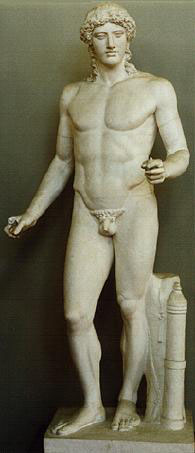
"Kassel Apollo". Kassel
Marble
Statue
1.97 m
Bought in Rome in 1776-77. Von Kekule later associated it with a statue that had been in the Conti collection and had been described by Winckelmann. The Conti statue came from near Circeo, between Terracina and Nettuno on Lago di Sabaudia, and was said to have been found in a temple with niches. In the early 20th century an imperial villa, perhaps belonging to Domitian, was excavated in the same area. The question remains whether the Kassel statue is the Conti statue
Germany, Kassel, Staatliche Kunstsammlungen, inv.no. 1
Preservation:The statue has been restored twice. The first restoration by Cavaceppi tilted the statue to the right since the right knee was too short and breaks in the left leg were filled with too much cement. (This is preserved in the cast). The second restoration, in the early 20th century, corrected this and aligned the plinth with the shoulders. The statue is missing part of the locks on the left shoulder, some locks in front of the right ear, the middle zone of the right shoulder locks, and the attributes of both hands, though a piece of the bow is preserved in the palm of the left hand. Modern restorations on the statue include: The tip of the nose, the outer part of the plinth, the inner front part of the right foot, the toes of the right foot, the three first toes of the left foot, the right knee and adjoining area, the middle of the right breast, the first three fingers of the right hand, the end of the ring finger, thumb, and pinky of the left hand. There are cracks on the upper head, the hips, the right elbow and wrist, the ring finger and pinky of the right hand, the left upper arm, the left forearm, the left middle finger, the left foot, and the support. There are various chips and areas of reworked surface. The general surface of the statue has been overcleaned. There are traces of red paint in the hair and pubic hair; gilding on the piece of the bow preserved in the left hand; and rust stains on the support and quiver. Behind the shoulders are traces of the sacks used to protect the statue in World War II.
Description:The statue depicts a naked male who stands frontally with the body weight resting on the left leg. The right leg comes forward. The feet are narrowly spaced and the right foot, with its heel close to the left instep, points to the right. The left hip is raised and pushes outward. The upward body, large and fully developed, features sharply defined anatomical lines, particularly those running from the pubes to the hips, and shoulders which are wider than hips. The right arm rests at the side of the body; its forearm pulls slightly away from the body. The left arm also stays near the side of the body, but is bent at an approximately 90 degree angle at the elbow. The forearm, thus, projects forward from the body. In the left hand is a trace of the bow which must have extended downward to the lower leg. The attribute held in the right hand is unpreserved but was probably a laurel branch to judge from coins with the image. Along the left leg is a tree-trunk support next to which is a quiver. The straps of the quiver are rendered on the tree-trunk support.
The head turns to the left and looks slightly downwards toward the bow. The head is dominated by the complex arrangement of hair. The hair is combed downwards without a part from the crown. A ringlet passing around the head above the ears keeps the hair tightly pressed against the skull. From ear to ear over the brow, the hair is rendered as a raised mass of short curly locks that give the impression of a crown. These short locks have a central part. The hair of the back head is long and gathered in at least two braids. Two corkscrew locks directly behind the ears are separated from the braids and allowed to fall loose on to the shoulders. The braid beginning behind the left ear is pulled around to the right ear and then passes to the front of the head; the right braid follows the same pattern in reverse. Although this is not entirely clear on the left side of the Kassel head, other copies show it. At the back of the head the braids are bound vertically by a broad band at the point where they cross over each other. Presumably the braids were tied together at the front of the head but this is concealed from our view by the tousled front bangs.
The face itself has a long oval shape and a frontal appearance which seems to intersect the profile in a sharp bend. The brow is flat and the eyebrows are virtually horizontal. The eyes themselves are almond shape and have a sharply defined upper lid. The lips are full and open so that the upper teeth can be seen. The chin is almost square. The lower part of the face seems to recede and the brow to project.
Discussion:The attributes of the statue, bow and laurel branch, clearly identify the statue as Apollo. Numerous other copies of the “Kassel Apollo” type exist in various media. In sculpture Schmidt in 1966 located 8 statues (including the Kassel statue), 13 heads, and 3 statuettes; in addition the type is represented on coins, a gem, a pottery medallion bowl (not noted in Schmidt), and a sarcophagus. The copy in the Kassel collection is the best known and even gives its name to the type since it is the only preserved full-scale copy in the round.
Schmidt, who critiques the statue as a Roman copy of the original, deems it to be true to the original; it features details that correspond precisely with the details of the other renditions and it is in keeping with the style of the end of the Early Classical period. She dates the copy between the late first and early second century CE on the basis of its stylistic rendering. She notes in particular the reduction of volume, the hard lines, the classical facial structure, and the plinth, all but the last of which she compares to the so-called Genius of the Roman People in the Cancelleria Relief A and a statue of Trajan in Copenhagen (Schmidt p.13). Moreover, she adds that handling of the back suggests that it was post-Trajanic and placed in a niche. In short, she believes the statue might well be that statue described by Winckelmann which was found in a niche in a temple between Terracina and Nettuno that is dated by its brickstamps between the late first and early second century.
Given the number of copies of the “Kassel Apollo” type, the original is indisputably a famous work by a famous artist. Scholars have ascribed the original to a range of early Classical to Classical artists whose names have been handed down to us by the literary tradition; for instance, Myron (Furtwangler), Pythagoras (Klein), Phidias (Curtius), and Kalamis (Beiber). The latter two attributions have won the most support. Pausanias on his way up the Akropolis in Athens notes a statue of Apollo Parnopios (“the Grasshopper Killer”) by Phidias. Because the “Kassel Apollo” type is an Apollo with a bow and because the statue is chronologically on the brink between the Early Classical and High Classical periods, it seems suitable to associate the “Kassel Apollo” with the Apollo Parnopios.
Bieber, however, rejected this suggestion since she believed that the statue had no Phidian qualities. She felt that the face of the “Kassel Apollo” had none of the full-roundness of the works of Phidias and that on the whole it had a reflective, hostile, and almost ascetic facial appearance which was totally unlike the quiet, kindly, harmonious works created by Phidias. Moreover, she pointed out that the type appears on Athenian coins (see J.Kroll Agora XXVI pl.21) and the type on these coins greatly resembles the colossal Apollo on coins of Apollonia which was known to be done by Kalamis. Since Kalamis was also known to have made one of the two statues in front of the Temple of Apollo Patroos in the Athenian Agora, that known as Alexikakos, she proposed that the “Kassel Apollo” was none other than Kalamis’ Alexikakos. This is supported by Harrison who not only does not see Pheidian characteristics in the statue but sees also similarities to the Aphrodite Sosandra of Kalamis, which she believes is the “Kore Albani.”
In conclusion, the statue in Kassel was made in the Roman period and certainly copied a celebrated original of the mid-fifth century. The date of the Roman copy may well be late first century, though the comparisons to the Cancelleria Relief are not convincing. The location of the original statue was almost certainly Athens given the numerous copies, the Athenian coins, and the pottery head from the Agora. The artist of the original work cannot be determined. The argument that it is the Alexikakos in front of the Temple of Apollo Patroos is more persuasive than that in support of the Phidias’ Parnopios.
Bibliography:C. Karousos,
"Zum 'Schreitmotiv' des Kasseler Apollon" in Festschrift zum 60. Geburtstag von Bernhard Schweitzer (Stuttgart 1954) pp.161-165
discussion of the stance, especially of the lower legs, considers the statue to be Phidias’ ParnopiosE. Schmidt,
"Der Kassel Apollon und seine Repliken" (AntPl 5 1966) pp.10-14 pls.1-11
M. Robertson,
A History of Greek Art (Cambridge 1975) p.337
compares the sharp cutting and heavy modelling of the eyelids of Kresilas’ Perikles, considers it a “chilly” piece of “daunting academicism” that “says nothing to me”B. Vierneisel-Schlörb,
Katalog der Skulpturen Band II: Klassische Skulpturen des 5 und 4 Jahrhunderts v. Chr. (Munich 1979) p.13 no.2
in discussion of “Omphalos Apollo”, mentions it with point that we know nothing of young works of PheidiasW. Fuchs,
Die Skulptur der Griechen (Munich 1993) pp.78a-80 no.72
dates to ca. 450, considers it to be Phidias’ Apollo Parnopios, points out Polykleitos and chiastic structure have not influenced PhidiasE. Harrison,
"Pheidias" Personal Styles in Greek Sculpture (Cambridge 1996) pp.64-65
believes that the Kassel Apollo represents the Apollo Alexikakos of Kalamis