Commentary Prepared by Dr. Julia Lenaghan, Ashmolean Museum
C 015
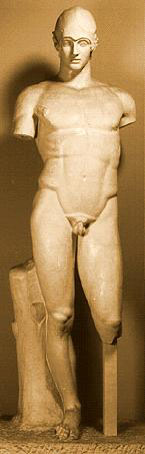
Somzee Warrior or the "Ares Somzee". Mariemont
Marble
Statue
2.315 m
Probably from Italy since it was formerly in the Villa Ludovisi, Rome
Belgium, Mariemont, Musee de Mariemont, 140
Preservation:The statue is missing both arms from the shoulders downwards, the left leg from the mid-thigh downwards, the right leg from the knee downwards, and the nose. The right knee, foot except for the heel, and lower leg were three different restorations. The knee and foot have been removed. The tree trunk support and the strut from the left waist to the left arm (removed in the cast) as well as the genitals are restorations. There is a trace of a strut on the left side at the ribcage and a raised broken surface on the right chest near the armpit. The head was broken in transport from Rome to the Somzee collection and restored by memory by Furtwangler. The restoration overseen by Furtwangler has been dismantled and the head has now been reset with the plaster removed. The upper part of the helmet has been broken, the hinged cheek guard is partially preserved only on the right side, and an inserted crest has been lost.
Description:The statue depicts a naked male who stands frontally with the body weight placed over the right leg. The head turns to the left; the right turn of the head in the cast preserves a mistaken restoration which was corrected only in 1966. Because of the downward position of the left shoulder and the strut on the ribcage, the left upper arm appears to have rested at the side and the left forearm seems to have been bent upward and to have projected outward from the body. The right shoulder also is in a position of rest and the strut for the right forearm is on the chest neart the armpit. Thus, the right upper arm rested alongside the body and the right forearm was raised such that the right hand was at shoulder level. Given the position of the arms and that the statue wears a helmet, the statue probably wore a shield in the bent left arm and held a lance in the right hand.
The head has a long oval shape at more or less the center of which are the eyes. The helmet, the bottom border of which follows the outline of the eyebrows, covers the upper part of the head. The hinged cheek guards are flipped upwards. A rectangular mass of curly locks emerge in front of the ear and below the raised chin guard. At the back of the head another mass of wavy hair emerges out from under the helmet and rests on the nape of the neck and the back.
The face, framed by the helmet, has non-distinctive cheekbones, smooth flat cheeks, and a solid round chin. The bottom border of the helmet and the eyebrows follow the same low arching pattern. The eyes themselves are large and wide open notwithstanding their heavy upper lids. The long nose leads to a regular mouth, the equal-sized lips of which are separated by a broad groove. The protrusion of the chin below the lips is modelled.
Discussion:Furtwangler, who first published the statue, considered it a representation of Ares, whence the name the “Ares Somzee”. Later retracting the appellation since Ares appears bearded and cuirassed up until the time of the Parthenos, he suggested that it represented a hoplitodrome.
Although the statue is not preserved in any other known replica, its style and size are convincing indications that it is a copy of a fifth century original. Furtwangler compared the warrior stylistically to the statues of the Olympia pediments, particularly those of Oinemaos and Pelops, and to the “Omphalos Apollo”. He considered the statue the to be the only large work of second rate artist. Amelung, in contrast, thought the “Omphalos Apollo” and the statue were so similar that he attributed them to the same hand, that of Kalamis. Others (Cumont and Buschor.), in contrast, emphasized the Olympia connection and suggested that the artist was a Peloponnesian master. The names of Ageladas and Pythagoras have also been proposed as possible artists; for a summary of the opinions, see Dorig 1977 p.23.
Most recently, Dorig has addressed the statue in detail. His argument is three-fold. First, he considers the dress of the statue; the stance, which he sees as a combination of a balanced lower body and a tense upper body; the interactive look to the left; and the pensive face, all to be appropriate for a warrior tense with excitement. He likens the total appearance of the statue to what he imagines would have been suitable for one of the Achaean heros depicted by Onatas of Aigina and located in front of the Temple of Zeus at Olympia. According to Pausanias (5.25.8), the monument showed eight heros clustered excitedly around Nestor, who by drawing a lot would determine which hero would fight Hector. The date of this monument, the base of which was found under the foundation level of the temple, is generally placed between 470-460 BCE.
Second, Dorig recognizes the similarity between the statues of the Olympia pediment and the warrior but points out numerous differences. He believes that the warrior is an older work which the sculptor of the pediment might have had always in mind. For instance, a sculptor working on the pediment on the Temple of Zeus at Olympia would have been confronted daily with the dedications in front of the Temple. Third, Dorig notes that stylistically the most similar head is an Athena head in the Louvre from Aigina. From these three facts, he concludes that the warrior formed part of the multi-figured dedication made by Onatas of Aigina that depicted a scene from the Iliad and was placed in front of the Temple of Zeus at Olympia. Dorig continues his argument by naming two other statues that he believes were copied from statues of the Olympia group. These are a torso in the Torlonia collection (Torlonia 401) and a statue known as the Poseidon Borghese now in the Capitoline Museum.
In my opinion the statue inarguably is a Roman copy of an early fifth century original and was certainly contemporary to the “Omphalos Apollo” (who varies too much in facial features for us to consider it to be by the same hand.) Dorig’s suggestion is certainly appealing but so too is Harrison’s (in Greek Art. Archaic…1985) proposal that the Riace bronzes represent heros from the Achaean monument at Olympia.
Bibliography:A. Furtwängler,
Sammlung Somzee (Munich 1897) pp.3-5 no.4 pls.3-5
first modern publication, compares the statue to the “Omphalos Apollo” and the Pediments of the Temple of Zeus at OlympiaW. Amelung,
"Der Meister des Apollon auf dem Omphalos und seine Schule" (JdI 41 1926) p.247
comparison with the “Omphalos Apollo”P. Leveque,
"Antiquites Grecques" in Les Antiquites du Musee de Mariemont (Brussels 1952) p.66 G4 pl.20
catalogue entryA. Hermary, J. Marcadé et al,
"La Restauration de l'Ares Somzee" (Cahiers de Mariemont 4 1973) pp.47-57
discussion of restorationJ. Dorig,
"Le Guerrier Somzee au Musee de Mariemont" (Cahiers de Mariemont 4 1973) pp.33-46 figs.1-2
considers the statue part of the monument made by Onatas of Aigina, set up at Olympia, and depicting the scene from the IliadJ. Dorig,
Onatas of Aegina (Leiden 1977) pp.21-27
considers the statue part of the monument made by Onatas of Aigina, set up at Olympia, and depicting the scene from the IliadB. Vierneisel-Schlörb,
Katalog der Skulpturen Band II: Klassische Skulpturen des 5 und 4 Jahrhunderts v. Chr. (Munich 1979) pp.10-11 no.2
acknowledges the similarity of the “Somzee Warrior” to the “Omphalos Apollo”