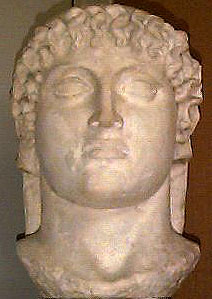
Commentary Prepared by Dr. Julia Lenaghan, Ashmolean Museum
C 012
Townley Apollo. London
Marble
Head
47 cm
The head, which was bought in Rome, is thought to come from Italy.
United Kingdom, London, British Museum, 208
Early Imperial Copy or Loose Rendition of an Original of the Early Classical Period ca.470-460
Preservation:The head has been made separately from its body. It is evenly cut around the base of the neck for insertion into some other object. A lock behind the left ear is broken and others have been restored. The tip of the nose is also restored. The flat part of the head in front of the crown is abraded.
Description:The head depicts a young clean-shaven male who has long hair that hangs in stylized corkscrew locks over the brow. The hair, which is without a part, falls naturally to all sides from the crown of the head. Parallel engraved lines are used to delineate strands which are slightly wavy and long. The hair of the back and back portions of the sides is loosely brought together so that it falls down the nape on to the back in a tapering tail. Above the ears and running around the entire head is a ring, a band that is circular in section. It is visible at the back of the head but disappears just in front of the ears. This is because the locks at the front of the head are combed over it. These locks are then cut around the face and their ends, from the point when they pass over the hair band, are curled. The curled part of each lock hangs separately from the neighboring locks so that the forehead is revealed in the spaces between locks. Although separate, the locks follow more or less parallel paths. They move over the hair band and toward the left side of the head; they then turn back to the right, thereafter, they move to the left and curl into themselves so that the end of each lock has a circular form with a drill hole in the center.
The face is squarish in contour and the cheeks do not slope naturally back but appear to form an edge with the sides of the face. The result is that the head has a box-like structure with flat profiles. Below the curls the brow is flat, tall, and wide. The eyebrows, which arch, form a fine projecting line. The left eyebrow has a raised bump near its end. There is a flat slightly receding space between the eyebrows and the eyes. The arched upper eyelids are thick and projecting. They continue slightly beyond the intersection with the lower lids at the outer corners of the eyes. The eyes themselves are wide open and in the inner corner or tear duct of the left eye there is a drill hole. The lower lids, which are straighter than the upper lids, have a flat rim. Below the eyes the surface is modelled. The nose is fine and relatively short. Below the septum and above the center of the upper lip is a vertical furrow. The mouth is broad and the corners dip downward. The upper lip hangs down at the center and below the center of the lower lip is an indentation which makes the sides of the lower lip look fuller than the center of it. The chin is broad, solid, and not particularly projecting. The neck is thick and at the center of its base there is a V-shaped indentation designed to depict the tendons.
Discussion:This head, which derives its name from its original collector (Townley), has been universally accepted as a head of Apollo. Its unshaven ideal face and its long hair are typical traits of Apollo.
The head presents difficulties for any assessment beyond the identity of the god depicted. It features details that are characteristic of the Early Classical Period; for instance, the blocky face without much surface modulation, the long hair tied at the back, and the repetitive front bangs. Yet, there is no other preserved example comparable to the head and the Early Classical details are presented oddly. The face appears particularly square; the juxtaposition of the front locks which are plastically rendered and full of volume with the hair of the rest head which is flat and engraved is unusual; and the large spaces between the front locks are also without parallel. In addition, the ears are not worked out carefully and do not resemble the ears of other Early Classical works.
Other problems regarding the head are that it is an over life-size, is known in no other replicas, and is an insert head. Its large size and its severe aspect naturally lead scholars to consider the possibility that it or whatever it derived from was a cult statue. Yet it is strange that it has no replicas. Several images, however, have been associated with the head; for instance, terracottas from Asia Minor, a statuette in the possession of the Banca d’Italia, and a fragment from the storerooms at Hadrian’s villa in Tivoli. The fact this head is worked separately for insertion has caused scholars to suggest that it might have belonged to a dressed statue and/or an acrolithic statue.
Three possible theories have developed about the head. The most widely published view is that the head is a Roman copy of a cult statue dated about 470-460 BC. Lippold believes the head to be a copy of the Apollo Klarios of Kolopon, which was seated and with a cithara. He does not explain his rationale but it can be inferred that he believes this because terracotta heads in Asia Minor, especially at Myrina, feature similar hairstyles. Paribeni also believes the head represents a Roman copy of an unknown prototype possibly from Asia Minor. He associates the head with a small marble statue of Apollo which wears a chlamys, like a shawl, around his shoulders and is known in two small copies. The head of that Apollo also features long hair falling down the nape of the neck, short bangs, and an Early Classical or Classicizing aspect. Thus, Paribeni believes that the head is a copy of a standing bronze statue which showed Apollo with a short chlamys. Paribeni, in addition, considers a fragment of an over life-size head from Tivoli to be a replica of the Townley head. The fragment in Tivoli preserves the back left side of the head, which in general corresponds to the Townley head. Yet it wears a wreath and the front locks are closer together.
Another theory is alluded to by Ridgway and Simon but is nowhere published. It apparently proposes that the head derives from an early fifth century original from Magna Graecia.
The final theory regarding the head is that it is a Roman creation based loosely on originals of the early fifth century. Although Ridgway does not explicitly state such a belief, she first points out the unusual details of the hair. She acknowledges that one could possibly explain the hair’s different volumes as the style of the copyist and that the large spaces between forehead locks do appear on fifth century coins (from Leontinoi) not just on archaizing works. Yet she concludes her statement by noting that Beyen compares the head to the Pisoni Kouros and the Piombino Apollo both of which are now accepted as Roman creations based on earlier works. Harrison is also of the opinion that the head is a fundamentally Rome creation.
This lattermost proposal is probably the most convincing. It explains why there are no replicas of the head and why there are other works in various sizes (statuette and over life-size) and various media (terracotta and marble) which resemble the head. It is impossible to state definitively whether this head was made for an acrolithic draped statue or for any draped statue as opposed to a herm.
Bibliography:A.H. Smith,
A Catalogue of Sculpture in the Department of Greek and Roman Antiquities. British Museum I (London 1882) no.208
catalogue entryK. A. Pfeiff,
Apollon (Frankfurt 1943) pp.73-75 pls.19-23
careful physical description, believes the head to be a copy of a Greek original, probably a citharoidos type, ca.470-460 BCG. Koch and H. Sichtermann,
Die griechische Plastik (Munich 1950) p.122 footnote 8
remarks that the statue of Apollo Klarios at Kolophon was erected between 460-450 BC and showed Apollo seated with a cithara, lists Townley Apollo as a derivative of this statueB. S. Ridgway,
The Severe Style in Greek Sculpture (Princeton 1970) pp.39-40 no.6
thorough presentation of the opinions concerning the head, seems to suggest that the head may be a Roman classicizing creationE. Paribeni,
"Di un nuovo tipo di Apollo di stile severo" (AntPl 17 1978) pp.104-105
associates the heads with two statuettes which show Apollo with a small chlamys around his shoulders, cites a head in Tivoli as a replica(E. Simon),
"Apollon/Apollo" Lexicon Iconographicum Mythologiae Classicae II (Zurich 1984) p.388 no.73
dates, whether copy or original, to ca.460 BC; notes if not attached to a herm, the head had to belong to a dressed statue, probably a citharoidos type; severe style suggests it was a cult statue