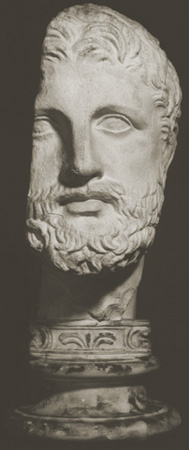
Head of a man, from a portrait statue.
Commentary Prepared by Dr. Julia Lenaghan, Ashmolean Museum
B 229
'Heroic' portrait of a man, from the Mausoleum at Halicarnassus.
Marble
Head
H. 35 cm
Found on the site of the Mausoleum at Halicarnassus (modern Bodrum, Turkey), during the excavations of C.J. Newton in 1857. Newton found the head in the main deposit of sculpture on the north side of the northern wall of the terrace of the Mausoleum.
United Kingdom, London, British Museum, 1054
c. 350 BC
Preservation:The right side of the head has been broken off along a vertical axis, through the neck. The back of the head has also broken off, including the back of the neck. The left side of the neck is preserved. The surface of the rest of the head is in remarkably good condition. The decorative base on which the cast of the head is mounted is modern.
Description:The cast is taken from an over life-size marble head of a bearded male, which was originally part of a full body statue. Only a slim section of the neck remains on the left side of the front, but from this, it seems there was little torsion in the neck, so that the face was frontal. The hair of the man is depicted as short and wavy, with strands of hair grouped into tousled locks. At the front of the brow, the hair is parted in about the centre, forming a sort of ‘anastole’. The beard is rendered in the same manner as the hair on the head, although it is shown as shorter. The features of the face are not terribly distinctive. The brow swells out over the eyes in a manner seen in other fourth century sculptures. The eyes are deeply set, and the ridge of the brows where it meets the bridge of the nose is sharply modelled. The outer section of the orbital process (the bone around the eye socket) is prominent. The nose has a slight bump in the centre. The mouth is fairly small, and the lips are shown as fleshy and quite full. The lips are parted.
Discussion:The cast reproduces the best-preserved head of the ‘heroic’-size statues from the Mausoleum at Halicarnassus. Newton originally used the term ‘heroic’ and the name is kept by Waywell, who estimates the size of these statues at about 2.30 metres high – this compared to the ‘colossal’ scale of about 3 – 2.70 metres and the ‘life-size’ scale of about 1.80 metres.
The ‘heroic’ statuary group comprises standing figures. The ‘colossal’ group includes both standing and action figures, and the life-size figures are all in action poses. Waywell assigned eighty fragments to the ‘heroic’ group, from which it has not been possible to restore full body statues. Fragments indicate the group includes male figures of in tunic and sandals (‘Greek’ dress), males in long, snug trousers and long-sleeves shirts, typical of Easterners (Persians and Anatolians), and females in long chitons and himations. Based on the beard, this head should be associated with the bodies with ‘Greek’ type dress. Although when it was found, Newton thought this head was not individualising enough to be a portrait, the current consensus is that, like the ‘colossal’ standing figures (the ‘Mausolus’, B 97, for instance), the ‘heroic’ standing statues too represent portraits of family members or ancestors of Mausolus.
The number of statues belonging to this group, and where they were displayed on the Mausoleum is not clear. The placements proposed by scholars largely depend on their reconstructions of the podium, which remains the most disputed aspect of the Mausoleum. The general form of the monument is clear from ancient literary sources – it was a huge, squarish, tower-like structure, with a tall podium, a colonnade and a pyramidal roof, which stood over 48 metres high – over double the height of the Parthenon (Pliny, N.H., 36.30 – 1; see also Vitruvius 2.8.11 and 7.13). The architectural evidence recovered by the Danish excavators included clues that the top of the podium was narrower than the bottom, and fragments of courses with cuttings for individual statue bases have led the excavators and Waywell to conclude that the podium was stepped, with statues arranged along ‘shelves’ running around it. Scholar disagree over the number of steps which should be restored, however, and this particularly affects the position of the ‘heroic’ sized statues. Waywell hypothesises three steps surrounding the podium, on which the three sizes of statues are arranged, with the ‘heroic’ standing figures lining the middle step. Such an arrangement requires something in the region of seventy-two statues. Jeppesen thinks such a large number of ancestor or family portraits is implausible, and restores a smaller number of such statues between the columns of the colonnade (where Waywell would place the ‘colossal’ standing figures). Hoepfner, who argues against the restoration of any steps around the podium, also restores the ‘heroic’ statues to the level of the colonnade, but places them in pairs on a shelf-like base running around the cella within the colonnade (where Jeppesen would like to place the ‘colossal’ standing figures).
In conclusion, it should be mentioned that Pliny and Vitruvius name several sculptors who worked on the Mausoleum: Leochares, Bryaxis, Skopas of Paros, Timotheos and perhaps Praxiteles (the last, mentioned by Vitruvius, being dropped by most scholars). However, there is no consensus on attributions, and the sculptor of this head remains unknown.
CMD
Bibliography:C.J. Newton,
A History of Discoveries at Halicarnassus, Cnidus and Branchidae (London 1862) 104 - 5, 107, 225 - 26, no. 187
(perhaps too ideal to be a portrait)A.H. Smith,
A Catalogue of Sculpture in the Department of Greek and Roman Antiquities, British Museum, vol. 2 (London 1900) 126, no. 1054, pl. 20, fig. 1
(probably represents ancestor of Mausolus or a local hero)G. Waywell,
The Free-Standing Sculptures of the Mausoleum at Halicarnassus in the British Museum; A Catalogue (London 1978) 48 - 50, 57, 115 - 16, no. 45, pl. 20
(the essential catalogue entry; restores on hypothetical ‘shelf’ around podium; attributes to the sculptor of a head of Zeus in Boston)T. Linders and P. Hellström (eds.),
Architecture and Society in Hecatomnid Caria (Uppsala 1989)
(numerous essays covering more than just the Mausoleum; see in particular Waywell, who maintains that the statue belongs on a third base-step around the podium)W. Hoepfner,
“Zum Maussolleion von Halikarnassos,” AA (1996) 95 - 114, esp. 107 - 110
(thinks the figures of this size belong on a base around the cella, behind the colonnade, contra Waywell and Jeppesen)I. Jenkins and G. Waywell (eds.),
Sculpture and Sculptors of the Dodecanese and Caria (London 1997)
(various short reports on aspects of the Mausoleum; in particular: Jeppesen on placement [between the columns], Walker and Matthews on marble type [Parian],others on polychromy and sculptors)