Commentary Prepared by Dr. Julia Lenaghan, Ashmolean Museum
B 220
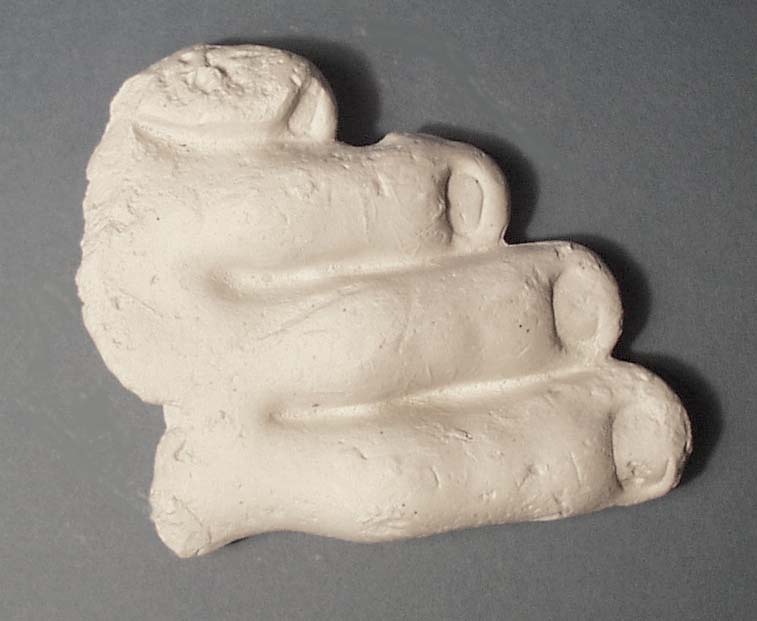
Fragment of a Cast of Four Toes from Left Foot of a Statue of the "Athena Velletri" type. Baia
Plaster
Statue Body Fragment
L 10 cm, W 9.2 cm
Found in a cellar room in the Baths of Sosandra at Baiae (modern Baia). It was found among dirt fill and other casts.
Italy, Baia, Museo Archeologico dei Campi Flegrei, 174.528
Roman Period Cast of a Late Classical (ca.425 BC) Statue
Preservation:The four toes are made of fine plaster. The big toe is missing. The smooth surface at the base of the outside of the second toe suggests that the big toe of the plaster model was cast separately. The surface of the preserved toes has chips and signs of wear. The surface of the outer upper side of the small toe is completely missing and has a series of small deep holes as if it had been picked. The underside of the foot looks as if the plaster had been spread with a spatula; (the underside of the Ashmolean cast of the cast is entirely filled in and does not faithfully represent the original cast.) Under the base of the little toe is filling which may represent the plinth. Between the toes there is also filling. Seams in the plaster are visible at the ends of the toes.
Description:The fragment, showing all the toes but the big toe, belongs to a left foot. The upper surface of the foot at the base of the toes features some modulation. The toes themselves are long and fleshy and at the joints they swell slightly. A sandal strap may have divided the second toe from the large toe. Each toe is distinct from the others. The second toe is raised at the middle joint , after which it turns slightly to its left. Its tip presses against the tip of the third toe which is straighter and less raised than the second toe. The fourth toe turns inward towards the third toe. Its tip rests against the third toe at a level just below the nail of the third toe. The small toe is raised. It possibly rested on, not in, the strap of the sandal. Pushed forcefully against the fourth toe, its nail presses into the side of the fourth toe. The nails of the toes are cut particularly short and are deeply embedded so that the flesh rises around the engraved line that defines them.
Discussion:
Interpretation:
The cast fragment of the toes of a left foot is thought to represent the left foot of a bronze statue of the “Athena Velletri” type. At least eleven and possibly fifteen plaster fragments of a statue of the “Athena Velletri” type were found at Baiae.
The type (see cat. C 92) is preserved in three full-scale marble statues of which only an example in the Louvre still has the ancient feet. Both feet of Louvre copy of the “Athena Velletri” type are to some extent preserved. The toes of the left foot, though not entirely restored, have been worked over. The length, width, and placement of the toes, however, is ancient and do correspond to the Baiae cast fragment.
The right foot of the Louvre statue, however, is completely ancient apart from the top of the big toe. It, therefore, provides more useful comparative material for the cast. The general size of the Louvre foot and the length and width of the toes correspond to the measurements of the plaster cast from Baiae. The toes of the Louvre statue, however, do not have the same individuality of the toes of the Baiae cast and therefore, loose some of their life-like quality. The Louvre toes are uniform and lack modulation and variations in the surface of the toes. In the Louvre copy, the nails are, as in the cast, depicted as deep set and short. Yet they are generally bigger and not quite as pronouncedly embedded.
Landwehr points out that toes of the “Athena Velletri” plaster foot fragment resemble the plaster cast of the toes of the “Capitoline” or “Sosikles Amazon” (cat. B 218). The toes of both are fleshy and swollen at the ends. They both have a modulated upper surface and smooth embedded nails. Yet she points out that overall proportions of the feet are different. The toes of the “Athena Velletri” type statue are certainly longer relative to the foot. This elongation, Landwehr, notes, occurs in the later fifth century. As an example she cites the akroteria of the Temple at Rhamnous.
The plaster fragment of the toes in conjunction with the plaster fragments of the aegis, peplos, mantle, and hair of the “Athena Velletri” type statue led Landwehr to conclude that it was a work of the late fifth century. This is the date arrived at by many other scholars as well and seems acceptable.
Bibliography:C. Landwehr,
"Statuenkopien der Tyrannemorder-gruppe: Die Statue des Aristogeiton in Rom" (JdI 10 1986) pp.77, 82, and 87-88 no.47 pls.49 and 105 a
full description of foot