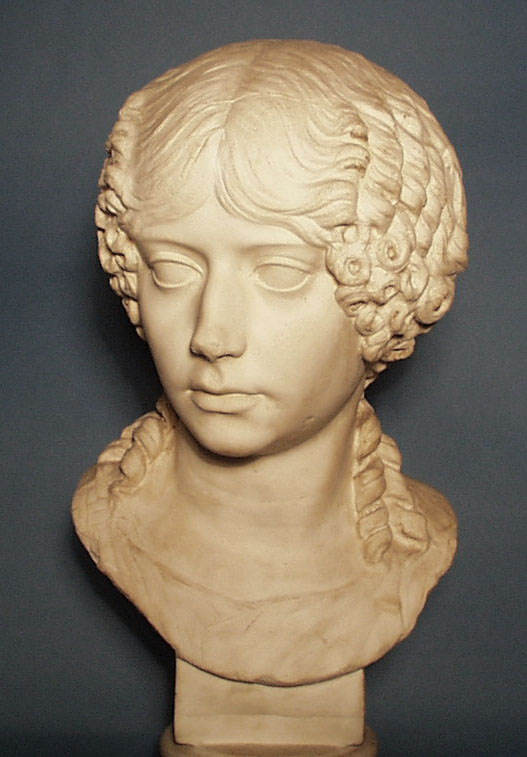
Portrait head of a girl ('Minatia Polla').
Commentary Prepared by Dr. Julia Lenaghan, Ashmolean Museum
B 199
"Minatia Polla". Rome (Museo Nazionale in the Palazzo Massimo)
Portrait bust of a girl from the early Julio-Claudian period (ca.15-35 AD). Found in the "Sulpicius Platorinus" tomb in Trastevere (Rome) with a cinerarium inscribed Minatia Polla.
Marble
Bust
34 cm
From Rome. Found in 1880 in a tomb in Trastevere. The tomb lay 20 m from the Tiber between the Ponte Sisto and the Aurelian walls. Inscriptions from the tomb provide the names of several different families, the identities range from Augustan-Tiberian officials to relatives of the wife of Titus and the mother of Trajan. In addition to the bust, cineraria, a bare-chested male portrait statue wearing a hip mantle and physiognomically similar to Tiberius, and a draped female statue of Neronian date were found. The cinerarium next to this bust was inscribed Minatia Polla.
Italy, Rome, Museo Nazionale (Palazzo Massimo), 1043
Tiberian-Caligulan
Preservation:The state of preservation is excellent. There is slight damage at the tip of the nose and a small abrasion on the left cheek.
Description:The bust portrays the portrait head of a young woman turned to its right and a small area of the chest and shoulders which lies directly adjacent to the neck. The bust is hollowed out behind and has no spine. The hair of the portrait is carefully fashioned in a Julio-Claudian mode; the style is that worn by Agrippina Maior.
The hair is parted in the centre. Approximately the first five centimetres of the hair that grows out of this part is natural and combed towards the sides or back of the head. After the initial five centimetres, the hair is gathered in small locks and twisted. At the front of the head, in the area between the temples and the ears, the twisted locks are additionally curled. A series of rows of pin curls border the face and cover the ears. All of the hair is collected at the back of the head. This section of hair is then folded so that it rests in an oblong shape on the nape of the neck. Behind the ears, four corkscrew locks are deliberately not included in the hair knot at the back. They are pulled forward, two on each side, and fall forward along the sides of the neck.
The hair comes down low on the brow which is not tall. In fact, the hair covers the outer corners of the eyebrows. The combination of the curling full hair at the temples, the wide cheekbones, and the tapering cheeks give the face a triangular aspect. The cheeks are smooth and have no wrinkles and barely a dimple anywhere. Below horizontal eyebrows are wide set large eyes. The bridge of the nose is small and indented. The middle of the nose ridge, however, swells. The mouth is small and the lips are parted. The upper lip pushes forward, presumably forced by the teeth and shape of the gums behind it. The central part of the upper lip dips downwards. The chin is smooth and harmoniously blends into the cheeks.
The right turn of the neck reveals tension in the muscles. At least one thin crumpled garment covers the small portion of body depicted. Two garments, an inner garment buttoned down the upper edge of the arm and an over garment with thin straps, may well be depicted; the rendering, however, is sketchy. On both shoulders there appear to be indications of a shoulder strap. Under the ends of the corkscrew curls on the left side of the neck is a distinct, short and narrow horizontal line that denotes the coming together of two bands of material. Similarly a horizontal line appears on the front of the right shoulder area between the bottom border of the bust and the ends of the corkscrew curls.
Discussion:This fine and marvellously preserved bust of a woman of about 20 years of age is easily dated to the Tiberian period or just after on account of the hairstyle. Because it was found in a modern era (1880) by modern archaeologists (Lanciani), the archaeological context of the bust is well recorded and permits true understanding of its function as well as a possible identity.
Even without the context the bust is readily dated by its hairstyle. The hairstyle is exceedingly careful and modish. It is the same hairstyle that Agrippina Maior, wife of Germanicus, wore. Agrippina Maior’s portrait image was probably conceived in the Tiberian period, when she was the wife of the heir to the Empire. Use of the hairstyle probably continued after the Tiberian period as well.
The bust is interesting on account of its depiction of a garment with thin shoulder straps, in addition to an inner garment. Modern scholars consider this garment with shoulder straps to be the "stola". Whatever its ancient name, the strap closures of the garment appear commonly in the Julio-Claudian period. As the first century progressed the straps became more pronounced and larger.
The tomb in which the bust was found (traditionally known as the tomb of the Sulpicii Platorini) was located in Trastevere, between the bank of the Tiber river and the modern Via Lungara. The excavation that exposed the tomb went on to reveal the exciting painted remains of the Farnesina villa. After excavation, the tomb was dismantled and stored with material excavated at the Farnesina. In 1911 the tomb was reconstructed in the Baths of Diocletian (Museo delle Terme). Unfortunately, painted details, architectural elements, and the mosaic floor had by then been lost and in the case of several finds in the storeroom it was difficult to judge what had come from the Farnesina and what had come from this tomb.
This area of Trastevere was not a necropolis area but rather one of large villas. Thus, this tomb appears to have been built on the private property of the family interred within it. Numerous inscriptions, on plaques attached to the outer walls and on the cineraria, provide many different family names. These names range in date from an Artorius Geminus, a man whose career overlapped the reigns of Augustus and Tiberius, and a Sulpicius Platorinus, son of a man who minted coins in 18 BC, to family members of the wife of Titus and the mother of Trajan. Traditionally it had been thought that Sulpicius Platorinus was the original founder of the tomb since it seemed that his inscription fell from over the doorway. Silvestrini, however, argues that Artorius Geminus was the founder (his name appears at least three times and on a block that may have been built into the tomb at the time of its original construction. Silvestrini also suggests Artorius’ wife was Minatia Polla. This latter detail relies on lines 6-7 of CIL VI 31767 which may be possibly restored to say Minatia Polla wife of Artorius Geminus. Moreover, the cinerarium with her name (CIL VI 31763) was found at the front of the tomb where one imagines the first burials would have been.
Our bust of the young woman with the Tiberian period fashion hairstyle was found next to the cinerarium inscribed Minatia Polla. The cinerarium and its inscription are of such a type that they cannot be specifically dated. Lanciani investigated the remains in the cinerarium and found a hairpin and what was judged to be the bones of a ca. 25 year old woman. Thus, he identified the bust as Minatia Polla. Silvestrini has accepted this as probable and even reinforced the idea with other hypothetical conclusions--for instance, that Minatia was the wife of the tomb’s founder, who was late Augustan to Tiberian in date. He believes also that the bust is similar in conception and function to a hip-mantle male statue also found in the tomb; that statue also clearly imitates imperial models, both in its body type and in its facial appearance. Because the portrait of that statue resembles Tiberius, he identifies the statue as Artorius Geminus. Both the statue and the bust deliberately and closely imitate the imperial images in order to show themselves as part of the upper echelons of society.
Regardless of the exact identity of the "Minatia Polla" bust, the bust remains a significant and well-preserved example of private female portraiture of the elite senatorial class in the Julio-Claudian period in metropolitan Rome. It is, as expected, tightly connected to the imperial image and technically fine. Its funerary context, with statues of other men and women buried in the same tomb, allows us to visualize it in the same manner that it was seen in antiquity.
Julia Lenaghan
Bibliography:B. Felletti Maj,
Museo Nazionale: I Ritratti (Rome 1953) 64 no.107
catalogue entry(V. Picciotti Giornetti),
Museo Nazionale Romano: Le Sculture I/1 (Rome 1979) 287-289 no.179
catalogue entryF. Silvestrini,
Sepulchrum Marci Artori Gemini: La tomba detta dei Platorini nel Museo Nazionale Romano (Rome 1987) 51 no.5, 66-67 no. 6, especially 75-77 fig.42
detailed discussion of the find context and bust which is associated with the urn for Minatia Polla who is considered the wife of the tomb’s founder.