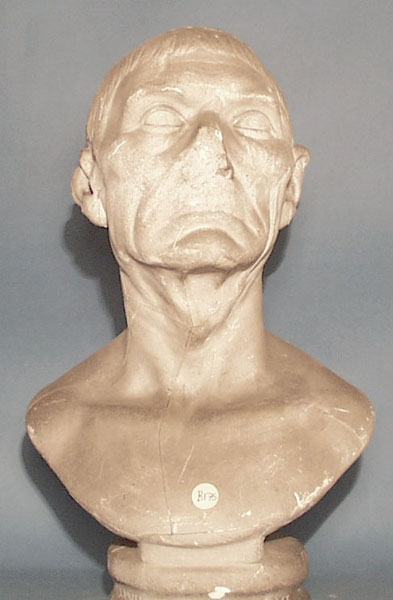
Portrait bust of an old man.
Commentary Prepared by Dr. Julia Lenaghan, Ashmolean Museum
B 175
Bust of M. Vilonius Varro. Copenhagen
Portrait bust of an old man with inscription identifying him as M. Vilonius Varro. The bust was erected in the first century AD for a Roman citizen from the countryside outside of Rome.
Marble
Bust
47 cm
According to Studnizcka, the bust was found in Torrimpietra, near Palo, along the Via Aurelia. According to Pollak it stood for many years on the balcony of Palazzo Rospigliosi in Rome. It was purchased by the Glyptotek in 1908.
Denmark, Copenhagen, Ny Carlsberg Glyptotek, 2286
Tiberian or Trajanic
Preservation:The nose is broken and missing. The rims of the ears are chipped. There is an iron ring in the back of the spine (possibly for fixing to the balcony of Palazzo Rospigliosi).
Description:The bust is worked in the same piece of marble as its low cylindrical foot and the rectangular cushion spacer between the foot and the bust. The portrait head depicts a weathered older man who looks sharply up and to his left.
The cylindrical foot is between five and ten centimetres high. It has a broad flat upper and lower moulding. Between the moulding runs an inscription that reads: M.VILON.VARR.Q.ADOPT.PATR.MARCI.N.
Resting directly on the upper surface of the cylindrical foot is a wedged-shape spine. It rises about 15 cm at the back. At the front it is faced with a blank rectangular panel. On top of this rectangular begins the bust.
The bust area is naked and limited; it extends only as far as the beginning of the shoulders and down as far as the centre of the sternum. The clavicle protrudes. At the base of the neck there is a deep hollow. The neck itself is lined with horizontal creases and two hanging edges of skin trail down beneath the chin. The Adam’s apple is prominent.
The head is turned to the left and held with chin pointed upward. The heavily lined face features sunken temples and sunken cheeks which stand in sharp contrast to the protruding cheekbones. The forehead is relatively short and has one horizontal furrow. Below the furrow the brow juts outward. It projects especially over the outer corners of the eyebrows and around the base of the nose. They eyebrows arch and shadow the eyes. The base of the nose is deeply indented; lower down, however, the nose leaps outward in a great hook shape. The naso-labial folds are deep and there are significant creases around the jowls. On the left side the creases are especially numerous. The mouth is wide from side to side and it corners hang down. The lips are thin and pressed together. The chin is prominent but short.
The hair is thin but covers the entire surface of the head. It originates at the crown and falls naturally in short tiers forward from the crown. There is a small part in the hair over the brow and the hair at the back of the head seems to have more volume. The hair leaves the ears uncovered and they stand significantly away from the head.
Discussion:The bust of M. Vilonius Varro in Copenhagen, found in a rural Italian context and representing a local man, has attracted interest for three reasons. First, its inscription is obscure and its authenticity has been questioned. Second, scholars have been impressed by its combination of elements of "Hellenistic pathos" and "Roman verism". Third, most recently, the form of its bust makes it chronologically controversial.
The inscription was originally not accepted for CIL because it was considered to be modern. Careful analysis, however, seems to show that the weathering of the letters corresponds to the weathering of the bust. Moreover, more examples of busts with inscriptions have been found. The inscription reads M VILON VARR Q ADOPT PATR MARCI N. It has been published in a footnote by Zanker (with help from Castren and Torelli) as M(arcus) VILLON(ius) VARRO Q(ui) ADOPT(avit) PATR(em) M(arci) N(ostri). This footnote, cited by Goette and Johansen as if the definitive reading, is both incorrectly transcribed and not totally satisfying. According to Zanker’s interpretation, the bust shows M. Vilonius Varro who adopted the father of our Marcus. The "our" is to be understood by the context which he believes is the lararium of a rustic villa. To this author, a reading such as M(arcus) VILON(ius) VARRO Q(uinti) ADOPT(ivus) PATR(is) MARCI N(epos) seems equally possible. Such a reading would make Marcus Vilonius Varro adopted by his uncle Quintus.
Zanker, furthermore, uses the portrait bust in a discussion of the differences between early portraits of the freedmen class in Rome and early portraits of the citizens of the Italian peninsula outside of the city of Rome. Whereas the freedmen class in Rome tended to use "veristic" portraits, the citizens of the peninsula combined aspects. In this case, the upward tilt of the head is considered a trait borrowed from the Hellenistic pathos formula. The observation is clearly well-grounded but the total argument is in many ways subjective and forces over-categorization along social lines. The dating presented by Zanker has also been seriously questioned (see below). In any case, regardless of the bust’s exact chronological moment, it is clear that various modes of self-representation existed simultaneously for long periods of time and that these modes could be combined indiscriminately, (probably even by individuals of all social levels).
The form of the bust has also been considered significant. Made from the same piece of marble, the bust consists of a relatively small chest area set on a moulded cylindrical foot with a rectangular plaque placed between the cylindrical foot and the chest. The spine, visible at the back, is significantly narrower than the spines typically seen in Julio-Claudian busts. Goette is convinced (and has convinced Johansen) that this type of bust with cylindrical foot in the same piece of marble in not possible before the late first century AD. The first absolutely securely dated marble bust with such a foot is a portrait of late Flavian date; it is a portrait of Nerva recut from a portrait of Domitian (H. Götze,"Eine neues Bildnis des Nerva" MdI 1 1948 pp.139-156 pl.47). Moreover, all other busts in this format seem at earliest to be of Flavian date. Moreover, Goette cites other examples of "realistic" or "veristic" portraits dated to the early second century AD.
Cain, arguing for a Tiberian date for M. Vilonius Varro, points out that a portrait bust of young woman from the Villa Doria Pamphili, considered to be Tiberian in date, (Cain 1993 p.24 especially footnote 79) was worked together with a solid rectangular foot, and that bronze busts worked together with their bases appear in the Caligulan period. She, moreover, argues that the M. Vilonius Varro bust is Tiberian in technique.
Whether the Copenhagen bust is Trajanic or Tiberian, it is clear that the "veristic" portrait tradition continued to be a viable option for portraits in the first century AD. In this particular case, it may also be that the man represented belonged to a different, earlier, generation than the family members who commissioned the portrait.
J. Lenaghan
Bibliography:V. Poulsen,
Les Portraits Romains I. République et dynastie Julienne (Copenhagen 1973) 119-120 no.87 pls.119-120
catalogue entry, adamant that the inscription is ancientP. Zanker,
"Zur Rezeption des hellenistischen Individualporträts in Rom und in den italischen Städten" Hellenismus in Mittelitalien (Göttingen 1976) 603-604 especially footnote 108
considers to be from the lararium of a rustic villa, shows combination of verism and hellenistic pathos, provides transcription of the inscription used by following authors.H-R. Goette,
"Das Bildnis des Marcus Vilonius Varro in Kopenhagen" (Boreas 7 1984) 89-104
dates the bust to the Trajanic era both because of the bust shape and because of the mode of self-representationP. Cain,
Männerbildnisse neronisch-flavischer Zeit (Munich 1993) 24 footnote 81
gives it a Tiberian dateF. Johansen,
Catalogue of Roman Portraits I; Ny Carlysberg Glyptotek (Copenhagen 1994) 202-203 no.89
catalogue entry that dates the portrait to Trajanic period