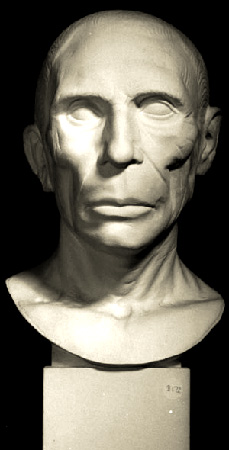
Portrait head of old man.
Commentary Prepared by Dr. Julia Lenaghan, Ashmolean Museum
B 172
Republican period portrait of an old man. Dresden
Portrait head of an old man with small portion of bust that was probably inserted into a herm. From about the middle of the first century BC.
Marble
Head
34.5 cm
Germany, Dresden, Albertinum und Staatliche Kunstsammlungen, Skulpturensammlung, Hermann 329
ca. 50 BC
Preservation:The rim of the left ear is slightly broken and the edge of the lobe of the right ear is broken.
Description:The head and neck are worked together with a small, neatly rounded portion of the chest. The chest area has a thick, plug-like form and was without doubt inserted into a socket, probably in a herm.
The head depicts an old man with a gaunt face who turns ever so slightly to the right. The shape of the skull dominates his appearance. The dome of the cranium is visible; there are significant indentations at the temples; and the entire cheekbones protrude forcefully.
The hair is rendered in short, engraved lines on a surface that is only fractionally raised from the surface of the brow. The brow is tall and continues the natural convex curve of the skull. It is traversed by several creases. The eyebrows hang off and forward from the brow; they are deeply undercut to achieve this effect. They arch and engraved lines indicate the individual hairs. The eyes below appear flat and have wrinkles at the outer corners and at the inner corners; the wrinkles on the inner corner run horizontally over the lateral surface of the nose. The nose also has horizontal creases over the bridge. The center of the ridge bulges and the tip is flattened and broad. Below the nose, the gums and teeth slant outwards. The mouth is broad and the upper lip is especially thin. The chin is short and recedes. The skin on the face has been stretched out of shape; it hangs in deep folds around the jaw and mouth. Moreover, deep wrinkles, going in all directions and rendered with engraved slashes, make the skin appear tough and leathery.
The neck is also heavily lined with horizontally creases and emaciated so that the tendons and ligaments are visible. The collar bones and the indentation between them are prominently visible.
Discussion:This head depicts an unidentified old man in what scholars have traditionally labeled a Roman veristic style. This style, which accentuated real-looking features, was popular in the period of the Roman Republic, and most scholars associate the harsh, supposedly "true" aspect of portraits such as this with Republican admiration for no-frills strength, sobriety, and sternness.
Whereas the portrait was designed to, and successfully does, convey the appearance of a specific individual, it in point of fact follows a standard established format, a sort of caricature, of the an old man. There are numerous examples of this format of the balding elderly man with pronounced cheek bones, hanging cheeks, and tight lips; for instance, head in a funerary relief in Copenhagen and a portrait in the Vatican Chiaramonti collection are both commonly cited parallels. The link between such representations, which give the impression that they were made just before the portrayed’s death, and the Roman tradition of death masks is not entirely clear. Certainly, this type of pseudo-realistic portraiture was obviously considered an acceptable and indeed desirable visual formulation for a man who had lived a full and proper life.
P. Zanker points out that these realistic types were typically used by the middle levels of society, frequently rich freedmen, rather than aristocrats. Aristocrats, according to his theory, were more likely to incorporate Hellenistic elements into their portraiture and to avoid using this unadulterated brutal realism.
The shape and structure of the bust of this head indicate that it needed to be set on another element in order to stand upright. A tall pillar or herm seems the most likely possibility.
J. Lenaghan
Bibliography:P. Herrmann,
Verzeichnis der Antiken Originalbildwerke der Staatlichen Skulpturensammlung zu Dresden (Berlin 1925) 79 no.329
brief entryB. Schweitzer,
Die Bildniskunst der römischen Republik (Leipzig 1948) 114-117 no.H1 figs.12 and 14
recognizes so many similar portraits that considers them all product of the same workshopP. Zanker,
"Zur Rezeption des hellenistischen Individualporträts in Rom und in den italischen Städten" Hellenismus in Mittelitalien (Göttingen 1976) 592-595, 603
notes that this type of portrait belonged to middle class of Roman society and did not come from death masksK. Vierneisel and P. Zanker,
Die Bildnisse des Augustus. Herrscherbild und Politik in kaiserlichen Rom (Munich 1979) 90 no.9.4
portrait for herm, ca. 30 BC, freedman mode of self-representationV. Kockel,
Porträtreliefs Stadtrömischer Grabbauten (Mainz 1993) 66 footnote 549
list of heads with same formulation,
Die Antike in Albertinum (Mainz 1993) 52-53 no.29
catalogue entry with one large colour picture