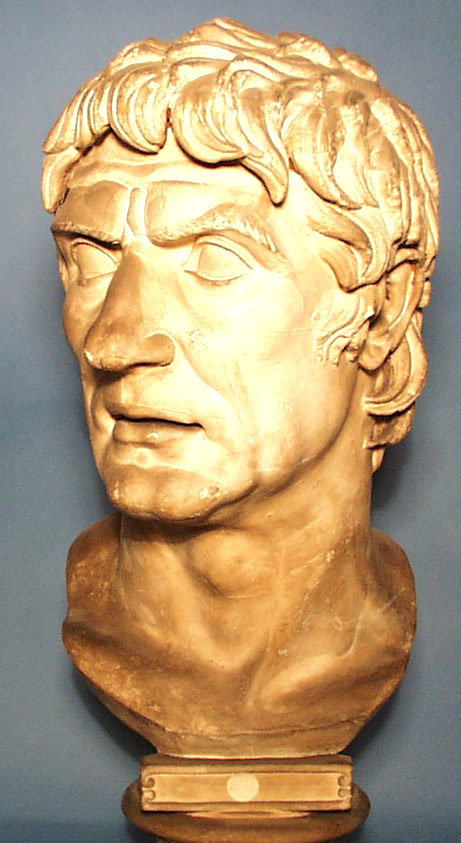
Male portrait head.
Commentary Prepared by Dr. Julia Lenaghan, Ashmolean Museum
B 171
'Sulla'. Fictional Portrait of an Earlier Republican Leader.
Marble (Parian)
Head
H 0.42m (total); 0.27 m (chin to crown)
Acquired in 1811 by M. v. Wagner from the art dealer Pietro Vitali in Rome for crown prince Ludwig of Bavaria. Said to have come from the Palazzo Ruspoli (previously in the Palazzo Gaetani and before that in the Palazzo Crescenzi).
Germany, Munich, Glyptothek, 309
ca. 30 BC - AD 20; Augustan
Preservation:The nose, the frontal locks over the forehead, and portions of the chin and both cheeks are restored. The lower rim in front was cut for insertion into a modern bust. The surface was cleaned with acid.
Description:The slightly over life-sized portrait head shows a clean-shaven, mature man with relatively long, unkempt hair. The head is emphatically turned to the right, the face is wide and almost square with a heavy chin. The eyes under the furrowed forehead and contracted brows are wide-open, the lips are parted. Deep folds run through the face. The hair radiates in thick strands from a point high up the back of the crown, and reaches down the forehead and neck. On the left side of the head, parallel locks are leading to the back, on the right side to the front. Over the forehead the locks are deeply undercut. The individual strands of hair show little inner detail, the eyes are left blank.
Below the neck a very small part of the shoulders and the inner section of the clavical bones are indicated.
Discussion:Before the head was acquired for crown prince Ludwig of Bavaria, the renowned neo-classical sculptors Thorvaldsen and Canova were asked for an expertise. On the basis of perceived similarities with coin portraits, Canova identified the portrayed as the Republican leader Sulla, and this name, although probably wrong, has stuck with the sculpture.
In the 17th century the head was restored and inserted into a bust made by the baroque sculptor Alessandro Algardi; subsequently the antique origin of the head itself was cast into doubt.
R. Wünsche, however, has argued very convincingly that the head is indeed antique. It has to be seen together with a second, closely related head in Munich (the so-called Marius, Glyptothek 319), that displays very similar stylistic features but much shorter hair. The close resemblance between the two heads strongly indicates that they were originally conceived as pendants, either to illustrate some historical connection (as expressed in the names ‘Sulla’ and ‘Marius’) or to mark them out as related members of one family.
The ‘Sulla’ displays distinct features that belong to the formal repertoire of Hellenistic portraits of the 2nd century B. C.: These include the pathos-filled quality of the portrait brought about by the energetic turn of the head, and the powerful visual expression with strong mimic details such as wide-open eyes and mouth, and emphatically contracted brows, elements that can for example be found in the portraits of Hellenistic rulers. A detailed comparison between the ‘Sulla’ and such Hellenistic works reveals, however, clear differences in the technical application of these formulae. Contrary to Hellenistic heads, the facial features of the ‘Sulla’ remain in one vertical plain and the face turns sharply back at the corners of the brows; despite the emphatic turn of the head, the ‘Sulla’ also shows far less distinct asymmetries in the face than the earlier examples. The best comparisons for the technical execution of the ‘Sulla’ are works of the Augustan period.
It is therefore likely that the image was created at the time of Augustus as a fictional portrait of a leader of an earlier period. There a several scenarios for such a creation: The Forum of Augustus, for example, contained a great number of largely imaginary portraits of the summi viri, mythological figures as well as important military leaders and politicians from Rome’s history. Another possibility is that one of the old Republican families at this time commissioned new portraits of their ancestors for an important monument or family tomb.
Bibliography:A. Furtwängler,
Beschreibung der Glyptothek König Ludwig's I zu München (Munich 1900) 320-321
Catalogue entry with basic information.R. Wünsche,
"'Marius' und 'Sulla'. Untersuchungen zu republikanischen Porträts und deren neuzeitlichen Nachahmungen." (MuJb 33 1982) 7-38
The basic and widely accepted study of the 'Sulla'. Wünsche interprets the sculpture as a fictional portrait of an earlier Republican leader commissioned in the Augustan period.L. Giuliani,
Bildnis und Botschaft. Hermeneutische Untersuchungen zur Bildniskunst der römischen Republik (Frankfurt a. M. 1986) 175-185
Giuliani accepts the basic points made by Wünsche; he tentatively associates the Munich 'Sulla' and 'Marius' with the tomb of the Scipiones on the Via Appia, and identifies them as Scipio Africanus and his brother.