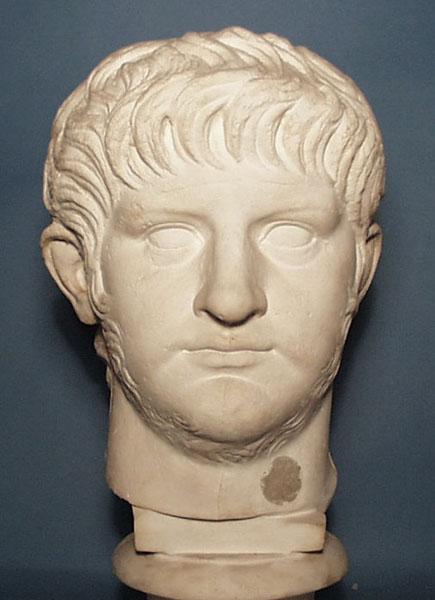
Head of Nero.
(reigned 54-68 AD).
Commentary Prepared by Dr. Julia Lenaghan, Ashmolean Museum
B 166
Portrait head of Nero. Rome (Museo Nazionale in the Palatine Museum)
Portrait head of the Emperor Nero (AD 54-68). From a statue probably made between 59 and 64 AD, and displayed on the Palatine or in the Forum at Rome
Marble
Head
31 cm
From the Palatine. Found in 1869 during P. Rosa’s excavations for Napoleon III. The head was found with other material gathered for a lime kiln in the east wing of the cryptoporticus below the area sacra of the Temple of Apollo.
Italy, Rome, Museo Nazionale (Museo del Palatino), 618
59- 68 AD
Preservation:The ears are restored in plaster. The end of the nose, a fragment of the chin, a portion of the top of the head, and part of the neck with the nape (the latter two items worked separately) are missing. Above the left ear are two round holes as well as a slash in the locks of hair.
Description:The head, broken through at the neck, depicts a young man with long hair and a full face. The hair has no part and falls naturally from the crown in undulating, sometimes tousled waves of long locks. The locks leave the ears uncovered and extend down the back of the neck. The ends of the locks of hair over the brow all have an almost C- shape; that is, the lock originates from a point at the left, curves out to the right, and then ends in a spit that turns leftward. This pattern of C (or sickle)-shaped locks runs from the right corner of the brow to the left ear. At the right corner are several locks, the ends of which turn to the right and fall downward. In front of the ears the pattern of the locks continues in a long sideburn. Further down the cheek, the sideburn yields to a beard, rendered by engraved lines, that grows under the chin. The beard hair has a pattern of wavy locks, going now one direction and now another, similar to that of the hair on the head.
The brow is low and little of it emerges from underneath the hair. The eyebrows are generally horizontal by have a small upward flare over the outer corner of the eye. On the brow over the nose are two inward slanting creases. The eyes are small and deep set. The bridge of the nose is thick. The mouth is small with up-turned corners and thin lips. The chin is round and pronounced but the jaw line itself is heavy but receding. The cheeks are round; they swell below the eyes and their fullness creates hanging jowls and significant folds above the corners of the mouth which appears tucked into the heavy cheeks.
Discussion:This head represents the Emperor Nero (AD 54-68). It was found, in a dump of marble material, on the Palatine in the penultimate year of the 1861-1870 excavations of P. Rosa. After a period in the Terme museum, it is now on display once again on the Palatine. The head is the best extant example of Nero’s third portrait type, that showing him as a young adult. The third portrait type has even been named the "Terme" type after this head (which was for many years in the Terme Museum in Rome.)
As part of the Julio-Claudian family, Nero was always in the public eye. He was born in 37 AD to Agrippina Minor, daughter of Germanicus, sister of Caligula; adopted by his step-father, the Emperor Claudius, in 50 at the age of 13; became emperor in 54 at the age of 17; and ruled for fourteen years until he committed suicide in 68 at the age of 31. His official image, therefore, progressed from that of a child to that of an adolescent, from that of an adolescent to that of a young man, and finally to an image of a mature man (cf. cat.no. H 40).
The head found on the Palatine corresponds to an image of Nero first presented on coins in 59 AD; it is logically assumed, therefore, that the original model for the type was created in 59. The type shows Nero as a young adult. The first two portrait types of Nero (the “Parma” and “Cagliari” types) show a child and an adolescent. This, the third portrait type of Nero, features a fuller face and a particular fringed hairstyle which seems to conform to Suetonius’ description (Nero 51) of Nero’s hair as “coma in gradus formata”. The hairstyle marks a change from the seemingly more natural and less consciously fashionable hair arrangements of Nero’s Julio-Claudian predecessors. In addition, the type sometimes features, as in the case of the Palatine head, an under the chin beard, an item never seen in conjunction with his second portrait type.
Because Nero’s memory was damned after his death—that is, his name and face were removed from public monuments—many of his portraits were recarved and made into portraits of his Flavian successors. Of the third Nero portrait type, there are four examples, known to modern scholars, that have not been altered. These include this head from the Palatine, a head in the Uffizi, a no longer traceable head of which photographs exist, and a head in Modena.
The portraiture of Nero is remarkable for several reasons. First, it shows how the image production centers of Rome dealt with the development of a child to a man. Second, so many of Nero’s portraits have been so obviously re-fashioned into images of other emperors. Third, the images of the adult Nero (Nero types three and especially type four) differ considerably from that of the earlier Julio-Claudians and even from his own childhood images. Why this occurs and what it may reflect have been the source of much scholarly consideration (see cat.no. H 40). The image has been seen in relation to a more Hellenistic concept of monarch, to Nero’s flamboyant concept of himself as a poet and actor, or more simply to Nero’s attention to high fashion.
J. Lenaghan
Bibliography:F. Johansen,
"Portraetter af Nero Claudius Caesar Germanicus" (MedKøb 0) 29-59, especially 59 fig.24
full description of Nero's four typesB. Felletti Maj,
Museo Nazionale: I Ritratti (Rome 1953) 73 no.123
catalogue entryK. Vierneisel and P. Zanker,
Die Bildnisse des Augustus. Herrscherbild und Politik in kaiserlichen Rom (Munich 1979) 97 no.10.9
excellent copy of third portrait type of Nero(E. Talamo),
Museo Nazionale Romano. Le Sculture I, 1 (Rome 1979) 272-273 no.168
catalogue entryP. Zanker and M. Bergmann,
"'Damnatio Memoriae' Umgearbeitete Nero- und Domitiansportrats" (JdI 96 1981) 322-326, especially 324 no.a, fig.5
uses the head as best example of Nero’s Type III portraits which is named after this head the Terme type.K. Fittschen and P. Zanker,
Katalog der römischen Porträts in den Capitolinischen Museen und dem anderen Kommunalen Sammlungen der Stadt Rom, Band I (Mainz am Rhein 1985) 18 especially footnote 4
remarks on Nero's 3rd and 4th portrait typesM.A. Tomei,
"Gli scavi di Pietro Rosa per Napoleone III (1861-1870)" Gli Orti Farnesiani sul Palatino (Rome 1990) 85
detailed discussion of excavation of the Palatine and its finds, including the head of NeroD. Boschung,
"Die Bildnistypen der iulisch-claudischen Kaiserfamilie" (JRA 6 1993) 76-77 Zc Typus Thermenmuseum
brief remark about the type with bibliographyM.A. Tomei,
Museo Palatino (Milan 1997) 80 no.55
latest catalogue entry with bibliography and colour photographM. Bergmann,
Die Strahlen der Herrscher (Mainz 1998) 148-149 pl.28.1
description of Nero's types and interpretation of types three and four as foppish