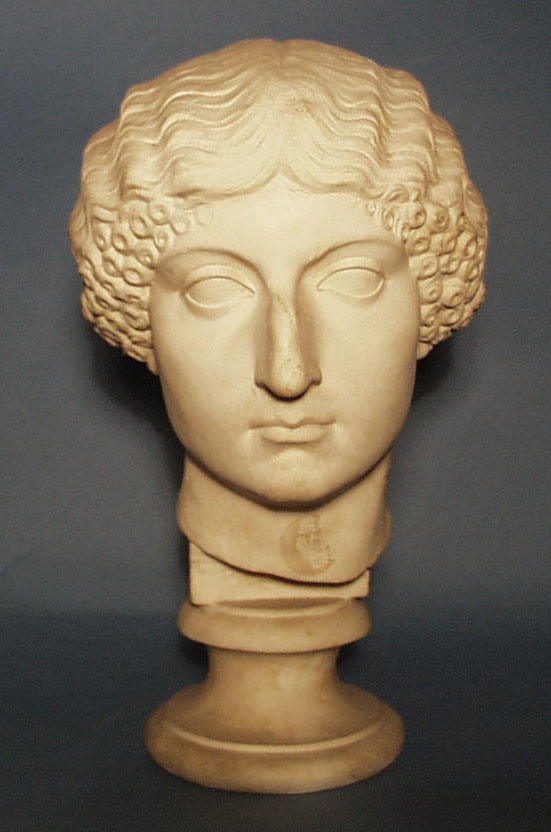
Portrait head of Livia.
Commentary Prepared by Dr. Julia Lenaghan, Ashmolean Museum
B 164
Female portrait head from the tomb of the Licinii Crassi. Copenhagen
Portrait head of a late Tiberian to Claudian period woman. Possibly from a statue set up in the family tomb of the Licinii Crassi in Rome.
Marble
Head
27 cm
Acquired from Count Tyskiewicz’s in Paris in 1897 with at least eleven other portraits; Tyskiewicz had purchased all the portraits a few years earlier in Rome. The portraits are said to have been found at the family tomb of the Licinii Crassi near Porta Pia, in the area of Via Salaria and Via Piave.
Denmark, Copenhagen, Ny Carlsberg Glyptotek, 747
Late Tiberian to Claudian
Preservation:The head has broken off through the neck and the collected bunch of hair at the nape of the neck. There are traces of color in the pupils of the eyes. There are broken locks of hair over the left ear and a break in the right side of the ridge of the nose. The crown of the head, in two separate pieces, and the nose were worked separately and added. The crown of the head is fractionally too large and plaster curls were used to disguise the difference in size at the joining seams. Isotope analysis of all the lower head with face, the bi-partite crown, and the nose revealed that the core of the portrait was made of Parian marble, the crown of the head was made of marble from Asia Minor, and the nose from Carrara marble. The crown and nose have been removed from the rest of the head. According to F. Johansen, both the crown and the nose were modern restorations. According to D. Boschung and M. Hofter the top of the head is ancient; it shows natural encrustation and root marks and the dowel hole is ancient. M. Moletesen also believes the crown is ancient because other of the heads have flaws in the marble and the nineteenth century restorer did not use marble from Asia Minor.
Description:This head seems to have been made separately from the element to which it was joined. The surface at the base of the neck seems deliberately smoothed. The head turned slightly to its right. It depicts an adult woman whose face is framed by a thick wreath of pin curls.
The face has an oval shape. In frontal view, the curve from the cheeks into the chin has an almost harmonious U shape. The brow is low and flat. The eyebrows form a sharp arch. The eyes are large and also feature sharply defined lids. The upper lid is heavy. A shadow of the painted pupils remains. The nose is fine but hooked. The mouth is small with a distinct upper lip. The upper lip has a pronounced and peaked dip at its center point. The naso-labial folds are lightly depicted and there is a vague indication of folding skin running diagonally downwards from the corners of the mouth. The chin, relatively recessive in comparison with the hooked nose, is small in width.
The hair wears an elaborate hairstyle. Even should the fragment of the cranium be modern, it nonetheless restores the proper ancient hairstyle. The hair is parted at the center and falls to both sides in parallel undulating locks. These locks are pulled gently back from the face and are collected at the nape of the neck. At the nape the hair is gathered and tied together by braids of hair. Emerging from underneath the undulating locks that are pulled back is a mass of pin curls. They build up in volume, standing a few centimeters off the head, and cover the ears. The hair forms a low slight arch over the brow. At the temples and over the outer corners of the eyes are the pin curls, which even touch the eyebrows at the temples, and near the center of the brow are the softly waving locks.
Discussion:This portrait head, almost certainly made for a statue, represents a private woman and not a member of the imperial family as was once thought. The portrait’s hairstyle follows the fashion worn in metropolitan Rome between the late Tiberian and Claudian periods, and thus provides a secure date for the head.
The head is mainly of interest because it is said to come from the tomb of the Licinii Crassi, an extremely prominent senatorial family of the early Empire which could trace its lineage back to Crassus and Pompey (cf. cat. no. 159). Fifteen portraits (twelve Julio-Claudian and three second century portraits), now in Copenhagen, seven sarcophagi, and numerous inscriptions were allegedly found in the ‘three-roomed’ grave building located near the intersection of the modern Via Piave and Via Salaria in Rome. At the end of the nineteenth century this area of Rome, previously in the hands of large landowners, underwent massive urban development. The archaeological material found during this urbanization was frequently suppressed and concealed lest it hinder the progress of development or in this case plundered by workmen at night. Thus, modern scholars are left with brief and random notices of finds and hearsay remarks. Nonetheless, in the case of the tomb of the Licinii Crassi, which came to light between 1884 and 1885, the rumors and succinct notes seem to correspond and be credible.
The group of first century portraits is fundamentally coherent in date, manufacture, and mode of repair—though to be sure, some are busts and others were made for statues. In addition, the area around the Porta Pia (near the Via Piave and Via Salaria) seems to have clearly belonged to the family of the Licinii Crassi. Epigraphic evidence from the area mentions the family numerous times; there are the funerary epitaphs for several members that were supposedly found in the tomb with the busts; funerary inscriptions of freedmen bearing the family name were found in the same general area; and a boundary stone (cippus) marking family property lines was discovered in the area. Also the coincidence of the portrait of Pompey, a distant ancestor of the same family, supports the theory. Thus, it seems that the Licinii had a suburban villa in this area and that on this property they built a family tomb.
The scenario is much like that of the tomb of the Sulpicii Platorini (cat.no. B 199) on private land in Trastevere in Rome. The tomb of the Sulpicii Platorini also featured a mixture of portrait busts and portrait statues. Boschung suggests the reason for the combination of portrait modes in the tomb of the Licinii may be either that the busts were fitted into the niches and the statues flanked the niches or perhaps the ancestral dead were given portrait busts and the more immediate family statues.
The head of this particular female statue was conserved in 1980. The conservation revealed that the upper portion of the head was carved from a different block of marble that had broken into two pieces. Analysis showed that the lower portion of the head was made of Parian marble whereas the upper part was made of a marble from Asia Minor, and the nose of Carrara (Italian) marble. The upper portion of the head, however, seems to be an ancient repair (pace Johansen), one that occurred before the head was even set on its statue in the tomb. Moltesen points out that several of the heads from the tomb group have marble flaws and that in this case the flaw may have made it impossible for the ancient sculptor to complete the head in one piece of marble. Moltesen also notes that the restorer of the late nineteenth century used material from the group itself to make repairs; for instance, drilling into bases to obtain marble for the repair of noses. The fact that the top of the head is a centimeter too large is absolutely insignificant. Prior to restoration, this difference had been concealed by plaster curls and whether the plaster curls were ancient or nineteenth century is irrelevant, since the ancient sculptor would have used the same technique to conceal the join between the two pieces. The top of the head has been removed and the portrait is now reduced to merely the section between the chin and temples.
Even though the head cannot be precisely identified, it remains an excellent example
of private female portraiture of the elite senatorial class in the Julio-Claudian period in metropolitan Rome and reveals interesting technical details about sculptural manufacture.
J. Lenaghan
Bibliography:K. Polaschek,
"Studien zu einem Frauenkopf in Landesmuseum Trier und zur weiblichen Haartracht der iulisch-claudischer Zeit" (TrZ 35 1972) 273 fig.9.7
study of female hairstyles that dates this hairstyle to Caligulan periodV. Poulsen,
Les Portraits Romains I. République et dynastie Julienne (Copenhagen 1973) 74-75, 101-106 no.39 pls.64-65
catalogue entry and discussion of tomb group of the Licinii Crassi, believes that all the portraits did come from the tomb.D. Boschung,
"Uberlegungen zum Licinergrab" (JdI 101 1986) 270- 271especially footnote 62
discussion of the history of the group, believes head belongs with group and that the upper portion of the head is ancient(M. Hofter),
Kaiser Augustus und die verlorene Republik (Berlin 1988) 316, 320-321 no.162
description of tomb group, thinks this head earlier (Tiberian or Caligulan) than most which are Caligulan or early Claudian.M. Moltesen,
"Neue Nasen, Neue Namen" (AA 1991) 274-279 figs.7-10
full discussion of the conservation status and the restoration techniques usedF. Johansen,
Catalogue of Roman Portraits I; Ny Carlysberg Glyptotek (Copenhagen 1994) 104-105 no.40
catalogue entry with most recent bibliography, first entry after 1980 removal of the crown of the head