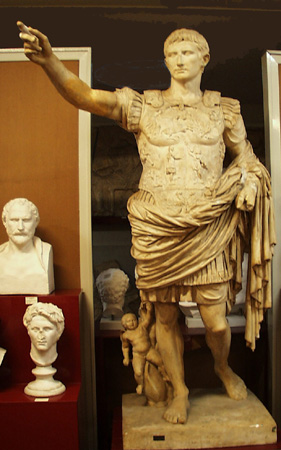
Cuirassed statue of the Emperor Augustus.
Showing on the breastplate an allegorical cosmos with the victory over the Parthians at its centre.
Commentary Prepared by Dr. Julia Lenaghan, Ashmolean Museum
B 161
Augustus of Prima Porta. Vatican
Cuirassed statue of the Emperor Augustus (31 BC- AD 14) found at Livia’s, his wife’s, villa at Prima Porta. Showing on the breastplate an allegorical cosmos with the victory over the Parthians at its centre.
Marble
Cuirassed Statue
2.06 m without plinth, head 27.5 cm
From near Rome. Found at the Villa of Livia at Prima Porta, ancient Saxa Rubra, nine miles north of Rome. The statue was found in 1863.
Italy, Vatican, Braccio Nuovo, 2290
ca. 20-17 BC
Preservation:The right arm was broken off. The break under the right shoulder strap is now filled with plaster. The outer portion of the upper part of the support with a piece of the dolphin's tail has broken. There are also breaks on the right elbow, the right wrist, the left lower leg, diagonally through the right ankle, and through both feet. Restorations include part of the left ear, a part of the left shoulder, the edge of the right shoulder strap and under part of the left strap with the button, the fingers of the right hand, the left index finger, the tail and mouth of the dolphin, the left heel, a small part of the mantle, the lowest part of corner of drapery which hangs down, the majority of the plinth. On the right arm and on the left leg are the remains of ancient restorations. The head was worked separately and inset. There are traces of paint preserved which indicate that the cuirass was painted, that the pupils were large, the irises reddish, and the hair brown.
Description:The statue depicts a mature man in military dress. Looking to the right, the figure raises his right arm. Near the right foot is a support in the form of a Cupid riding a dolphin.
The statue wears a military cuirass and a mantle wrapped around its hips and draped over the left forearm. It is, however, barefoot. The body weight rests over the right leg; the right arm is outstretched and raised; the left arm, resting by the side, held a scepter or sword which is no longer preserved. Next to the right leg is the support. The lower portion of the support is a vertically placed dolphin; the face is toward the ground and the tail is in the air. Stradling the dolphin is a nude little boy whose left arm reaches up the leg of the main figure.
The breastplate of the statue features figural decoration. In the center a barbarian soldier hands a military insignia to a Roman legionary who is accompanied by his faithful dog. Above this scene a charioteer rides across the cuirass in his chariot which is led by a winged female figure with a pitcher in hand. Over the shoulders of this woman appears a veiled woman with a torch. These figures of charioteer and two appear under a bearded male figure who holds a cloth over his head. Below the scene of the legionary, at the bottom of the cuirass, sits a female goddess, bountiful and holding a cornucopia. On both the left and the right of the scene with the legionary at the sides of the cuirass are seated, defeated barbarians; on the right the barbarian holds a sheathed sword with its hilt away from the body and on the left the barbarian has a dragon trumpet and a boar standard. Below the barbarians are respectively Apollo on a griffin and Diana on a stag. Depicted on the shoulder straps are sphinxes. On the back of the cuirass there is the wing of a Victory and a Trophy under the right arm.
The head of the statue, which turns to the right, bears a portrait. The face has a square form with a pointed chin. The brow is broad and its surface is ruffled by two vertical lines of contraction rising from the inner corners of the eyebrows. The eyebrows are narrow and mainly straight. The eyes, directly below, are almond shaped. The nose has a bulge at the center. The mouth is closed with perfectly shaped lips. The chin is short, round, and projecting. The skin of the cheeks around the mouth is modeled; there are small tucks around the upturned corners of the mouth. The widely spaced cheekbones project forcefully and the ears stick out.
The hair falls downward from the crown in medium length locks. Over the brow the hair forms a fork and pincers motif. The ends of the locks over the inner corner of the left eye fork; they fall in opposite directions, creating a triangular space between them. The locks over the nose and inner portion of the right eye begin widely spaced but their ends turn inward toward each other, creating a pincers. In front of the ears are short sideburns that are brushed forward toward the face.
Discussion:This statue, known as the Augustus of Prima Porta, depicts the Emperor in military dress with his right arm raised as if addressing the troops and with a spear in his left hand. The statue is the most famous extant statue of the Emperor Augustus and possibly the most extant famous statue of any Emperor. Its completeness, intriguing find location, elaborate iconography, and portrait head have deservedly created much discussion among modern scholars.
The statue was found in the remains of an imperial villa at Saxa Rubra, eight miles north of Rome. This private house clearly belonged to the imperial family and its location fits the description given by ancient authors of Livia’s villa. The statue was said “to have been found in front of the building on a terrace toward the Tiber that probably once formed a portico or terrace in front of the main façade of the palace.” Its location proves without doubt that the statue had the approval of the imperial family. Many scholars (including P. Zanker) insist that the statue, from the private imperial home, is a marble copy of an honorific bronze statue of the Emperor, a statue presumed to have been erected on a prominent occasion and in a prominent place and to have, therefore, been dear to the imperial family. There, however, is no proof for this postulated bronze original. Not only are there no copies of the statue body but also the dolphin support of the statue seems too iconographically integrated to be considered a copyist’s addition.
The breastplate of the statue features multi-tiered decoration in relief that relates to a specific historic event, the Parthian victory of 20 BC, and, consequently, dates the statue to shortly after 20 BC. In 53 BC the Roman army directed by Crassus was defeated, losing even its military standards, by the Parthians. Under Augustus, in 20 BC, a treaty was negotiated with the Parthians and the standards were returned to the Romans. Hailed as a great victory, this effaced the previous Roman disgrace. The triumphant event was particularly accentuated since it immediately preceded the secular celebration of 17 BC. The central scene of the Prima Porta statue’s cuirass shows a Parthian handing the lost standard back to a Roman legionary. Zanker even believes that the Prima Porta statue held in its right hand a facsimilie of the returned standards. The appearance of Apollo and Diana on the cuirass have also been used to support the date of 20-17 BC. These two divinities feature prominently in Horace’s Carmen Saeculare written for the year 17 BC.
The cuirass’ figural decoration follows a careful program. Below the cuirass’ central scene of the return of the standard is a reclining female figure with a filled cornucopia and small children (a similar image appears on the Ara Pacis). The figure represents the Earth (Tellus or Terra) that flourishes productively in peacetime. On either side of and slightly above Tellus appears the fraternal duo of Apollo and Diana. Apollo on the proper right of the cuirass rides a griffin and Artemis on the proper left rides a stag. Their presence indicates their approval of the events.
Behind the legionary, at the side of the cuirass above Apollo, is a seated downward looking barbarian figure who holds a sheathed sword. Her dress identifies her as an Easterner or a German. Behind the Parthian, above Diana, is another seated and dejected barbarian whose boar and dragon paraphernalia identify her as a Celt. Thus, the sides of the cuirass show personifications of the eastern and western edges of the Empire.
Above the central scene, the sun god drives across the cuirass bringing a new day. In front of his chariot is Aurora, the winged goddess of dawn, with a pitcher from which she drops dew. On her shoulders, she carries off the torching bearing Moon goddess (Luna). Over these figures is Caelus, the god of the sky, who holds up the heavens. Two sphinxes on the shoulder straps watch over the entire scene.
Depicted is a resplendent orderly Roman cosmos at the dawn of a new day. The prosperous world centers about the Roman military, extends from the ground to the sky, has eastern and western borders, functions with the approval of Apollo and Diana, and is guarded by the sphinxes.
Just as the cuirass, the statue support also bore a particular message. The dolphin is an animal related to Venus from whom Caesar and his adopted son, Augustus, claimed to have descended. Astride the dolphin is a Cupid, another son of Venus. Some scholars have even attempted to identify the Cupid with Caius Caesar, Augustus’ grandson who was born in 20 BC since Augustus is known to have erected a statue of one of his grandsons in the guise of Cupid.
The statue and its head have been repeatedly discussed by modern scholarship as consciously neo-classical; that is, they deliberately use the structural vocabulary of art of the fifth century BC. They are generally compared to the Polykleitos’ famous statue of the Doryphoros, spear-bearer (see cat.nos. C 32-35). This statue was described by Quintilian as gravis et sanctus, concepts that seem appropriate for an image of Augustus. The structure of the head type and the stance of the Prima Porta statue are even said to be identical to those of the Doryphoros. There are certainly some similarities. Yet Smith convincingly shows that these are not intentional and probably did not belong to the original portrait model.
The head of the Prima Porta statue gives its name to the most widely used and popular portrait model made for Augustus. This portrait type model, perhaps more than being consciously neo-classical, deliberately chooses to use a new portrait formula. This new formula, made in the early 20s BC, intends to portray an older, now fully mature Augustus who was in his mid 30s when the portrait was conceived. The portrait type, in addition, avoids the intense realism of Republican portraits, a realism that gave a very particular individual and human character to portraits. It also avoids the sense of “pathos” or the emotional element that characterized Republican portraits. The result presented the average viewer with an almost inhuman image of attractive agelessness, calm control, and careful sobriety. In the Prima Porta statue the non-mortal element of the portrait is heightened by the heroic trait of bare feet and the supporting elements, Cupid and dolphin, from the world of Venus.
P. Zanker presents the “Prima Porta” portait model as a visual expression of the Res Gestae, of Augustus’ auctoritas which surpassed that of all others, and of the title augustus which was invented for Augustus and defies succinct definition. The “Prima Porta” portrait model does, at least to the modern viewer, give a deceptive momentary impression of ordinariness, not unlike Augustus’ repeated and hollow claims to be equal to the other men.
The portrait head type certainly existed in the first part of the 20s BC; see the Meroe head, cat.no. H 17. This has allowed scholars to associate its creation with the important year of 27 BC. In 27 BC Augustus, officially surrendering all power (potestas) and retaining only authority (auctoritas), handed the Republic back to the senate and Roman people. In gratitude, the senate awarded him the title augustus, the corona civica (see cat.no. B 162), as well as a series of provinces. Although it is a logical hypothesis, particularly given Zanker’s interpretation of the image, there is no secure proof for an association of the portrait with the year 27 BC.
J. Lenaghan
Bibliography:K. Köhler,
"Statue di Cesare Augusto" (Annali Instituto di Correspondenza Archeologica 1863) 432-449
fine description with notes on color and more keen analysisG. Henzen,
"Scavi di Prima porta" (BdI 1863) 71-78
excellent first publication with a full interpretation of the cuirass that is still today acceptedH. Jucker,
"Dokumentationen zur Augustusstatue von Primaporta" (HASB 3 1977) 16-35
excellent list of bibliography with summary of the conclusions of each entry on the listK. Vierneisel and P. Zanker,
Die Bildnisse des Augustus. Herrscherbild und Politik in kaiserlichen Rom (Munich 1979) 45-46 no.4.1
catalogue entryK. Fittschen and P. Zanker,
Katalog der römischen Porträts in den Capitolinischen Museen und dem anderen Kommunalen Sammlungen der Stadt Rom, Band III (Mainz am Rhein 1983) 3-5
general discussion of the Prima Porta portrait typeP. Zanker,
Augustus und die Macht der Bilder (Munich 1987) 103-106, 192-196
discusses the portrait head type and its intended meaning as well as the statue with emphasis on the cuirassD. Boschung,
Die Bildnisse des Augustus (Berlin 1993) pp.179-181no.171 pls.1.5,69, 70, 82.1, 148.1, 213
D. Boschung,
Die Bildnisse des Augustus (Berlin 1993) 38-40, 1799-181 no.171 pls.1.5, 69, 70, 82.1, 148.1, 213
catalogue entry with full bibliography and full technical analysis of portrait type and its copiesD. Boschung,
"Die Bildnistypen der iulisch-claudischen Kaiserfamilie" (JRA 6 1993) 42-43 Ae Prima Porta Typus
brief remark about the type with bibliography and creation date of 27 BCR.R.R. Smith,
"Typology and diversity in the portraits of Augustus" (JRA 9 1996) 31-47
intelligent review of Boschung's Augustus with especially interesting discussion of the Prima Porta type and Polykleitos