Commentary Prepared by Dr. Julia Lenaghan, Ashmolean Museum
B 142
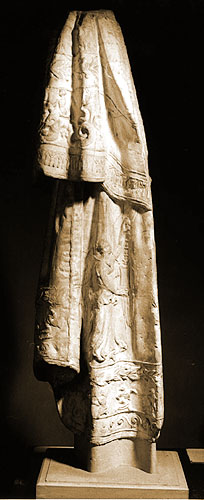
Fold of Despoina’s cloak from Lykosoura. Athens
Corner area of a folded cloak with elaborate decoration embroidered on both sides. From the cult statue of Despoina at Lykosoura, ca. 215-180 BC.
Marble
Statue Fragment
1.13 m (Karusu), 1.18 m (Kavvadias)
From the Temple of Despoina at Lykosoura. Found with many fragments (now in the National Museum at Athens or in the Lykosoura Museum) of a colossal cult group composed of four statues.
Greece, Athens, National Museum, 1737
Late third-early second century BC
Preservation: The fragment is finished on three of its four sides. It is broken at the top and at the top of the back side. The upper surface of the backside is rough and the lower surface of the side is finished, if only summarily. There are some worn vertical patches and some chips on the bottom edge.
Description:The fragment preserves a corner zone of a rectangular piece of decorated cloth that is folded both horizontally and vertically. The horizontal fold creates an overlapping horizontal border and two corners in the same general area. The vertical fold creates two outer surfaces.
The two horizontal layers, the upper folded section and the section appearing below the bottom edge of the folded section, are decorated with horizontal friezes. The upper section shows 1) a frieze of long triangular rays, 2) eagles alternating with thunderbolts, 3) olive leaves, 4) a marine theme, and 5) tassles. The section appearing below depicts two Nikes holding censers and flanked by tree-like vegetation (myrtle or olive), 2) olive leaves, 3) animals in human clothing dancing and playing musical instruments, and 4) a meander border. The vertical crease of the garment leaves in the lower section one Nike on either side of the crease. In the upper area, on one side of the vertical fold, there is a dolphin a Triton, and a Nereid resting on the coils of the Triton. At the vertical crease there are two dolphins and on its other side a Nereid rides a hippocamp.
Discussion:This fragment of drapery hung from a large cult statue of Despoina made by Damophon of Messene for the city of Lykosoura at the end of the third century BC or in the early second century BC. The cult statue was one of four statues depicting Demeter, Despoina, Artemis, and Anytos, that were placed on a large T-shaped based at the back of a hexastyle prostyle temple dedicated to Despoina.
The group is exceptional because the modern audience is unusually well-informed about its history. Pausanias (8.37.2-6) visited Lykosoura and described the temple and the statues which he noted were made by Damophon of Messene. Excavations in 1889 uncovered the temple and large fragments of the statues. Further excavations and restorations have brought to light more of the temple and reconstructed more of the impressive cult statues. Not only do the archaeological remains correspond remarkably with Pausanias’ description but also a Roman coin from the neighboring city of Megalopolis depicts a cult statue group that corroborates Pausanias’ description and the sculpted fragments. Although in the early part of the twentieth century, there was debate about the date of the sculptor Damophon (fourth century, Hadrianic, or second century), historical, archaeological, and epigraphic evidence from Lykosoura and Messene almost assuredly show that Damophon was active between ca.215 BC and 180 BC. The Lykosoura group, it seems, was subsequently restored in the Hadrianic period.
The group originally sat on a tall base that had a long transverse section and a short projecting central area. On the broad central area the two most important deities of the sanctuary, Demeter (see cat. B 144) and her daughter Despoina (a mystery goddess who governed aspects of nature), were depicted seated on a large double throne. Flanking them were two smaller standing figures. On Demeter’s right was Artemis (see cat. B 143) and Anytos (see cat. B 145).
Despoina, seated to Demeter’s left, is the only statue of the group, the head of which was not found. Yet many fragments of the statue do exist. They show that the statue’s right arm was bent at 90 degree angle and left arm was raised holding a sceptre. She wore an elaborately decorated mantle. Dickins suggested (and no one has doubted) that this large fragment of folded cloth with three worked sides actually represents a corner that was held high by the raised left hand (which was also grasping the scepter at the same time). In this way, the two large flat sides of decorated material would have been visible in profile views and the crease would have faced forward.
The mantle is decorated with a series of horizontal friezes. Most of the motifs--eagles and thunderbolts, marine creatures, Nikes with censers, and vegetal decoration—are standard iconography of the Greco-Roman world, especially in the Hellenistic period. The bottommost frieze, which shows animals dressed in human clothing frolicking and playing instruments, is unusual and has been traced back to Arcadian roots. There is another fragment with this decoration that appears to belong to Despoina’s shoulder.
Some scholars have endeavored to interpret the iconography of the decoration of the mantle specifically in terms of the cult of the “Mistress” (Despoina). According to A. Stewart, the eagles and thunderbolts belong to Zeus, who had an important sanctuary nearby on Mt. Lykaon; the sea creatures recalled Poseidon who, having raped Demeter, was the father of Despoina; myrtle, olive, and censers were part of the sacrifices carried out to Despoina; and the animals dressed in human clothes might either recall the fact that Despoina was the mistress of animals or that animal sacrifices were made to her. Yet, apart from the unusual animals, I repeat, the friezes depict standard Hellenistic symbols of divine power and piety.
J. Lenaghan
Bibliography:P. Kavvadias,
Fouilles de Lycosoura (Athens 1893) 11 pl.4
brief description of excavation, first description of objectA. Daniel,
"Damophon" (JHS 24 1904) 41-57
detailed stylistic observation (to prove that the group dates to the fourth century BC)G. Dickins,
"Damophon of Messene" (BSA 12 1905) 109-136
discusses date of Damophon’s cult group at Lykosoura on basis of historic, architectural, and epigraphic details, concludes ca.180 BCG. Dickins,
"Damophon of Messene--II" (BSA 13 1906) 357-404, especially 392-395
discussion of fragments and reconstructionS. Karouzou,
National Archaeological Museum. Collection of Sculpture (Athens 1968) 173-174 no.1737
very brief catalogue entryE. Lévy and J. Marcadé,
"Au Musée de Lycosoura" (BCH 96 1972) 967-1004, especially 979 fig.1
reassessment of and additions to Dickins restorations on basis of more fragmentsA. Stewart,
Greek Sculpture. An Exploration (New Haven 1990) 95
good summary of the group with bibliography, guilty of over-interpretation in regard to veilP. Themelis,
"Damophon" Personal Styles in Greek Sculpture (Cambridge 1996) 154-185, especially 167
dates Damophon's work between late third and early second century on basis of Asklepeion at Messene and Messene inscription with seven decrees for himE. Faulstich,
Hellenistische Kultstatuen und ihre Vorbilder (Frankfurt 1997) 204 no.12.8
catalogue entry