Commentary Prepared by Dr. Julia Lenaghan, Ashmolean Museum
B 120
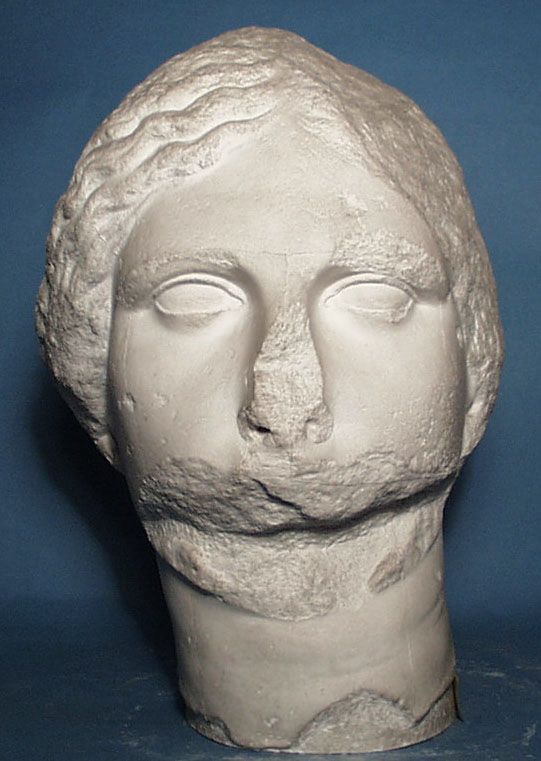
Over life-size female head from Knidos. London
Over life-size female head found in the sanctuary of Demeter at Knidos. Possibly depicts Kore and may have belonged to a statue that formed the pendant to the seated cult statue of Demeter. Ca. 350-330 BC.
Marble
Head
32.5 cm
From Knidos. Found in the Sanctuary of Demeter. Brought to London by C. Newton in 1858.
United Kingdom, London, British Museum, 1314
ca. 350-330 BC
Preservation:The head has broken at the base of the neck. The back of the head has a flat, rough-picked, vertical surface that continues through the neck. The back right side of the head has broken diagonally off; the break slants outward from the top. The portion of the hair framing the left side of the forehead and temple has broken off. The lower portion of the face and most of the nose are missing. The left eyebrow is chipped. There are unfinished surfaces at the backmost extant portion of the neck and the hair on the right side between the temple and the ear is not fully worked.
Description:The head depicts a young female with regular features and long hair that is pulled back off the face. The head turns to the left.
The brow is tall, slants outward from top to bottom, and curves backwards at the sides of the face. The eyebrows are low arches. The eyes are deep-set and long with defined tear ducts. The skin between the eye and the eyebrow (orbital) hangs heavily over the outer corner of the eye. The eyeball is flat and separated from the lids by fine engraved lines. The upper eyelid is a crisply defined fla[ of skin. The lower lid is merely a flat surface. Below the lower the skin indents gently. The nose has a flat broad bridge and ridge. The cheeks are full and seem soft. The neck is modelled and has two closely spaced Venus rings.
The hair is parted in the center of the brow and pulled back over the ears. Only the lower part of the ears was not covered. The central part is high and gives a triangular shape to the hairline over the brow. A drilled groove separates the hair around the right side from the face. The hair itself is impressionistically rendered in long wavy strands separated by irregular by mainly parallel grooves. The deep grooves between the strands are created with a drill and the shallower lines are created by a chisel. The rough surface of the hair contrasts with the smooth soft face.
Discussion:The female head in the British Museum was found at the sanctuary of Demeter at Knidos and was brought to London with other material found there by C. Newton in 1858. Although neither its date nor subject can be securely ascertained, scholars generally place it after the middle of the fourth century BC and suggest that it represented Kore (Persephone).
The date for the statue is based mainly on stylistic grounds. The head features a softness of flesh with a rough illusionistic treatment of hair as well as a high swelling brow and deep set eyes. These details have been related by scholars to the similar details visible in the head of the famous Aphrodite of Knidos by Praxiteles (cat.no. C 172-176). This head also has been compared to the head of the seated statue of Demeter from Knidos (cat.no. B 119). The head has in common with the Demeter the rendering of the hair, eyes, neck, and soft flesh. This latter comparison is certainly very convincing, yet the fourth century date of the Demeter is not entirely secure.
The combination of the over life-size scale, ideal features, and soft feminine beauty almost ensures that the head represented a female divinity. A.H. Smith and C. Blinckenberg thought the head represented Aphrodite. Blinckenberg even suggested that it was a contemporary copy in relief (because of the flatness of the back of the head) of Praxiteles’ Aphrodite of Knidos. Ashmole and Schwarzenberg have suggested that the head might perhaps be better identified as Kore because it was found in the sanctuary of Demeter and a second goddess, presumably Kore. Schwarzenberg stresses the similarities of material, size, and style between this head and that of the seated Demeter statue. Since the Demeter statue was turned and perhaps accompanied by an other statue, Schwarzenberg proposes that the head belonged to Demeter’s pendant, a cult statue of Kore.
The unusual flat, rough-picked back of the head, the lateral breaks and workings, and the unfinished hair near the right ear may reflect ornaments that were added separately and/or the presence of drapery held over the head like a veil.
J. Lenaghan
Bibliography:A.H. Smith,
A Catalogue of Sculpture in the Department of Greek and Roman Antiquities, British Museum II (London 1900) 208, no. 1314
catalogue entry, suggests that head represents AphroditeC. Blinkenberg,
Knidia. Beiträge der Kenntnis der Praxitelischen Aphrodite (Copenhagen 1933) 85-87, 182-187 figs. 31, 67-69
first and fine full description. Interpretation-contemporary relief of the Aphrodite of Knidos by Praxiteles-less convincingB. Ashmole,
"Review. C. Blinckenberg, Knidia. Beiträge zur Kenntnis der Praxitelischen Aphrodite" (JHS 54 1934) 86
suggests head might derive from a statue of PersephoneE. Schwarzenberg,
"Knidische Miscelle" (BJB 169 1969) 98-103, no. 6 figs. 6-9
suggests that head belonged to cult statue of Persephone, pendant to the cult statue of Demeter