Commentary Prepared by Dr. Julia Lenaghan, Ashmolean Museum
B 089
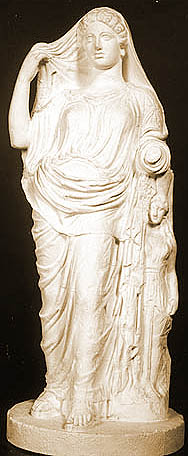
Small-scale statue of Aphrodite from Tarquinia. Berlin
Late fifth century statue or Roman version of a late fifth century statue of Aphrodite resting against a pillar in the form of an archaic idol and reaching toward her veil in the gesture of a wife or bride. Probably deriving in some fashion from an image of Aphrodite Ourania by Pheidias or Alkamenes.
Marble
Small Statue
83 cm
From Tarquinia. Once in the Falzacappa House in Corneto. Purchased in 1857 from E. Gerhard.
Germany, Berlin, Staatliche Museen, Antikesammlung, Sk 586
ca. 430-400 BC or Roman version of late fifth century statue
Preservation:The head has broken through the neck and been reset. Restorations include: the left hand with the phiale; the right hand with part of the mantle; a portion of the left side of the mantle; both feet with a part of the ankles; most of the base; almost the entire face of the support figure; and the left breast and the left forearm of the support figure. There are traces of reworking on the right thigh. [The restored left hand with the phiale have been removed from the Ashmolean Cast.]
Description:The small statue on a mainly modern round plinth depicts a female who rests on a pillar in the shape of a standing woman. Holding her mantle in the gesture of a bride, the figure, endowed with classical features, looks slightly to its right.
The statue stands with its weight over the right leg which is set back. The slightly bent left leg comes forward. The upper body leans to the left. It rests its weight on the left arm which is bent at a 90 degree angle and is braced on a vertical support. The vertical support takes the form of a standing woman. The right arm of the statue pulls the mantle, draped over the head, away from the head-in the gesture of a wife or bride. The right upper arm is lowered and stands away, to the side, from the body at a 45 degree angle. The right forearm is vertical and the hand holds the drapery. The head of the figure looks out and to the right, but is not turned enough so as to be looking at the action of the right hand.
The statue wears two garments. The inner garment or chiton is much broader than the body and extends from the shoulders to the feet; it is visible emerging out under the outer garment near the feet. The inner garment is buttoned together at the shoulders and along the upper arms. On the right shoulder near the neck the buttons fall forward and the neckline, in part adjusting to the position of the buttons, dips twice over the right breast. The garment is belted at the waist. At the sides of the body some of its material is pulled out and over the belt to form a kolpos. The garment features many fine folds that follow the leftward lean of the body.
The second garment or himation is basically thrown over the head and both shoulders and covers the entire back of the body and the lower portion of the front of the body. A portion of the left edge of this second garment is wound around the left arm. It then passes from the left elbow around the back and over the head. The right arm grasps the section of it that falls from the head down behind the right shoulder. It is then is pulled from below the right arm across the body to the left side and pinned near the left arm, from which point the excess material falls vertically downward. As the garment crosses the body its edge is rolled and folded down, forming a loose bunch of material in a U shape at the waist. In comparison to the inner garment, this garment has fewer and thicker folds.
The feet wear thick-soled sandals. There is a notch in the soles between the big and second toes. The sandals consist of two straps that coming from opposite sides of the foot converge just above and between the big and second toes. At the meeting point is a heart-shaped decorative element. These, however, are entirely restoration!
The statue’s head, lightly turned to the right, features hair that appears to be parted in the center and is pulled tidily back from the face. It covers the tops of the ears and frames the face in a smooth arch. It is separated from the face by a shallow fine groove which emphasizes the difference between the smooth face and the thick curly mass of hair. The individual strands are, at best, only impressionistically rendered.
The face is a broad oval. It has flat vertical cheeks that fall harmoniously and almost straight down into a round, non-projecting, chin. The forehead is tall and smooth, and the eyebrows are sharp. The upper eyelid is a thick roll of marble and the lower lid is also prominent. The nose straight, and the mouth is small with shapely lips. The upper has a central dip and the lower lip pouts outwards.
The vertical support under the figure’s left arm takes the form of an archaic statue of a woman. The archaic female stands erect with its left arm at its side. The right arm is not visible. It wears an archaizing dress that is sleeveless, reaches the feet, and is girded at the waist by a thick belt. The upper section of the dress is folded down. The bottom edge of this fold is visible below the belt in the region of the thighs. The edge, hanging in flat folds, extends further at the sides of the body than at the center of the body where it rises. The head of the figure is also archaizing. The hair is parted in the center and pulled back off the face. Two long locks fall, pulled forward from the back, fall down the left shoulder. The face is oval and its arching eyebrows, straight nose, and smiling mouth are almost completely restoration. The figure carries a kalathos on its head.
Discussion:The small Berlin statue almost certainly represents Aphrodite and, though found in Tarquinia and presumably made in Southern Italy, it is based on Attic precedents. Possibly a votive dedication, it is generally thought to be an original work of the fifth century BC, though this is impossible to ascertain.
The statue preserves no attributes so its identification cannot be entirely secure. Nonetheless, the identification rests on solid observations. The young attractive face and the inner garment which slips slightly off the right shoulder are characteristics of Aphrodite. The gesture of pulling the veil around the face is usually interpreted as that of a bride or wife and as such is appropriate for Aphrodite, the goddess of love. Moreover, the idol-like female figure on which the figure rests also presents compelling evidence for the Aphrodite identification. Female herms and idols appear on other statues of Aphrodite and this particular variety may represent an archaic Aphrodite type.
In regard to the date of the statue, the model --particularly its head type and drapery patterns--belong stylistically to the late fifth century. How soon after the creation of the original model the Tarquinia statue was made is difficult to determine. As there are no copies of the type but many related statues, it seems to be a loose version of a model. This might but certainly need not indicate that it was made before Roman precision copying
Although the statue is known in no replicas, it is related to three groups of statues associated with Aphrodite. The original models for all of these groups seem to date to the second half of the fifth century. The first group is best represented by the Brazza Aphrodite in Berlin which is discussed fully in cat. no. B 85. This statue and its variations show an Aphrodite who is dressed in the same way as the small Tarquinia statue in discussion. The Brazza group Aphrodite raises a foot, resting on a tortoise, and the left arm rests on a pillar-like support; the upper body, however, does not lean. The second group is that to which the small Tarquinia statue most closely corresponds. It is best represented by the ‘Leaning Aphrodite’ in Naples. This statue, dressed again in broad chiton and himation, leans its body weight on a pillar under the left arm; the right arm reaches toward the portion of the chiton falling along the right side of the head. In the some versions of the motif, the pillar takes the form of a female herm or female idol. The third group also shows a leaning Aphrodite. Yet the pillar on which she leans rises all the way to the armpit and the legs are crossed.
Scholars have associated two or three literary descriptions with these three extant groups of images based on late fifth century models. The most important association is with Pausanias’ and Plutarch’s description of the chryselephantine cult statue of Aphrodite Ourania at Elis which was made by Pheidias. It is generally accepted that the Brazza Aphrodite (cat. no. B 85) provides a rendition of that Pheidian statue either loosely or exactly. A second passage in Pausanias (1.19.2) describes a statue of Aphrodite in the gardens near the Illisos in Athens. That Aphrodite, made by Alkamanes, rested on a square herm that was inscribed, “Aphrodite Ourania is the oldest of those called the Moirai”. A third passage in Pausanias notes that Pheidias also made a statue of Aphrodite Ourania in Parian marble for a temple near the agora in Athens.
Many scholars have tried variously to label the three groups of Aphrodite statues with the sculptors and places mentioned by Pausanias; some scholars have even labeled entire groups Roman creations dependant on the fifth century models. Regardless of which statue format ought to be associated with Pheidias and which with Alkamenes and which might be Roman, two useful points do emerge. Alkamenes worked with Pheidias and was junior to him; in the late fifth century he may well have adopted a format established by Pheidias at a slightly earlier moment to create a new but similar statue type. Second, part of the iconography of ‘Aphrodite Ourania’ appears to have been the herm on which she rested. There is, therefore, evidence for various original, possibly related, models, in the fifth century BC of Aphrodite statues with pillars or herms that referred to an older aspect of the goddess.
J. Lenaghan
Bibliography:C. Blümel,
Staatliche Museen zu Berlin. Katalog der Sammlung antiker Skulpturen: Katalog der griechischen Skulpturen des fünften und vierten Jahrhunderts v. Chr (Berlin 1928) 7-10 pl. 8, K 6
catalogue entry with full detailsS. Settis,
Chelone. Saggi sull' Afrodite Urania di Fidia (Pisa 1966) 168 and 170, fig.22
discussion of Aphrodite images leaning on female herms and idols which he connects with Pheidias’ Ourania at ElisC. Blümel,
Die klassischen griechischen Skulpturen (Berlin 1966) 98-99, no.117, figs.192-193
repeats verbatim information of previous catalogue with more illustrationsS. Hiller,
"Statuenstützen im fünften Jahrhundert v. Chr" (AntPl (19) 1976) 31-34, pl. 7.3
discussion of fifth century statues of Aphrodite Ourania and their supportsB. S. Ridgway,
Fifth Century Styles in Greek Sculpture (Princeton 1981) 116-117, 127, 193 t
ends to consider the statue an original of just after 420 BC, presents stylistic analysisA. Delivorrias,
"Aphrodite" Lexicon Iconographicum Mythologiae Classicae II (Zurich 1984) 29a
summary discussion of veiled leaning Aphrodite typeStaatliche Museen zu Berlin,
Die Antikensammlung im Pergamonmuseum und in Charlotteburg (Berlin 1992) 141, no. 98
latest museum catalogue entry with bibliography