Commentary Prepared by Dr. Julia Lenaghan, Ashmolean Museum
B 085
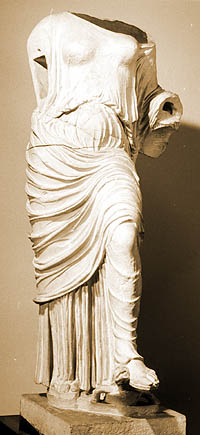
Brazza Aphrodite. Berlin
Late fifth century statue or Roman version of a late fifth century statue of Aphrodite stepping up and probably with a tortoise under foot. Thought to be related in some way to a statue of Aphrodite Ourania made by Phidias and described by Pausanias.
Marble (Pentelic)
Statue
H 1.58 m
Probably from Attica. Allegedly brought from Greece to Rome in the 1700s. In 1820 it was in Palazzo Brazza in Venice. Thereafter it moved to Villa Brazza di Fornazzi at Dolo where it was restored by a Venetian. In 1892 it was bought by the Berlin Museum.
Germany, Berlin, Staatliche Museen, Antikesammlung, SK 1459
ca. 430-410 BC or Roman version of a statue ca. 430-410 BC
Preservation:The statue is missing the head, the throat, the left shoulder, the entire right arm, and the left forearm from the elbow down. The surface is weathered and appears to have been acid washed. The greatest weathering of the surface is visible around the right breast and in front of the left shin bone. A large restored section that ran from the back bottom edge of the himation around the side to the left arm has been taken off. Most of the superfluous restorations have been removed except (1) two fold edges of the himation rendered in marble, which run from the right to the left thigh, (2) the left foot with the tortoise, and (3) the left knee which was restored in plaster. The statue is broken through the middle; on the upper edge of the break a piece of there is a piece of restored drapery.
The right and left forearms were worked separately. The rectangular dowel holes are ancient, though they have been used by the modern restorer who has added a round hole for an iron pin in the right upper arm. The restorer also went over the join surface with a claw chisel. The head was also worked separately and inserted into a socket in which there is now a modern iron dowel. Through the restored tortoise there is a lead pipe which was used for water; now a marble stopper closes this. Around the belt there are three drill holes which were used to attach an object in bronze. Under the left arm is a concave area for the insertion of an object on which the arm rested.
Description:The statue depicts a female who steps up with her left foot onto a small object. The statue stands with its weight over the right leg and the left leg steps upward. The right shoulder appears slightly raised. The left shoulder is lowered and the arm, bent at a 90 degree angle, rests at the side with the forearm perpendicular to the body. The left arm rested on an object that ran from the forearm to the ground.
The statue wears two garments. The inner garment or chiton is much broader than the body and extends from the shoulders to the feet. It is buttoned together at the shoulders and along the upper arms and is belted at the waist. Some of the material is pulled out and over the belt to form a kolpos. The kolpos has a semi-circular shape with its uppermost point at the center of the body. Below the belt and the kolpos, the material hangs in numerous parallel vertical folds around the right leg. Because the left leg pushes through the material the folds follow parallel “U” shaped paths against the lower leg.
One end of the second garment or himation is wrapped around the left arm and the other end falls over the left knee. The himation passes from the left elbow around the back. Its upper border moves from just above the left elbow to the right hip and its lower border moves from the left elbow to the right knee. Thus, when it reappears at the front of the body, it extends from hip to knee. It is then pulled loosely to the left side. The raised left leg pushes the bottom border up over the knee.
The drapery is heavy, copious, and features many folds that carefully are arranged in contrasting series of parallel paths. Yet the drapery also reveals certain anatomical features of the body. For instance, the folds adhere to and define the left lower leg and they also follow the protruding roundness to the central stomach area below the kolpos. Even the navel appears through the material. The widely spaced breasts, though the original surface there is not well preserved, also appear clearly through the material.
The right foot, the only original foot (significantly different from the smaller restored left foot), wears sandals but the straps are not defined. The sole of the foot is square from the large toe to the third toe. At the third toe the sole slants diagonally back.
A few technical details are worth mentioning. On the left side of the left lower leg, below the himation, are about forty small drill holes in one fold groove. On the vertical folds of the chiton, traces of the running drill are visible. The surface lacks a fine finish and polish.
Discussion:The Brazza Aphrodite is known in no replicas but in several related statues and statuettes; in 1966 Settis listed five (two in Cyrene, one from Izmir, one from Dura Europos, and one in the Prado). The statue is generally considered to be an original work of the late fifth century on account of the technical details that appear to Blumel to be of the fifth century. Harrison, however, notes that this is not entirely clear to her (not having seen the statue in person) and that it could also be a Roman copy of a work of the late fifth century.
Scholars are agreed that the statue (or the original of the statue) post dates the sculpture of the Parthenon. Although it has certain similarities to those sculptures, it most resembles the figures of the Erectheion frieze and even the Nike Parapet. One of the figures from the Erectheion frieze (Akropolis Museum 1077) so closely resembles the statue in pose and drapery that it is thought perhaps to be an imitation. Another of the figures (Akropolis Museum 1072) shows a similar handling of the drapery folds.
The statue has evoked interest both because it appears to follow a precedent that was well-known and even imitated in the Erectheion frieze and because the left foot of the statue steps on a tortoise. Pausanias (6.25.1) and Plutarch (Coniugalia Praecepta 32 and De Iside et Osiride 75) both mention a chryselephantine statue of Aphrodite Ourania by Pheidias at Elis which stepped on a tortoise. In the Berlin statue the tortoise appears to be restoration. Yet because it has been greatly worn since it was used as a fountain, it is difficult to ascertain the boundaries of the restoration. Moreover, other Roman period variations of the statue show the left foot on a tortoise. These variations were not, however, published or known to the Venetian restorer of the early 1800s. Finally, as Blumel points out, the tortoise fits the composition perfectly. Thus, Settis believes that the restorer, without any possible knowledge of other variations and probably with no knowledge of the ancient texts, must have created the tortoise on the basis of some extant remains which he may even have entirely replaced.
The Brazza Aphrodite cannot itself be the statue which Pausanias saw at Elis. Yet, according to Pausanias (1.14.7), Pheidias did another statue of Aphrodite in Parian marble which was erected in the Sanctuary of Aphrodite Ourania in Athens. Thus, a few scholars, assuming the two Pheidian statues would have been generally similar, have attempted to identify the Brazza Aphrodite which is in pentelic marble with this statue. They dismiss Pausanias’ note that the Pheidian statue was Parian marble by pointing out that Pausanias did not always correctly recognize marbles. Or Becatti attempted to explain the problem by suggesting that the missing limbs of the Brazza statue were of Parian marble. Settis and Harrison, however, have suggested that Pausanias’ attribution of this statue to Pheidias may be incorrect. The interest in the part of the Agora did not occur until the 420s when Pheidias was in exile and the mention of Parian marble brings to mind Agorakritos, the pupil of Pheidias.
Blumel and Settis would prefer to see the Brazza Aphrodite as merely related to the securely Pheidian chryselephantine Aphrodite Ourania by Pheidias at Elis. The link that connects these two statues of Aphrodite in the eyes of these scholars is the tortoise. Harrison agrees with both of these authors but argues the connection without using the tortoise since the tortoise is restoration. She points out that pose of this statue is an anodos pose; that is, the figure is stepping up. Furthermore, according to Settis, the epithet Ourania in the fifth century might refer to the Hesiodic legend that Aphrodite was born from sea foam of the severed member of Ouranos. Pausanias (5.11.8) says that the birth of Aphrodite on the base of Pheidias’ statue of Zeus at Olympia showed her coming out of the sea. Thus, even without the tortoise but with another similarly sized object, the rising position of the statue is appropriate for a Pheidian statue of Aphrodite Ourania.
Harrison further points out that the use of a pillar-like support under the left arm was a device used by Pheidias in the Athena Parthenos and adopted by his pupil Alkamenes in his statue of Aphrodite in the Gardens. Therefore, even this motif of the Brazza statue might be traceable to a Pheidian prototype.
Finally if one were to except the tortoise as an original element of the Brazza statue, this too would be fitting for a statue of an Aphrodite born from the sea. The tortoise, both because it crawls out of water on to land, and because it retreats into itself and reappears, is an appropriate symbol for a goddess that emerges.
Neither Settis nor Harrison intend to connect the Brazza statue strictly with the Pheidian work. They view it rather as a statue (or a copy of a statue) of the late fifth century by an artist who knew the Parthenon sculpture and the work of Pheidias. The Brazza Aphrodite, they believe, is probably loosely based on the famous statue of Pheidias.
Bibliography:C. Blümel,
Staatliche Museen zu Berlin. Katalog der Sammlung antiker Skulpturen: Katalog der griechischen Skulpturen des fünften und vierten Jahrhunderts v. Chr (Berlin 1928) pp.5-7 pls.6-7 K5
catalogue entryC. Blümel,
Die klassischen griechischen Skulpturen (Berlin 1966) pp.91-93 no.109 figs.161-169
repeats verbatim information of previous catalogue with more illustrationsS. Settis,
Chelone. Saggi sull' Afrodite Urania di Fidia (Pisa 1966) pp.9-23 fig.1
considers the statue to be tightly connected to the Aphrodite Ourania of PheidiasA. Delivorrias,
"Aphrodite" Lexicon Iconographicum Mythologiae Classicae II (Zurich 1984) p.28 no.177
summary of the research with bibliographyE. Harrison,
"A Pheidian Head of Aphrodite Ourania" (Hesp 53 1984) pp.382-387
dates the statue or if it is a copy the original from which it was made to the end of the fifth centuy, believes that it derives in some way from Pheidias’ Aphrodite Ourania in ElisStaatliche Museen zu Berlin,
Die Antikensammlung im Pergamonmuseum und in Charlotteburg (Berlin 1992) 139-140, no. 47
latest category entry with bibliography