Commentary Prepared by Dr. Julia Lenaghan, Ashmolean Museum
B 083
Sphinx. Aegina
Marble (Parian)
Statue
H 97.2 cm without plinth, 1.066 m with plinth
From Aigina. Found in 1904 among the rubble of a Byzantine house in front of the northeast corner of the Temple of Apollo
Greece, Aigina, Museum, 1383
ca. 460-450 BC
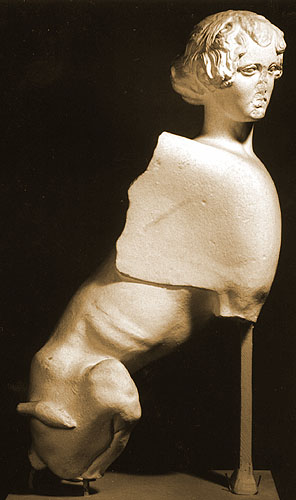
Preservation:The statue is missing the front right leg between the haunch and the paw, the left front leg from just above the knee down (including the paw), both back paws, a large section of the tail, the end part of the wing that extends off the body, the nose, the lips, and the front surface of the chin. The head has broken off the body at the neck but has been reset. The central clump of hair over the brow is abraded.
Description:The sphinx is shown crouching on its back legs with its head turned 45 degrees to the right. The lean dog-like body of the sphinx is supported by the fully extended erect front legs and the folded back legs. The upper portion of the back legs is thicker than the spindly lower legs. Both, however, appear sinuous and strong. On account of the position of the legs, the body rises from back to front. Yet, the posterior does not rest on the ground; it rather hovers a few centimeters above ground level.
The animal features a tail and wings. The tail begins directly between the back legs. It rises, resting on the back of the body, and curls. The end portion of it, parallel to the ground, is visible on the outer side of the upper part of the crouched back right leg. The wings are attached to the front haunches from which they extend backwards. They incline slightly upwards as they move back.
The head, unlike that of other sphinxes, neither faces directly forward nor turns 90 in order to face over the right shoulder. It instead turns only partially to the right. Therefore, whether this sphinx is viewed from the front or from the right, the head is always at an angle. The hair and face give the head an entirely human aspect.
The hair is cut short around the face and the longer head at the back of the head is tied up. The short hair over the brow is rendered in short uncontrolled wavy locks that are made up of individual strands. The hair directly over the brow has two symmetrical partings above the center of each eye. The lock of hair on the outer side of each parting falls and turns to the outside. The hair on the inner side of the part turns inwards. Thus, there is a “U” shaped tongue of hair that hangs down at the center of the brow. Between the part and the ear on each side the tousled locks pile on top of each other and acquire considerable volume. These locks extend downward in front of the ear until they are level with the ear lobe. The ear itself remains uncovered. Behind the ears and the short front bangs, the hair is brushed backwards. It is long and at the hairline it is rolled up over itself and somehow tied. This creates a bun at the back of the head.
The face is oval in shape. It has a tall brow and smooth cheeks that form a “U” with the chin. The eyebrows slope downwards and the arched upper eye lid virtually touches the eyebrow. The right eye has a slightly different shape and is less carefully rendered than the left. Both, however, feature upper lids that arch more fully than the lower lid and downward pointing inner tear ducts. The nose is short and the the mouth is small. The chin is small but relatively broad and smoothly completes the line of the cheeks.
Discussion:Because it is an early fifth century original with a provenance, this Sphinx has had a key role in the discussion of other early fifth century works that exist only in Roman copies. More recently, discussion concerning the statue has focused more on its place in the development and use of this animal in Greek art.
The Sphinx, especially its head, has been traditionally compared to the sculpture from the East Pediment of Olympia and the “Omphalos Apollo”. The head of the latter type is considered by many (Furtwangler, Dorig, Vierneisel-Shlorb) to be very similar and to be from the same workshop. The short tousled locks over the brow that fall without any pattern on a smooth forehead, the shape of the cheeks and chin, and the faraway removed look are usually noted as the major resemblances. In fact at one point, the “Omphalos Apollo” was considered to be a work of the Aiginetan sculptor Onatas because it so resembled the Sphinx which was from Aigina and consequently thought by some to be by Onatas of Aigina.
The tight connection of the Sphinx to the “Omphalos Apollo” has also met with some resistance (Ridgway and Walter-Karydi). Ridgway notes the differences in the eyes and the “impressiontic” aspect of the hair. Vierniesel-Schlorb is perhaps correct in pointing out that these differences may be in part due to the two different media of the originals. One could continue the thought also by pointing out the difference in function of the two originals. The Apollo statue was clearly an expensive and important work; the less carefully rendered sphinx from Aigina was a votive offering in marble.
In summary, there is a certain relationship between the two works. Yet it is probably best not to exaggerate the tightness of this relationship. The similarities are likely attributable to trends of that chronological period and undoubtedly important works like the “Omphalos Apollo” influenced other artists. Thus, the Sphinx should be dated about 460-450 BC and considered a good quality votive.
Sphinxes were popular in the sixth century on grave monuments. They were used also until about 480 BC as akroteria. Furtwangler suggested that this sphinx, found in front of the corner of the Temple of Apollo, was actually an akroterion. The turn of the head, which would be odd for an akroterion, and examples of sphinxes as votives have convinced recent scholars that this monument was probably a votive in front of the temple.
This sphinx differs from its Archaic predecessors in a number of ways. The three-quarter view of the head differs from the typical 90 degree turn of the head or the less common but still attestable forward position of the head. The wings also are naturalistic and would not have turned upward in a sickle shape. Finally, the body does not sit on its back legs but rather hovers, crouching, above the ground.
Ridgway has called this sphinx from Aigina “the last successful sphinx”. She points out that as time passed sphinxes became more humanized. Although this sphinx shows a “humanizing” tendency in the rendering of its head, the body is still entirely animal-like. Later even the body of sphinxes became more human since somehow the attachment of a human head on to an animal body was disarming. Walter-Karydi also considers this sphinx as an end point, but in a different manner. She notes the popularity of the sphinx in general declines after the mid-fifth century and as a concept it apparently loses some of its power. Thus, the Aigina sphinx is one of the last examples of the archaic concept of a powerful sphinx.
Bibliography:A. Furtwängler,
"Die Sphinx von Aegina" (MuJb 1 1906) pp.1-10
first publication, dates it ca.460 and compares it to the "Omphalos Apollo" and the Olympia pedimentsB. S. Ridgway,
The Severe Style in Greek Sculpture (Princeton 1970) pp.35-36 and 64
calls it the "last successful sphinx of the fifth century", notes it as an example of the "humanizing" trend, sees no relationship to the "Omphalos Apollo"J. Dorig,
Onatas of Aegina (Leiden 1977) pp.7, 29
notes that Sphinx is from Aigina does not mean that it is by Onatas, acknowledges relationship to Olympia pediment figures and "Omphalos Apollo"B. Vierneisel-Schlörb,
Katalog der Skulpturen Band II: Klassische Skulpturen des 5 und 4 Jahrhunderts v. Chr. (Munich 1979) p.10
believes that it is related to the workshop that produced the "Omphalos Apollo" and is probably a decade earlierE. Walter-Karydi,
Alt-Ägina II,2. Die Äginetische Bildhauerschule (Mainz am Rhein 1987) pp.80 no.52 and 118-120 pls.35, 38-40
catalogue entry, focuses on the unusual representation of the sphinx, does not believe the that it is related to the "Omphalos Apollo"