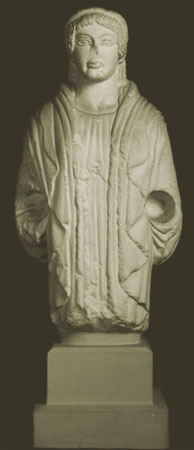
Fragmentary statuette of a woman.
Commentary Prepared by Dr. Julia Lenaghan, Ashmolean Museum
B 081
Propylaia Kore. Athens Acropolis
Marble (said to be Pentelic)
Statuette
H 51.5 cm
From Athens. The body was found in 1889 in the Propylaia and the head, certainly known in 1885, was probably found in 1882 during Stamatakis’ excavations of the Propylaia.
Greece, Athens, Akropolis Museum, 688
Preservation:The statue is preserved from the top of the head to the upper thighs. The head was found separately and has been reset in the modern era. The statue is missing the nose and both forearms. The forearms were worked separately from the statue and added later. In the right arm there are two dowel holes visible. The chin is badly chipped and the stephane is abraded. There had been traces of red in the hair and black in the eyes.
Description:The statue depicts a long haired woman who wears a stephane, a shawl-like garment (an epiblema), and a long garment with an apoptygma and a kolpos. The shawl-like is a rectangular piece of material; it is draped over the shoulders. In the back it reaches to the small of the back and in the front to just below the hips. Its lateral edges are folded back off the arms and lie neatly stacked in folds on the shoulders. The edge of the outermost folds on both sides follows a zig zag pattern from the breasts down. Below the shawl is the longer garment which has an apoptygma (over-fall) that reaches just under the breasts. The apoptygma’s bottom edge, visible between the two lateral sides of the shawl, is rendered in flattened omega folds that rise at the center of the body. The rest of the inner garment hangs down in vertical folds. At the hips, visible on the sides of the body, is a kolpos (an inward and upward fold of material which has been pulled out over a belt) that indicates a belt, probably around the waist.
The body faces forward. Both upper arms remain tightly pressed to the sides. Both forearms would have projected at a right angle to the upper arms and the body.
The head also faces directly forward. The natural indentation at the base of the neck where the various muscles and clavicle meet is perfectly central. The hair over the brow, shown in thick wavy locks, features a central part. From the part the hair is combed to the sides. It falls downwards at the temples and is looped upward in front of the ears so that the ears remain uncovered. Between the ears is a stephane. Behind the stephane the hair originating at the crown falls naturally to all sides. At the back of the head it falls straight down and disappears under the collar created by the shawl-like garment.
The face is long and blocky. The brow is not tall and the cheek bones are wide set. The eyebrows form high symmetrical arches that project. There is a tall flat space between the eyebrow and the upper lid. Whereas upper lid follows an arch parallel to that of the eyebrow, the lower lid is almost horizontal. The cheeks are smooth and large. The mouth with its projecting lips is tightly tucked into these cheeks. Both lips are full and the upper lip has a pronounced central overhang. Below the lower lip is a significant indentation before the marked diagonal projection of the chin which is broad and rounded.
Discussion:Most of the attention that the kore has received focuses on its stylistic elements. The kore seems to show features that connect it to the later “Severe” style rather than the older “Archaic” style. Although in genre and format the kore relates to the Archaic period, that is the “Propylaia Kore” remains a frontal female figure like archaic korai, it differs in a number of ways. It features centrally parted naturally flowing hair rather than horizontal bands of hair over the brow. It shows the face as a smooth single entity rather than an unified surface disrupted by the round protrusions of the cheek bones and cheeks. The lips are no longer raised in a frozen smile. The hair is pulled entirely back; no loose locks fall on the front of the shoulders. Finally the clothing is used as broad simple surfaces with a volume and a consistency of its own. It, therefore, conceals rather than reveals the body below it. Ridgway uses a comparison to the Kore of Euthydikos to illustrate these points.
The body and presumably the head of the “Propylaia” kore were found in the foundations of the Propylaia which date to 438 BC. On account of the stylistic elements, mentioned above, the kore is usually considered to belong to the “Severe” period and is dated after 480 BC and the Persian invasion. It is, therefore, assumed that it was taken down and used in the foundations of the Propylaia during the Periklean clean up of the Akropolis.
A detail that has not been given proper attention is the clothing worn by the statuette. Richter speaks of an epiblema (shawl) and a chiton. Yet, a chiton generally does not have an overfall. Dickins speaks of a himation and an ionic peplos. One generally, however, expects a himation to be a larger garment than the small shawl. Brouskari calls the clothing a himation with an ionic chiton that functions as a doric peplos. One should note that almost all of these terms are modern conventions. It is perhaps more prudent and useful to note that the statue wears a small heavy garment draped over the shoulders and a long inner garment. The long inner garment features an apoptygma (overfold), a kolpos (blousing over a belt), and sleeves that have no buttons nor any obvious seams.
Bibliography:G. Dickins,
Catalogue of the Acropolis Museum I: Archaic Sculpture (Cambridge 1912) pp.246-247
full catalogue entry with the information that is repeated by later scholarsG.M.A. Richter,
Korai: Archaic Greek Maidens (London 1968) pp.102-103 no.184 figs.587-590
brief catalogue entry, considers statuette an example of the transition from Archaic to Early ClassicalB. S. Ridgway,
The Severe Style in Greek Sculpture (Princeton 1970) pp.31, 34-35 fig.46
example of early Classical or Severe Style as opposed to ArchaicM. Brouskari,
The Acropolis Museum (Athens 1974) p.128 no.688 figs.244-245
summarizes previous research