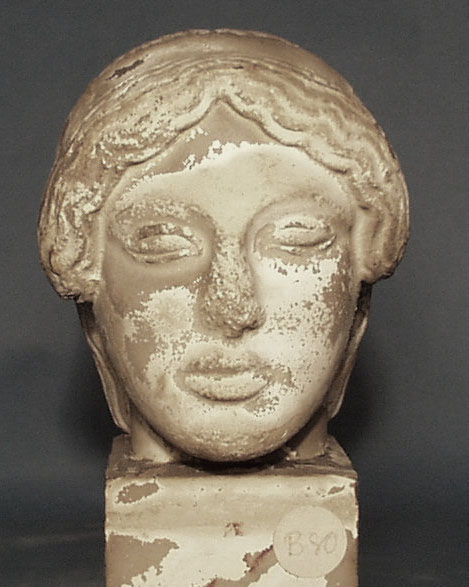
Female head.
Commentary Prepared by Dr. Julia Lenaghan, Ashmolean Museum
B 080
Female Head of a Statuette Probably from Selinus
Marble (probably Parian)
Statuette
10.3 cm
Alledgedly from Selinus in Sicily. Said to have been found on 20 April 1896 near the Propylaia of the Sanctuary of Demeter Malophoros. Acquired on the art market in that same year.
Germany, Berlin, Staatliche Museen, Antikesammlung, SK 1474
Preservation:The head is broken through the neck and the hair at the back of the neck. On the right side a piece of the neck and the hair at the back have been restored in plaster. Most of the nose has broken off and the eyebrows are lightly abraded. The entire face is covered with root marks.
Description:The small head depicts a young female with long hair held in place by a broad flat band. The hair, rendered in broad locks that are delineated by thick wavy engraved lines, falls naturally to all sides from the crown. A band or fillet, running all the way around the head and passing behind the upper part of the ear lobe, sits on top of the hair. It is knotted at the center of the back of the head. Behind the ears and below the band the hair continues down the nape of the neck. At the front of the head in front of the band, the hair has a central part that forms a high peak on the brow. The hair around the central part falls to the sides. When it reaches the ears or just below the ears it is pulled back and if needs be up. The ears remain uncovered by the hair.
The face has an oval shape with a high brow and high arching eyebrows that project. The left eyebrow is higher than the right. The eyes are long and narrow. The upper lid, whose arch follows that of the eyebrow, is heavy. The lower lid, beginning at the inner corner, rises before it arches downward. This creates a distinct corner tear duct. Below the eyes the cheeks are given special roundness. The mouth is tucked into the cheeks and is shorter on the left side than on the right. The groove dividing the lips rises at the corners and slants down into the center to give the upper lip a central overhang. The lower lip splays outward and its outer edge follows a smooth arc of a circle. The chin is rounded and projects solidly forward.
At the center of the bottom break surface is a dowel hole which suggests the head was worked separately or repaired in antiquity. There is also a hole at the top of the head, perhaps for an additional element such as a meniskos.
Discussion:The head, bought from an art dealer, was said to have been found on the 20th of April 1896 in the Propylaia of the Sanctuary of Demeter Malophoros in Selinunte. In 1927 Gabrici, privy to some other information, was convinced that the head came from the sanctuary.
The head certainly resembles another small head from the Sanctuary of Demeter Malophoros (Gabrici plate 24 figs.4-4a) and particularly recalls the sculpture from the metopes of Temple E (the Heraion) at Selinunte. For instance, the hairstyle and rendering of the hair resemble especially the female head numbered 3925 (no.19 in Marconi) and the mouth and nose are like those of the head numbered 3883 (no.15 in Marconi). The head cannot, however, come from the metopes because it is too small and is fully rendered in the round. In addition, the sculpted metopes, dated about 460-450 BC, appear slightly more advanced in style than the small head in Berlin which is consequently generally placed a decade or so earlier.
Marconi suggests that the head may have belonged to one of the three female statuettes found in the Sanctuary of Demeter some of which seem to have belonged to a pedimental group. Given the asymmetrical nature of the face (the eyebrows, mouth, and even cheek) Blumel believed that the head was turned to the left and could not belong to a frontal kore type figure. This would make the head yet more appropriate for the active small marble peplophoroii from the architectural decoration.
In conclusion, the head is likely to be Sicilian and may well come from the Sanctuary of Demeter in Selinunte. It is inarguably early classical.
Bibliography:R. Kekule von Stradonitz,
"Archaischer Frauenkopf aus Sicilien" Festschrift fur Otto Benndorf zu seinem 60 Geburtstage (Vienna 1898) pp.121-125
first full publicationE. Gabrici,
"Il santuario della Malophoros a Selinunte" (MonAnt 32 1927) p.167
resembles head from sanctuary of Demeter Malophoros and metope sculpture from Temple E at SelinusC. Blümel,
Staatliche Museen zu Berlin. Katalog der Sammlung antiker Skulpturen V: Römischen Kopien griechischer Skulpturen des IV Jahrhunderts vor Chr. (Berlin 1938) p.37 pl.77 K 254
catalogue entryV. Tusa,
La scultura in pietra di Selinunte (Palermo 1983) p.188 especially footnote 13
dubious of the information about the provenance, considers older than the metopes of Temple E and certainly not from Temple EC. Marconi,
Selinunte: Le metope dell' Heraion (Modena 1994) p.215 fig.91
compares it to heads of Temple E and suggests that belongs with one of the peplophoroi statuettes from the sanctuary of Demeter