Commentary Prepared by Dr. Julia Lenaghan, Ashmolean Museum
B 077
Statuette (Depicting Neanias?) Dedicated by Lysikleides at Rhamnous. Athens
Marble
Statuette
88 cm, base an additional 98 cm
From Rhamnous. The statuette was found together with its tall inscribed base (98 cm) in the cella of the smaller temple at Rhamnous. Also found there were a colossal statue of Themis and a statue for a priestess named Aristonoe.
Greece, Athens, National Museum, 199
Preservation:The statuette is completely preserved from the plinth to the crown of the head. Both hands are missing from above the wrists and the front surface of the right knee is chipped.
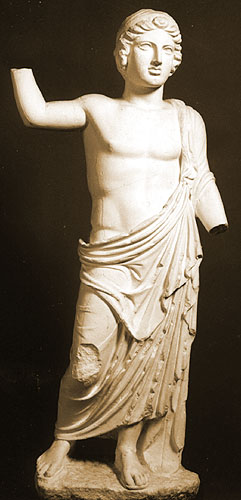
Description:The statue depicts a male who wears a single garment (himation) draped around his lower body. One end of the garment starts in front of the left armpit. The rest of the garment is pulled up and over the left shoulder. The outer portion of the material slides off the shoulder and covers the upper arm. This material, forming a sleeve around the upper arm, is tucked momentarily between the back of the arm and the body. After that tuck it falls down to the feet. The material piled on the inner side of the shoulder passes diagonally down the back to the right hip. It spills all the way down to the ankles. At the right hip the garment once again comes to the front of the body. The body hem remains in the neighborhood of the ankles. The upper part of the garment is bunched together and pulled from the right hip up to and then under the left elbow. As the bunched upper roll crosses the body, a corner and the adjacent material fall down over the rest of the garment. The corner itself lies between the legs at almost the height of the knee. Along the left side of the body the meeting of the two edges of the material is visible from the elbow down. That is, the edge that has just been pulled across the body meets the edge that having wrapped around the left arm fell straight down to the feet.
This garment leaves the torso essentially naked. The flesh is modelled but the muscles and bones are not articulated in detail. The lower shin of the left leg as well as the feet are also exposed. Beneath the feet are the soles of sandal. Yet no straps are rendered.
The body stands with its weight on the left leg. The right leg is bent and the foot turns to the right. The heel appears raised. The right upper arm is raised and remains in line with the shoulders. It extends directly to the right. The right forearm is also raised and forms a slightly greater than ninety degree angle with the upper arm. The left arm is lowered and the upper arm remains by the side. The forearm pulls slightly away from the body and comes forward.
The head turns to the right and tilts downward. The hair, which frames the face and covers the ears, is summarily worked. It has a flat fillet that runs around the head above the ears. From the crown to the fillet is a central part from which radiate crudely rendered and widely spaced diagonal slashes designed to delineate locks of hair. In front of the fillet the hair borders the face from below ear to below the other. Rendered in chunky locks, it is combed backward. Over the center of the brow between two locks which are combed away from the face is an oval area of hair which appears to be two locks perhaps knotted together.
The face has basically an oval shape. It is broad at the cheek bones but the cheeks slope back and the chin is narrow. The eyes are oval and the upper lid has a greater arch than the eyebrow. This means that the upper lid virtually touches the eyebrow. The nose is fine and the mouth is small. The pouting lower lip is fuller than the upper lip.
Discussion:The statuette rests on an inscribed base whose height attempts to ensure that it will be seen. The inscription (IG I2 828) of the base reads:
????????
??s????
???????
????????
??s??
?H?????
????????
????
????????’??
??????????s
Lysikleides, son of Epandrides, set this up as an offering to the goddess who rules this sanctuary.
The base provides us with the name of the dedicator and the knowledge that it was set up to a goddess. The statuette was found with a larger statue of Themis in the smaller of the two adjacent temples at Rhamnous. This temple, just as the larger temple, is to be associated with Nemesis and thus, the goddess mentioned in the inscription on the base of the statuette is probably Nemesis.
The letter forms of the inscription provide a chronological indicator; they appear to date to the second half of the fifth century. The statue itself suggests a similar date. It resembles the figures in relief on the base of the statue of Nemesis at Rhamnous (dated ca. 430-420 BC). Also the corner overfall that reaches between the legs follows a pattern set by the “Kore Albani” type and visible also in such statues as the “Dresden Zeus” and the “Hera Borghese”. Harrison who has studied this stylistic element notes that the overfall of the Lysikleides’ statuette has a smooth part that clings to inside of the right leg and fan folds on the left side. This, she points out, most closely resembles the “Hera Borghese” type and seems to come slightly after the “Dresden Zeus” which she dates at 420 BC.
The subject of the statue has received attention recently in conjunction with the discussion of the base of the statue of Nemesis at Rhamnous made by Agorakritos, a pupil of Pheidias. Pausanias (1.33.8) describes the scene on the base and notes that it included two brothers Epochos and Neanias. The latter of these was a Marathonian hero and may have been an Archegetes (founder) of Rhamnous. Both the brothers have recently been identified by Petrachos among the figures of the base. Neanias is depicted by either figure 1 or figure 14. Figure 14 wears a himation in an exactly the same manner as the statuette dedicated by Lysikleides. In addition, the statuette of Lysikleides features a hairstyle, with long knotted longs over the brow, that indicates youth. He has yet to cut his hair and dedicate it to the gods.
Thus, three facts emerge that have caused Despinis (cited by Petrachos) and Petrachos to identify the statuette as Neanias. First, Neanias seems to have been a local hero at Rhamnous. Second, Neanias was depicted on the base of the statue of Nemesis and this depiction (whether figure 1 or figure 4) resembles that of the statuette. Three, the statuette dedicated by Lysikleides expresses youth which would be suitable for Neanias whose name, in fact, means youth. One expects that there was no need to name the figure in the inscription on the base of the statuette because he would have been readily recognizable to the people at Rhamnous.
Bibliography:V. Stais,
"Agalma ex Ramnountos" (ArchEphem 1891) p.55 pl.6
first publicationV. Petrakos,
"Problemata tes Bases tou agalmatos tes Nemeseos" Archaische und klassische griechische Plastik (Mainz am Rhein 1896) p.95 footnote 16 and p.107
suggests statuette represents local hero NeaniasV. Stais,
Marbres et Bronzes du Musee National I (Athens 1907) p.51 no.199
catalogue entryE. Harrison,
"A Classical Maiden from the Athenian Agora" Studies in Athenian Architecture, Sculpture, and Topography Presented to Homer A. Thompson: Hesperia Supplement 20 (Princeton 1982) p.47 pl.7d
discussion of the development of the triangular overfallV. Petrakos,
Ramnous (Athens 1991) p.24 fig.15
illustrates find spot and gives important details of statuette(D. Tsiafaki),
"Neanias" Lexicon Iconographicum Mythologiae Classicae VIII (Zurich 1997) p.870 no.4
cites statuette as possibly representing Neanias, with most recent bibliography