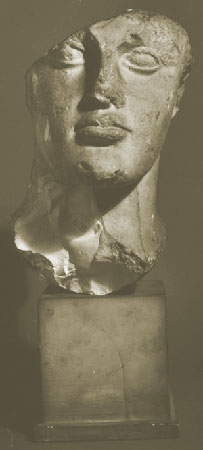
Head of youth.
Commentary Prepared by Dr. Julia Lenaghan, Ashmolean Museum
B 075
Head of a Youth (Associated with Selinunte). Hannover
Marble
Head
24 cm
Bought in Italy between 1817 and 1853. Probably from Selinus (Sicily).
Germany, Hannover, Kestner Museum
Preservation:The head was worked separately and inserted into a statue. There are chips around the edges of the insertion plug, especially at the front. The upper portion of the head has broken off. The break surface slants from the upper part of the right ear upwards to the area above the left ear. The upper part of the right ear and the top of the nose are missing. The left ear lobe, the left eyebrow, and the upper lip are badly chipped.
Description:The head depicts a beardless male with long hair and a flat fillet. The hair and fillet are preserved only behind the ears. At the back of the head and at a level above the ears is the fillet. Below the fillet the hair, rendered by engraved lines, falls in wavy strands. Where the curve of the skull meets the neck, the hair projects in a ledge. The hair on the nape is combed upward toward and into this ledge. Behind the left ear the hair, combed upward, is delineated in short locks with volume and behind the right ear the strands are summarily engraved.
The face has full cheeks that taper to a prominent chin. The right cheek has a different shape than the left; it is less taut. The brow appears to have been smooth with symmetrical arched eyebrows. The eyes are wide. The upper and lower lids have approximately the same width. The mouth is tucked into the cheeks and the splayed lips project forward. The lower lip is rounded and its outer line is only slightly curved. The outer line of the upper lip rises at the center. There is a marked indentation between the mouth and the chin that juts forward.
The head was turned to the right and tilted downwards. The muscle on the left side of the neck is stretched and raised. The line of intersection between the cheek and the neck that runs downwards from the ear is more pronounced on the right side. The hair behind the left ear is more carefully worked and the left cheek is slimmer.
Discussion:In 1920 Amelung wrote an article on the Hannover head. It has received little attention since that time. The Hannover head unquestionably resembles heads from the metopes of the Temple of Hera at Selinus which was built in the 480s BC. Furtwangler had even suggested that the Hannover head also came from the metopes. Amelung convincingly shows that the head might well have been purchased by Kestner in Selinunte. Kestner, who was an ambassador in Italy between 1817 and 1853, made a trip in 1824 to Selinunte where sculptural fragments had first come to light in 1822. Given these corroborating dates, Kestner’s interest in the sculpture, and the Hannover’s head blatant resemblance to the metope heads, Amelung believed that there was little doubt as to the head’s provenance. He did point out, however, that there was a difference in the quality of the head and that on the metopes only the female heads were made in marble and even then not the whole but just the front mask. Thus, he concluded that the head came from the same workshop as the metopes but not necessarily from the metopes (R. Holloway incorrectly summarizes Amelung’s opinion in his footnote). In the most recent publications of the metopes from Selinus, the head is not given great attention. Tusa remains doubtful that Kestner even acquired the head in Selinunte since his diary does not indicate that he did. Thus, both he and Marconi accept that the head belongs to the same period and perhaps same region but believe that no closer relationship can be ascertained.
The “Este Athlete” in Vienna is certainly related to the Hannover head; the two share the same unusual hairstyle. Amelung, who thought that they were both Greek originals, believed that they must have come from the same Sicilian workship. Lippold proposed that the Vienna head was a copy of the Hannover head. Since the Vienna head is not, however, strictly speaking a copy, Zanker proposes that either both the Hannover and Vienna head, though chronologically disparate, rely on the same or a similar model which in fact must have been much like the Hannover head.
Bibliography:W. Amelung,
"Archaischer Junglingskopf in Hannover" (JdI 35 1920) pp.49-59
believes the head to have been made in the same workshop that produced the metopes for the Temple of Hera at SelinusP. Zanker,
Klassizistische Statuen (Mainz 1974) pp.59-60
believes the head to be an original of 460 BCR. Holloway,
Influences and Styles in the Late Archaic and Early Classical Greek Sculpture of Sicily and Magna Grecia (Louvain 1975) p.24 fig.144
notes head in a discussion of the metopes from SelinusV. Tusa,
La scultura in pietra di Selinunte (Palermo 1983) p.188
notes that cannot come from Temple E and expresses doubt about the alleged provenanceC. Marconi,
Selinunte: Le metope dell' Heraion (Modena 1994) p.219 fig.100
similar to the metopes but not directly connected