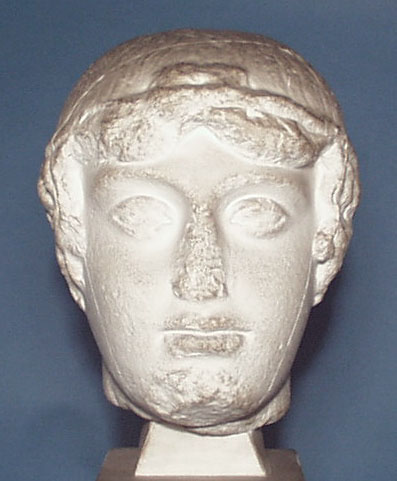
Head of boy.
Commentary Prepared by Dr. Julia Lenaghan, Ashmolean Museum
B 074
Head of Boy. Dresden
Marble
Head
15.5 cm
Bought in 1885 from the Dressel Collection in Berlin.
Germany, Dresden, Albertinum und Staatliche Kunstsammlungen, Skulpturensammlung, ZV 477
Preservation:The head is broken through the neck. The nose, the lower portion of the chin, a section of hair over the brow, and the ends of the locks in front of the ears have broken off. The left eyebrow and the right eye are abraded
Description:The head depicts a young male with long carefully tied hair and a diadem which runs around the head just above the ears. Above the diadem the hair clings to the skull and wavy strands are delineated by engraved lines. Below the diadem and behind the ears, the hair is gathered into a braid which begins at the base of the neck. Thus, the hair directly behind each ear is pulled in a large tress toward the center of the nape. Below the diadem and in front of the ear the hair falls in medium length locks. Between the ear and the temples four loosely curling locks fall to the middle of the cheek. The hair in front of each temple is pulled across the brow and the ends of this hair are knotted together over the center of the brow.
The face has an oval shape. The brow is low, the cheeks are full, and the chin is broad. The eyebrows arch. Below them are large round eyes with a heavy upper lid. Beneath the lower lid the roundness of the eyeball is articulated. The nose has a fine ridge and is neither long nor short. The mouth is also average in breadth. It features a thin upper lip over a full but shorter lower lip.
The head appears to have been turned to the left. The entire right side, for instance, the ears and the locks between the ears and the temples, are more carefully worked, on the right side. This suggests that the right side was to have been the principal viewing angle.
Discussion:The head has been most thoroughly discussed by Amelung in 1920. Amelung, noted that the unusual hairstyle of the head was repeated in two other heads, the Hannover head (cat. B 75) and the head of the “Este Athlete” in Vienna (cat. C 11). He was sure that the Hannover head was from the same workshop that produced the metopes of the Heraion at Selinunte (Sicily) and he saw similarities between the Dresden head and the heads from the metopes (for example, the structure of the face, the crown of the head, the eyes, and brow). He, moreover, insisted that the Dresden head was not of Parian marble. Thus, he concluded that the Dresden head was an example of Sicilian art of the early fifth century.
More recently, Zanker and Hermann in the Dresden catalogue (no doubt in light of Zanker’s remarks) have decided that the Dresden head is actually a Roman, probably Antonine, work that copies an original of the early Classical period. Zanker disassociates it with the Hannover and “Este Athlete” because its hair is different. In his opinion, however, details such as the eyes and mouth are taken exactly from the original.
Bibliography:W. Amelung,
"Archaischer Junglingskopf in Hannover" (JdI 35 1920) pp.51-52, 55
associates a head in Vienna and a head in Hannover with this head, considers them all to be examples of a Sicilian workshopP. Zanker,
Klassizistische Statuen (Mainz 1974) pp.59-60
believes the head to be an Antonine copy of an early Classical original(H. Protzmann),
Die Antiken im Albertinum: Staatliche Kunstsammlungen Dresden, Skupturensammlung (Mainz am Rhein 1993) p.15 no.1
Roman copy of a Greek original dated ca. 470- 460 BC