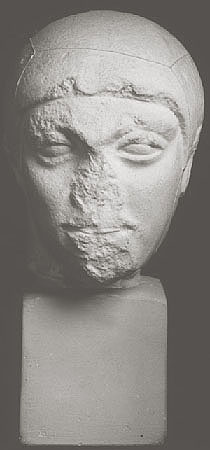
Head of a youth (?dying).
Commentary Prepared by Dr. Julia Lenaghan, Ashmolean Museum
B 073
Head of a Youth (Dying?) from a Temple at Aigina. Athens
Marble
Head
18 cm
From Aigina. Found in 1920 in the area of the Temple of Apollo (near Cape Colonna). In older scholarship, the head is often confusingly referred to as coming from the Temple of Aphrodite.
Greece, Athens, National Museum, 3459
Preservation:The head is broken through the neck and the lower part of the chin. The break runs diagonally upward from the right to the left. The nose is missing and the prominent features of the face are badly damaged. The eyebrows, the lips, the chin, and the ears are seriously abraded. In the hairline above the forehead on either side of the nose are two small chipped areas. Behind the left ear the surface is either not worked or not preserved.
Description:The head is under life-size and turns downward and to the right. It was intended to be seen from the left side. The head depicts a clean-shaven male with incompletely rendered hair. The hair has been about centimeter volume yet no strands or locks are rendered. It thus sits like a cap on top of the head and its border is clearly visible. It cuts horizontally across the brow, turns vertically downward at the temple, and then cuts diagonally backward from in front of the ear to the top of the ear. It proceeds around the ear and slightly down the nape of the neck before cutting across to the other side.
The face, below the horizontal frame of the brow hair, has a triangular shape. The taut cheeks taper to a narrow chin. The cheeks are asymmetrical since the head was turned. The right side appears slightly wider. The brow is low and the eyebrows clearly once projected. The root of the nose also bulges. The eyes are narrow and oval in form. The left eye is more carefully rendered and is longer. The upper lids, especially on the left side, are heavy and suggest that the eyes were closing. The line of the upper lid does not overlap that of the lower lid. The mouth seems broad since the lower face is so narrow. The tongue is visible.
Discussion:The head has often been thought to come from a pedimental figure. The closing eyes, which suggest that it depicted a dying warrior, and the turn of the head imply that it was part of a group. In a recent publication Walter-Karydi does not, however, include among the fragments of the various pediments of the Temple of Apollo at Aigina. This is because, although her main criteria for ascribing pieces to the pediment is that they be of Cycladic marble (as is the head), she dates the pediments to ca. 520 to 510 BC and the head to ca. 460. She, furthermore, notes that there were probably active votive groups also made of Cycladic marble in the precinct and this head must have belonged to one of these groups. Yet, one should be aware that neither the date of the assembled pediment fragments, which consist of fragments in Cycladic marble found in the general area nor the date of the head is absolutely secure.
The head is generally dated about 460 BC. It resembles the pedimental statues from the East Pediment of the Temple of Athena Aphaia at Aigina and the figures from the pediments of the Temple of Zeus at Olympia. The unfinished hair, left as a volumetric cap which would have been painted, appears frequently on the pediments at Olympia.
The head is among numerous works of sculpture found at Aigina that dates to the first half of the fifth century. It has, however, received little scholarly attention.
Bibliography:E. Buschor and R. Hamann,
Die Skulpturen der Zeustempels zu Olympia (Marburg 1924) p.33 fig.34
head of a youth from the Temple of Aphrodite at AiginaE. Langlotz,
Fruehgriechische Bildhauerschulen (Nuernberg 1927) pp.66-67 pl.32a
work of the Argive school from the Temple of Aphrodite at AiginaS. Papaspiridi,
Guide du Musee National (Athens 1927) p.36
lists with two other heads found at AiginaL. Guerrini,
"Sculture di Egina" (ArchCl 14 1962) p.145
calls it a male head, ca.460, from the Temple of Apollo at AiginaE. Langlotz,
Studien zur nordostgriecischen Kunst (Mainz am Rhein 1975) p.167
discusses under heading “Paros”, calls it a head from the pediment of the Temple of Aphrodite?E. Walter-Karydi,
Alt-Ägina II,2. Die Äginetische Bildhauerschule (Mainz am Rhein 1987) pp.77-78 no.40, also p.99, 101, and 142 pls.30-31
catalogue entry, does not believe it was part of the pediment