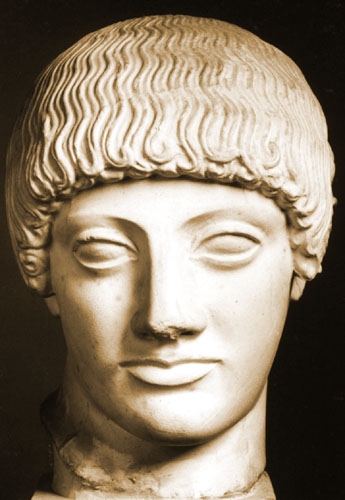
Youth.
Commentary Prepared by Dr. Julia Lenaghan, Ashmolean Museum
B 069
Blonde Boy. Athens, Acropolis Museum
Marble
Head
24.5 cm
From Athens. Found on the Acropolis within the walls of the ancient building at the southeast corner of the Acropolis.
Greece, Athens, Akropolis Museum, 689 (S 302)
Early Classical
Preservation:The head is broken through the neck. Some of the beginning of the right shoulder is preserved. The hair once retained traces of yellow. The irises were also painted yellow.
Description:The head tilts to the right and compresses the neck on the right side. It depicts a young male who is distinguished by short bangs and long braids. The hair, originating at the crown, falls down on all sides in parallel waves. These waves are delineated by shallow grooves. The hair in general sits like a raised cap on the head. Around the face the locks are cut short. They end in curls that appear to be two layers deep and that turn upwards and into themselves. These bangs end before the ears. In front of the ear some of the longer locks are clearly pulled back. Both the pulled back locks and the long locks of the back of the head are collected in two braids. The braids begin on each side directly behind the ears which are uncovered. From behind the ear the braids move slightly upward and towards the other ear, crossing over each other at the center of the back of the head. They presumably continue around the front of the head but are there concealed by the bangs.
The head, which turns to the right, is asymmetrical; the right cheek tapers toward the chin and the right eye is lower. The taper of the right cheek gives an almost triangular form to the face. The brow appears low. This is in part the result of the low-hanging bangs that cross the brow horizontally. The eyebrows flare; they reach their highest point at the exterior corners of the eyes. At this highest point above the outer corner of the eye the brow bulges outward. The eyes have a long shape with a marked tear duct. The upper lid is wide but does not overlap the lower lid. The nose has a flat ridge with a slight dip at the bridge. The mouth seems wide. The upper lip is longer than the lower lip; it continues beyond the intersection with the lower lip. It is markedly horizontal with a downward pyramidal point at the center. The lower lip in contrast has the form of a segment of a circle. The chin is strong and rounded.
Discussion:The head, which acquired its nickname “Blonde Boy” from the traces of gold paint in the hair, is an original work of the early Classical period. Although the head was originally thought to be found amidst debris from the Persian sack of the Acropolis in 480 BC, the context is no longer considered assuredly the result of the Persian sack.
The facial features greatly resemble those of the Kore of Euthydikos, so much so that Robertson believes that they are “hardly not by the same hand”. The hairstyle and general facial type are also comparable to the Apollo of the West Pediment of Olympia. This similarity allows Fuchs to assert that the head is the work of the “Olympia Master.” Yet the Apollo and the Blonde Boy share basic fashion trends whereas the Kore and the Blonde Boy share some striking (for example, the mouth) technical similarities. In any case, the date of the Blonde Boy is likely to be around the decade of 480 to 470.
A section of a torso, which includes the buttocks and genitals and shows the weight over the left leg, as well as a right foot have been associated with the head. Theoretically they come from the same statue and basically date to the same period. Their pertinence, however, cannot be proven and some consider them to be too large.
The head is generally praised for its emotive quality. Roberston speaks of its “melancholy” and Ridgway calls it “warm and alive”. In addition, the bend of the neck and the asymmetry of the face give it motion and an organic natural quality. Because of its spirituality and movement, it is considered a prime example of Early Classical statuary as opposed to Archaic statuary. Robertson hails it as a classical statue in contrast to a kouros. Although this may be true, we should be careful to read undefinable emotional qualities into a statue for which we have only an attractive head broken at a suggestive angle. Ridgway considers the Blonde Boy or a statue like it to have been an important masterpiece from which other sculptors borrowed. She cites heads from Volo, Cyrene, Cyprus, the Capitoline, Corinth, and Cleveland as all deriving from a similar model. These heads, however, seem to follow general trends in sculpture and their connection to the Blonde Boy does not appear to be tight. No matter how beautiful the Blonde Boy may seem to us, it surely was a small statue that followed greater trends. Not having stood for a long time since it must have been buried by the third quarter of the fifth century, it is not likely to have been an influential work.
Bibliography:M. Bieber,
"Drei attische Statuen des V. Jahrhunderts" (AM 37 1912) pp.151-158 pls.9-10
discusses a fragment of the buttocks that may come from the same statue as the headH. Payne and G. Young,
Archaic Marble Sculpture from the Acropolis (London 1936) pls.113-115
B. S. Ridgway,
The Severe Style in Greek Sculpture (Princeton 1970) pp.56-60
considers the head or a head like it to have been an important piece that influenced othersG.M.A. Richter,
Kouroi: Archaic Greek Youths (London 1970) pp.148-149 no.191 figs.570-574
beginning of new wera of kouroi--one in which anatomical form masteredM. Brouskari,
The Acropolis Museum (Athens 1974) p.123 no.689 figs.234-235
considers it to date before the Persian destruction and be work of an Athenian sculptor because of its spiritualityM. Robertson,
A History of Greek Art (Cambridge 1975) pp.174-175
compares the head to the Kore of Euthydikos, not a kouros but a statue in motionW. Fuchs,
Die Skulptur der Griechen (Munich 1993) p.550 no.653
considers it to be ca.480 and by the hand of the "Olympia Master"