Commentary Prepared by Dr. Julia Lenaghan, Ashmolean Museum
B 047
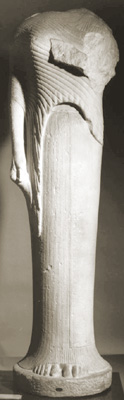
The so-called Hera of Cheramyes. Louvre.
Marble
Statue
H. 192 cm
Said to have been found c. 1875 about 10 m north of the North East corner of the Heraion, which corresponds with the sacred way. Girard recorded the statue as being in the possession of a local man, Léonidas Kydonieus. The statue was acquired for the Louvre in 1881.
France, Paris, Louvre, MA 686
580 - 560 BC
Preservation:Headless. The left arm and hand have been broken off, as has the front of the left breast. Otherwise, the figure is in good condition. The inscription is somewhat worn, but readable.
Description:An over lifesize, monolithic, marble female figure, on a small, round, integral socle. The figure stands facing forward, with her left arm bent, hand held to the chest and the right arm hanging by her side. The overall volume of the figure is columnar, tapering from shoulders (the widest point) to ankles, where the skirt fans out onto the socle, just revealing the feet in front. No gaps have been carved between the arms and the body (compare the earlier statues, B 35 and B 36). The remains of the left hand show that it was held closed and small pit in about the centre of the ruined surface of the hand indicates a hole was originally bored into it. (The pit is not readily perceptible in the cast.)
At least three garments are worn: a chiton, which can be seen at the left shoulder, the skirt of which is finely pleated; a himation is worn diagonally across the upper part of the body, covering the right arm (the fastenings look like those usual for chiton sleeves); and finally, a thin, plain, rectangular shawl (epiblema) is draped over the back, from head to ankles, and wrapped around the front of the left leg, being tucked into the belt in the front. The remains on the shoulders show that this epiblema covered the head of the statue. The border of another layer of an epiblema is visible across the back of the thighs and running up the right side of the back, but it is unclear whether this indicates another epiblema or simply a section of the one shawl, folded over (see interpretation, below). The diagonal himation and the epiblema meet in a sharp line which also seems somewhat unresolved. Note, however, the effort to indicate other sartorial details, such as the vertical folds of the chiton under the himation at the waist in front. The different garments would have been distinguished clearly with paint. The bare feet, which emerge from beneath the fluted skirt, are large and well-articulated, with widely-spaced toes.
An inscription runs vertically along the edge of the epiblema, in front of the left leg (I.G. I³ ):
Cheramyes dedicated me to Hera as agalma.
Discussion: This figure, which is widely celebrated as one of the most elegant of Greek statues, is one of at least four figures dedicated by a certain Cheramyes at the sanctuary of Hera on Samos. Previously another very similarl kore holding a hare and a kouros, both inscribed, were found at the sanctuary. In 1984, another inscribed kore almost identical to the so-called Hera was also uncovered. At the same time, a statue base with two circular, sunken bosses which fit the so-called Hera (kore A) and its twin (kore B) was found. One of the bosses reaches right to the edge of the base which indicates there was probably another section added on, so the base would have been longer, incorporating a larger group, more like the well-known Genelaos family monument erected not far east along the Sacred Way. There is some question, however, about whether the statues were originally displayed on this base; certain characteristics of the base have led the excavators to suggest it was reused from another monument.
The subject matter of the statue is unspecific. When first found, Girard identified the figure as Hera, and thought it must have followed the ancient cult statue (xoanon). He also pointed to the indications the head of the figure was probably veiled as an attribute suitable for a bride, Hera often being represented as the wife of Zeus. However, numerous korai from from Ionia and Western Anatolia (for instance, the little head from Miletos, B 39) are veiled. The pierced left hand would have held a trinket of some kind, such as are often found held by korai. The excavators remark that the finding of the Kore B once and for all proves that the statue does not represent Hera, but this is not quite true, since it have not been proven that the statues were displayed in a group. Multiple statues of goddesses could feasibly exist. However, it is also possible that the group of three korai and perhaps the kouros did form some kind of family group. Thus, this figure might represent a relative of Cheramyes. The point remains unresolved, however. The figure is probably best thought of as simply a korai, representing the idea of ‘agalma’ itself.
This statue shows important changes from the monumental figures of the preceding ‘Daedalic’ generation (see B 3 and B 4) – changes in both sculptural mannerisms and personal styling. The form is more cylindrical than rectangular, the anatomy imitates more closely the human form and the dress introduces the chiton and diagonal himation combination which will become the preferred attire for many korai up until the end of the 6th century BC. The figure tends to be dated to the second quarter of the sixth century, in between the so-called sub-Daedalic figures of the end of the seventh century and the Genelaos figures, which are taken to be a generation later, based on the higher degree of plasticity in the modelling of those figures. The recent discovery that the figures of Cheramyes could be part of one group has meant some adjustments in dating. Previously, the kouros fragment and the kore with the hare in Berlin were dated earlier and later than the Hera figure respectively. Martinez, going further, asks whether the differences between the Genelaos figures and the Cheramyes figures must be explained in terms of date.
Recent research on the personal name ‘Cheramyes’ suggests it is Carian, which prompts further consideration of the interactions between and distinctions to be made between wealthy Greek and Anatolian families in the archaic period. One recalls Herodotos’ claim that the chiton was originally Carian dress (5.87—8). Martinez, on the other hand, notes the linguistic origin of names need not relate directly to the ethnicity of the person.
Finally, one aspect of the figure’s dress is difficult to understand – the long epiblema. Martinez notes a theory originally proposed by Girard and supported more recently by Uta Kron: the figure actually wears two of these shawl-like garments – one folded double and extending from the head down the back, and the other over the right shoulder, under the left arm and tucked into the belt. This is possible, but some problems would still remain unresolved.
CMD
Bibliography:P. Girard,
"Statue de style archaïque, trouvée dans l’Ile de Samos," BCH 4 (1880) 483 – 493, pls. 13 and 14
(preliminary publication; identifies as Hera)G.M.A. Richter,
Korai: Archaic Greek Maidens (London 1968) 46, no. 55, figs. 183 - 85
(second quarter of the sixth century BC)G. Neumann,
"Zum namen des Cheramyes von Samos," WürzbJb 10 (1984) - 41
(argues the name Cheramyes is Karian)J. Frel, and M. Pécasse,
"La mutilation intentionelle de l’ ‘Hera’ de Cheramyes," Studia varia (Rome 1994) 33 - 34
(claims the Hera statue was possibly reused in the manner of the recently found kore, as both figure’s arms were knocked off)H. Kyrieleis,
"Eine Neue Kore des Cheramyes," Antike Plastik (Munich 1995) 7 - 36, pls. 1 - 8
(on the new finds from Samos, fully referenced)G.M.A. Richter - R.R.R. Smith,
“Une Corè de Cheramyès au Louvre”, in Au Louvre avec Jacqueline de Romilly, Jacques Lacarrière; La Core de Samos, vers 560 avant J.-C. (Paris 2001)
(the third essay in this booklet on the statue; potentially four garments worn; Cheramyes not necessarily Carian; may be contemporaneous with Genelaos monument; essential references to previous scholarship)