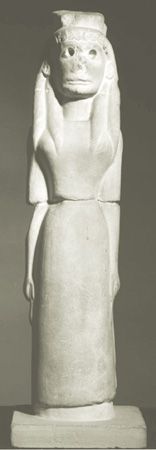
Fragment of a laver or holy-water-basin.
Commentary Prepared by Dr. Julia Lenaghan, Ashmolean Museum
B 039
Perirrhanterion figure. Olympia.
Marble
Vessel Element
H. 47.4 cm
Found at the Sanctuary of Zeus (the Altis), Olympia, during the late nineteenth century excavations. The head and torso were found in the entrance hall of the Bouleuterion, while the lower body was found built into late antique walls of the Echo Stoa. Fragments of the other korai supports and other fragments of the same perirrhanterion were scattered over the area of the treasuries and the stadium (see Pimpl and Treu for details).
Greece, Olympia, Olympia Museum, 1042
c. 600 BC
Preservation:The figure has three main breaks: at the neck, waist and bottom. The join at neck level is not as obvious at the join at the waist, where the edges along the break have been battered. A slice of the right front forearm is missing below the break at the waist. The bottom of the figure is uneven where it has been broken off the original base. The top edges of the headdress are worn and the surface of the figure is slightly weathered as whole. The inlaid irises of the eyes are now missing. The nose is missing.
Description:This cast is of a small, marble statue of a female. The whole figure has a rectangular block-like volume and is composed in a frontal scheme. She faces forward in a rigidly upright pose, hands firmly at her sides. The back of the figure is in general less detailed, especially the back of the figure’s long skirt, which is left quite flat. The breasts are prominent.
The figure wears a tall headdress like a polos or kalathos, but which is not quite cylindrical in shape; the sides are slightly concave. The head is large and squarish, with a very short forehead and prominent jaw. The eyes are huge and teardrop-shaped, with the point of the drop facing the outer edge of the face and angled down. Drilled holes remain where the irises were inlaid with another material. The mouth is thin and wide.
The hair is sectioned into thick tresses which fall onto the fronts and backs of the shoulders (braids or ringlets, perhaps). Two tresses hang onto the front of either shoulder, instead of the usual three. The ends of the hair on the back of the shoulders is not modelled. The fringe is styled into ten short curls, divided into two sets of five, which curl in opposite directions. The ears stick out and press against the hair tucked behind them.
The figure wears a chiton. Only the neck of the dress is indicated in relief, although the edges of sleeves might now be obscured by the break through the elbows. Other details would have been rendered in paint. In each hand, the figure grasps a long, rope-like object in each hand. On the right, a lozenge-shaped tuft at the end of the ‘rope’ indicates it is a lion’s tail.
Discussion:This figure is the most substantial fragment of a large basin, to which about ten smaller fragments have also been attributed (two fragments of two other female figures; two fragments of recumbant felines on the base; six fragments of the basin). The remains of several such basins, both with and without figurative decoration, have been found at the variety of sanctuary sites around the Mediterranean. They correspond to the perirrhanteria referred to in literary sources, which functioned both as votives and cult furniture.
Remains indicate such perirrhanteria were produced throughout classical antiquity, but the ones with figured supports such as the Olympia figure, are confined to the early period of production, from around the middle of the 7th century BC to the first or second quarter of the 6th century. They follow a similar formula: the large basin may be supported by either a central column and three korai (or Karyatids, as they are sometimes misleadingly called) arranged around the column, or simply three korai supports without a central column. The korai usually stand either between or on top of recumbant felines, holding their tails in one hand, and leashes in the other. The Olympia figure has been restored standing on top of a feline. It was thought at one point that another fragment belonged to the capital of a central column which would have added extra support for the basin, but this fragment has since been attributed to another, smaller basin.
The figured-perirrhanteria are generally divided into two stylistic groups, one represented by remains from Samos and Isthmia (Corinth) and another larger group usually referred to as ‘Laconian’, in which the Olympia figure takes its place. These stylistic differences are often interpreted as the marks of workshops of differing time periods and differing geographical regions – usually both. The ‘Laconian’ group has always been considered later in date than the other group due to a higher degree of plasticity in the modelling, although Richter was vague about the difference in date, dating the Corinth example to 650 – 625 BC, and the Olympia figure to 650 – 600. She considered the possibility that the Olympia figure was earlier than the Lady of Auxerre (B 36), thereby reorganising the relative chronology constructed by Jenkins, who had called the Olympia figure sub-Daedalic (620 – 600) and placed it later than the Auxerre figure (Middle Daedalic II – 645 – 40) . The figure is now often dated to around 600 BC, although perhaps Richter’s wider range is more appropriate for both of these figures.
The production centre of the Laconian group has been variously considered Corinth or Laconia, while the other group has been attributed to a Samian workshop. As this ‘Samian’ group were considered earlier, some have seen an East Greek origin for the whole perirrhanteria series. On the other hand, the greyish marble from which the figures of both groups are made has long been referred to as Laconian marble, and a recent study of this material supports this idea. Thus, Plimpl shifts the whole centre of origin of these objects to Sparta.
Plimpl’s main evidence for the Spartan origin of the series lies not in the material, however, but in the iconography. He stresses a link ( noticed previously) between images of Artemis as Potnia Theron, especially a votive found at the sanctuary of Artemis Orthia in Sparta, and the females and felines of the perirrhanteria. However, the little Olympia figure need not represent Artemis, but more generally a divine or semi-divine figure and it is a good example of the Greek delight in figurative ornament drawn from ‘oriental’ models, which blossomed in this period.
CMD
Bibliography:G. Treu,
Olympia 3 (Berlin 1897) 26 - 29, pl. 5, 4 - 5
(first publication)R.J.H. Jenkins,
Dedalica (Cambridge 1936) 73, no. 5
(sub-Daedalic, 620 – 600BC)G.M.A. Richter,
Korai: Archaic Greek Maidens (London 1968) 29, no. 8, figs. 45 – 48
(c, 650 – 600 BC)F.W. Hamdorf,
“Lakonische Perirrhanterien,” AM 89 (1974) 47 – 64, pls. 21 – 30, no. 1a, 48 – 49
(reconstructs perirrhanterion with central column)J.B. Carter,
“Isotopic Analysis of Seventh-century B.C. Perirrhanteria,” Classical Marble: Geochemistry, Technology, Trade. Proceedings of the NATO Advanced Research Workshop on Marble in Ancient Greece and Rome, ed. by N. Herz and M. Waelkens (Netherlands 1988) 419 – 31
(suggests Laconian provenance for marble)A. Mallwitz and K. Herrmann,
“Zu den lakonischen Perirrhanterion aus Olympia,” in 9. Bericht über die Ausgrabungen in Olympia (Berlin 1994) 140 – 49
(no central column, contra Hamdorf)H. Pimpl,
Perirrhanteria und Louteria. Entwicklung und Verwendung großen Marmor- und Kalksteinbecken auf figürlichem und säulenartigem Untersatz in Griechenland (Berlin 1997) 164 – 66, no. 8
(c. 600 BC; no central column; Laconian provenance and possibly Spartan origin of figure-decorated perirrhanteria)