Commentary Prepared by Dr. Julia Lenaghan, Ashmolean Museum
B 036
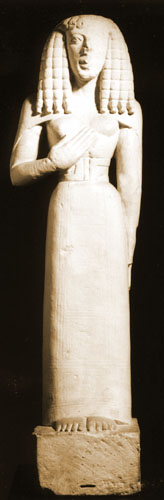
The so-called Auxerre Goddess, or the Lady of Auxerre. Louvre.
Limestone
Statuette
H. 65 cm. With base, 75 cm
The figure is first recorded in a sale notice of 1895, when the belongings of a certain Édouard Bourgoin were dispersed. Before retiring to Saint-Bris le Vineaux, near Auxerre, he had worked as a sculptor (of wood) and ran an antiquities shop in Paris, and presumably acquired the statue at this time. The figure was purchased for one franc by Louis David, caretaker of the Municipal Theatre. The statue apparently appeared in a production of Galatée put on by David’s theatre. From him it came to the Museum in Auxerre. The Louvre acquired the statue in exchange for a painting in 1909. The statue bears a number in arabic numerals: 285, indicating it was in an earlier collection. Which collection remains unknown; the number was not added by the Auxerre Museum or the Louvre. The figure most likely came from Crete originally, and Martinez argues the figure could be from Eleutherna, Crete.
France, Paris, Louvre, Ma 3098
c. 630 BC; orientalising
Preservation:The figure is intact, but was broken into three parts: the bottom skirt section with the left hand and lower arm attached; the upper torso section, with the head and the upper left arm; and the bent right arm, which had snapped off the body. Repairs were made at the Louvre. The left half of the face is broken off and there are a few chunks of stone missing, mostly on the rear side (back of left shoulder, on back of skirt and notably along the bottom of the statue’s cubic base on the right and rear sides, esp. the right rear bottom corner).
Description:A small limestone statue of a female figure, standing in a rigidly frontal pose, legs together. Her right arm is held down by her side, with the palm pressed flat against the body. Her left arm is bent, hand held on chest, palm in. Gaps have been carved between the arms and the narrow waist of the figure. The bent elbow of the left arm protrudes beyond the edges of the cubic socle on which the figure stands. The lower half of the body, comprising the long skirt of the figure, is block-like. Flat feet protrude from beneath the hem of the skirt to the front edge of the socle.
The modelling of the figure is schematic and rudimentary, although there is some degree of plasticity in the structure of the face, the throat, the torso and the arms. The remaining right eye is detailed, the pupil being incised. The mouth curves into a subtle smile. The breasts are prominently modelled. The hands and feet are quite flat. The extended fingers of the hand on the chest are almost all the same length and the peculiar turn of the wrist gives the whole hand a rubbery effect. Fingernails and toenails are indicated.
The hair of the figure is arranged in the so-called Daedalic style, gathered into several thick sections, and further articulated into ‘bunched’ segments (braids or ringlets), fanning out to frame the face. Four of these tresses lie on either side of the face. (The usual in statues of both the seventh and sixth centuries BC is three.) The hair covers the ears of the figure. The fringe is styled in a row of short curls. The figure wears a long tunic, with a thick belt with a cylinder-shaped clasp. A piece of fabric extends from the back, over the shoulders and is attached at the collarbones. This is usually referred to as an epiblema (cape), although here the fabric sheathes the back of the arms more like leaf-shaped sleeves. The left sleeve is longer, terminating at the wrist, while the right sleeve terminates at the elbow. On the back, the distinction between the tunic and this garment is not clear; it seems to be part of the tunic. The upper part of the tunic is incised with a scale-pattern decoration, and traces of red paint have been discerned here. The arms do not carry this scale decoration, but a band at the wrists is decorated with the same decoration on the trim of the neck of the tunic – ‘concentric’ rectangles. The impression is that the tunic has long, tight sleeves. The same geometric pattern is used on a larger scale to decorate the front (although here squares rather than rectangles) and bottom section of the skirt (rectangles). The bottom-most edge of the skirt is refined with vertically incised lines, suggesting a fringe. The feet are bare.
Discussion:Although the original find place is unknown, this figure has long been considered to be from Crete, because of similarities in dress and hairstyle shared with other statues from Crete, such as some well-known ones from Prinias. The type of dress itself need not be specifically Cretan; it could well represent a dress style adopted by the wealthy in the Aegean region rather than specifically Crete. But analysis of the limestone from which the figure is made has revealed similarities with the limestone of statues found at Prinias and Taranto on Crete.
Much of the literature on this figure has concerned itself with questions of style and date, one of the main aims being the construction of a relative chronology of early sculptures. Jenkins named his Middle Dedalic II group (645 – 40 BC) after this sculpture, differentiating its oval face from the squarer features of the woman in the relief from Mycenae (A 160), which he placed slightly later (640 – 30 BC), though the two faces are really quite similar. Richter placed this figure in the last quarter of the seventh century. Much literature places the piece in between these two dates, c. 630 BC, later than the more schematic Nikandre’s dedication (B 35).. To what extent this difference in plasticity results from difference in material and size, however, remains open to question. In general, the archaeological record for 7th century sculpture does not always permit the kind of refined dating that traditional approaches in Classical archaeology/art history have implied. Martinez thus would advocate a wider dating range 650 – 600 BC.
Martinez thinks he has been able to recognise the hallmarks of a particular workshop which could have made this figure. He points to recent finds of ivory heads which are very like the Auxerre face, as well as the lower half of a larger limestone statue which may have been gesturing similarly (her left hand is preserved on the thigh, the right is not), found in the cemetery of Eleutherna (modern Elefterna), Crete (where the torso, B 3, was found). He hypothesises the Auxerre statue could have been looted from the site of Eleutherna c. 1890, about when the limestone torso was found, and smuggled into France, where it is first recorded about 15 years later. This mean Bourgoin would have had to acquire the statue just before he retired c. 1881. (The presence of the number on the statue complicates this sequence, however.)
Until recently, this statue had the distinction of being the only preserved 7th century stone sculpture in the round with this gesture of right arm on the breast – a pose attested, however, in smaller scale figurative works found on Crete and in a number of statues said to have been found on Delos (Homolle, Diana simulacris – see bibliography of B 35). The above-mentioned statue from Eleutherna may share the gesture and in 2000, a colossal kore gesturing similarly was found on Santorini (ancient Thera). The gesture itself is not understood. It seems to imply adoration, although one should be cautious about making such an assumption. Surely the gesture has a specific meaning, but we are at a loss to decipher it (contra Martinez). The Eleutherna fragment and the colossal Thera kore were both found in cemeteries, but if the gesture was characteristic of statues found near the sanctuaries on Delos, then it cannot be exclusively funerary.
The dress of Daedalic figures, and this one in particular, is not well understood. The main debate centres on whether the fabric wrapped over the figure’s shoulders is a separate cape or the back of a tubular dress, pinned over the shoulders. The patterns on the wrists matching that at the neck suggests to some who would argue for the cape, that the figure wears a long-sleeved tunic. Others feel they could be bracelets, but still accept the cape. Harrison argues for a tubular, one-piece dress, and points to this statue as an extreme example of the kinds of conventions a sculptor could adopt when he chose to render the garment in stone. Martinez implies that the debate is futile, as sculptors did not render costumes with accuracy, although this perhaps underestimates what can be learned about ancient dress from visual representations.
The Cambridge Museum of Classical Archaeology owns a cast painted with a reconstruction of the polychromy. For more on early Archaic and Daedalic sculpture, see A 160, B 3, B 35, B 39, and 00-023.
CMD
Bibliography:M. Collignon,
“La statuette d’Auxerre,” MonPiot 20 (1913) 5 – 38, figs. 1 – 3
(second publication, but the fullest discussion. Maintains the sculpture is representative of the Cretan school, with little Ionic/island influence.)R.J.H. Jenkins,
Dedalica (Cambridge 1936) 42 - 45
(places statue at the forefront of his middle Daedalic II group, 645 – 40 BC; Cretan production)C. Rolley,
“Deux notes auxerroises,” BCH 88 (1964) 442 – 445, esp. 444 – 45
(in private collection of Louis David before Auxerre Museum)G.M.A. Richter,
Korai: Archaic Greek Maidens (London 1968) 32, no, 18, figs. 76 - 79
(last quarter of the seventh century BC)C. Davaras,
Die Statue aus Astritsi (Bern 1972) 55
(good references to those arguing for non-Cretan provenance)E. Harrison,
“Notes on Daedalic Dress,” JWaltersArtGall 36 (1977) 37 – 48, esp. 39 and 40
(not a cape, but a one-piece Dorian dress)L. Adams,
Orientalizing Sculpture in Soft Limestone from Crete and Mainland Greece (Oxford 1978) 32 – 34
(Concludes the sculpture is a Cretan product influenced by Ionia)B.S. Ridgway,
“The Fashion of the Elgin Kore,” J. Paul Getty Museum Journal 12 (1984) 29 – 58, esp. 33 – 36
(contra Harrison; article on the peplos in general)A. Trevor Hodge,
“The Auxerre Goddess: A Cautionary Tale,” Echos du Monde Classique 6 (1987) 87 – 197
(refutes notion the statue is a fake)M. Hamiaux,
Louvre. Les sculptures grecques 1 (Paris 1992) 43 – 45, no. 38
(short catalogue entry; figure wears cape; from Crete; incisions on wrists are bracelets)G.M.A. Richter - R.R.R. Smith,
La Dame d’Auxerre (Paris 2000)
(discussion of multiple aspects, including clothing (not exact representation), gesture (not specific meaning), the forgery issue, chronology and provenance (Eleutherna, Crete))