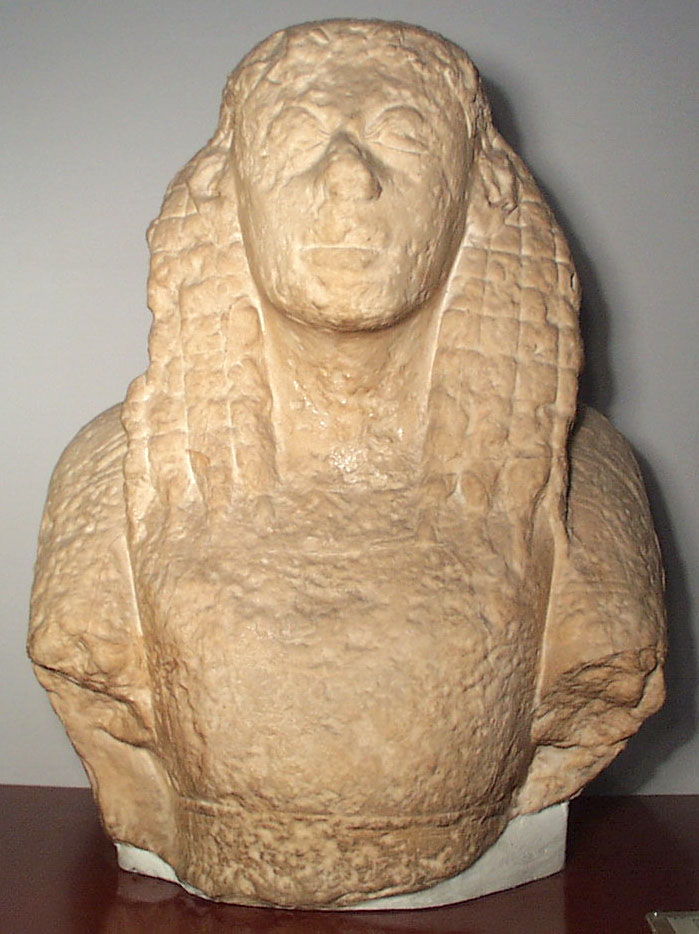
Upper part of male figure.
Commentary Prepared by Dr. Julia Lenaghan, Ashmolean Museum
B 003
Seated statue from Eleutherna, Crete.
Limestone
Statue
H. 57 cm
Said to have been found at ancient Eleutherna (modern Elefterna), near the modern town of Candia, Crete, in or before 1891. Joubain’s preliminary report indicates the statue was found by labourers working the fields in the region called Hore Petra, on the West side of the ancient acropolis of Eleutherna. It lay at the foot of a square column, 2.5 m in height. Early twentieth century publications record it in the collection of the museum at Candia. It is now in the museum at Heraklion.
Greece, Heraklion, Heraklion Museum, MA 47
c. 650 - 600 BC
Preservation:The bottom half of the figure is missing. It was made separately or has broken off. Both arms have been broken off in the middle of the upper arm, indicating the arms were carved in the round. The hair is broken along the edges, especially on the figure’s right side. The whole surface is rough and pitted from weathering. The cast itself has two noticeable air bubbles (caused when cast was made): one on the left edge of the hair, and one on the back of the right shoulder.
Description:This cast is a reproduction of a life-size, limestone statue. The nose is prominent and the chin thrust further forward than other examples of Daedalic stone sculpture in the Cast Gallery’s collection (for instance, B 35 and B 36). The eyes are large and bulging, with a large lid, and the lips are straight, but thick. The top of the head is quite flat.
The hair is styled in the wig-like manner associated with the Daedalic style, here with a thin headband constricting the upper mass of hair, thus revealing the flatness of the top of the head. The hair bulges out below this headband and is noticeably divided well above the ear. Two front sections on either side of the face fan out over the front of the shoulders and the hair on the back of the head hangs onto the back of the shoulders. The hair is further divided into several thick tresses which are in turn divided into a series of nodules (representing braids or ringlets). The fringe begins on the top of the head, and is articulated by thicker moulded tresses striated by thinner, incised lines. Each tress ends in a curl on the forehead. These curls seem to overlie the headband, or may lie over and then curl under it (compare this fringe style to B 36, A 160 and B 4). At the sides, the fringe is pulled behind the ears. The ears themselves stick out, and are pressed flat against the hair behind them. The edge of the figure’s tunic is barely visible at the neck, but the belt at the waist is clear (compare B 35 and B 36). Fabric covering the back of the figure is pulled over the shoulders, and falls past the belt; this is usually described as a small cape (epiblema), although some think these ‘capes’ are actually part of an early peplos. Some remnants of decorative details are noticeable on the belt and the edges of the ‘cape’.
Discussion:The position of the arms (now missing) and the slump of the shoulders is similar to the position of two seated statues from Prinias, also on Crete, suggesting most scholars are correct in describing this fragment as the upper portion of a seated statue. What is not clear, however, is whether the gender of the figure should be male, as some have described. No breasts are indicated, but the kind of dress the figure wears is associated with statues of female figures. There is some dispute over whether the figure wears a cape or not; several scholars support the idea that ‘Daedalic’ style female figures wear a short mantle or cape (epiblema), but E. Harrison argues the fabric is part of the dress, which is pulled over the shoulders and pinned at the collarbone (kata stethos – pinned at the breast, as Homer describes Hera in the Iliad 14). (For other examples of this garment, see B 35, Nikandre’s dedication and B 36, the Lady of Auxerre.)
This statue has not excited a great deal of scholarly attention. Besides some debate over the gender, questions asked of it mostly concern date and style. It is the eponymous piece of Jenkins’ late Daedalic group (630 – 20 BC), differentiated from the Middle Daedalic III (in which A 160 falls) by having squarer faces. However, the head, especially the shape and hairstyle, has similarities to the Kleobis and Biton statues from Delphi (see B 4) and a seated statue found at the Sanctuary of Demeter, near Haghiorghitika in Arcadia (Alford no.6), both usually dated to around the end of the 7th century. In general, it is not clear that it is possible to achieve a refined chronology of seventh century sculpture. Some scholars have suggested the date of the twin kouroi from Delphi should be brought forward to around 580 BC, thereby broadening the dating period for the whole of the ‘Daedalic’ series.
Adams concerns herself less with date than with the issue of the transmission of style, asking why facial features (the thick bridge of the nose, for instance) and the hairstyle of this figure stand apart from other large-scale stone sculptures found on Crete. Observing parallels between this work and smaller terracottas from Cyprus, she concludes that the sculptor may have been working from a small statuette imported from a neighbouring region to the East of Crete. It is not clear, however, that the facial details of a small figure would be faithfully translated in larger works. That would imply the use of scale models, for which there is no evidence at this date.
In terms of form, the figure takes its place amongst several other examples of seated female figures from Crete and elsewhere in Aegean of the 7th century BC. It is not clear whether the statue would have been a freestanding votive or architectural decoration, as are the seated figures from Prinias, Crete, but it was surely associated with a sanctuary. A sanctuary of Apollo is attested at ancient Eleutherna.
CMD
Bibliography:A. Joubain,
“Une statue crétoise archaïque,” RA (0) 10 – 20, pls. 3 – 4
(preliminary report)R.J.H. Jenkins,
Dedalica (Cambridge 1936) 51, pls. 7 – 8
(eponymous statue of his late Daedalic group)L. Adams,
Orientalizing Sculpture in Soft Limestone from Crete and Mainland Greece (Oxford 1978) 37 – 40, pls. 14 and 15
(figure stands apart from other Cretan stone sculpture; model may have been small figure from Near East)H.L. Alford,
The Seated Figure in Archaic Greek Sculpture (diss. Uni. of California 1981) 165 – 68, no. 5
(catalogue entry; end of seventh century; cloak tucked into neckline like Auxerre figure; full bibliography; general discussion of distribution, chronology, style and meaning of seated figures)H. Jung,
Thronende und sitzende Götter zum griechischen Götterbild und Menschenideal in geomettrischer und früharchaischer Zeit (Bonn 1982) 38 and esp. n. 165
(only mentions figure, but footnote contains a full bibliography and summary of some scholarship, particularly on the debate over gender; seated figures derived from iconography of gods)