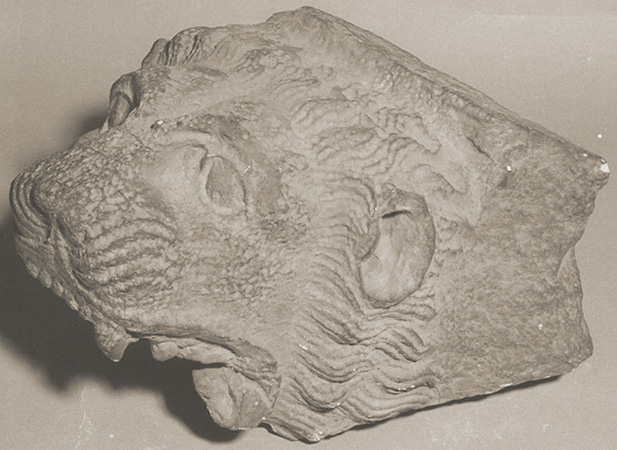
Cast Gallery catalogue number: A167
Lion-head waterspout.
- Plaster cast: Height: 25 cm, Width: 31 cm.
- Copy of a marble lion's head.
- The lion's head:
- was made around 400 BC.
- is from the sima of the second Temple of Hera at the Argive Heraion.
- is now in Athens, National Museum.
Detailed Record
Commentary Prepared by Dr. Julia Lenaghan, Ashmolean Museum
A 167
Larger lion’s head water spout from the Argive Heraion. Athens
Lion’s head water spout from the sima (frieze around bottom of lateral edge of roof) of the second temple to Hera at the Argive Heraion. Belonging to the larger series of lion’s heads on the sima. Ca. 400 BC.
Marble
Architectural Element
W 25 cm, D 31 cm
From the Argive Heraion. Found in 1892 in the excavations carried out by the American School of Athens.
Greece, Athens, National Museum
Ca. 400 BC
Preservation:The fragment preserves a worked upper border as well as the top portion of the back edge. These two surfaces form a 90 degree angle. It is broken on both the right and left side. The bottom is broken diagonally from the lower portion of the left jaw to the upper part of the right jaw. The surface is worn.
Description:The fragment depicts the upper portion of a lion’s head attached to a flat background. The face of the lion projects from a mane. The hair of the mane is brushed back off the face. It falls in two tiers of short parallel locks. Over the brow the upper tier of locks is less distinct than it is at the side of the face. The locks are the result of ridges between broad, shallow channels. The left ear is preserved between the two tiers of locks. Its interior is hollowed out and it is crescent-shaped.
There is a significant crease down the center of the brow. The eyebrows are heavy and stand out. The eyes are large round discs that are framed by an upper lid which is semi-circular and a lower lid that is almost horizontal. The face indents at the temples; this accentuates the bulge of the eyebrow and the bulge of the cheek. The nose is broad. It ends in the characteristically feline triangular line area. On the outer sides of this triangle, the whiskers are rendered by engraved lines that curve backwards into the cheeks. The central teeth are small and rounded. The canine (visible on the left side) is long, pointed, and sharp. The teeth behind the canine are also pointed.
Discussion: This lion head waterspout comes from the sima of the second temple of Hera at the Argive Heraion. The Argive Heraion was a sanctuary located on the eastern part of the plain of Argos, five kilometers from Mycenae and ten from Argos. The temple, to which this fragment belonged, is generally dated ca. 400 BC. For a fuller discussion on the sanctuary and this temple, see cat. no. A 109 and for other sculpted fragments from the temple, see cat. nos. A 110-114, A 166, and A 167.
The sima, the border around the sides of the temple below the roof, consisted of an elegant decoration of lotus plants, vegetal scrolls, and birds. This decoration in relief was punctuated by waterspouts shaped as lion’s heads in higher relief that served to drain water off the roof. Such waterspouts were not uncommon in Greek architecture. Fragments from the temple indicate that the lion head waterspouts were of two different sizes (cf. cat. no. A 166). This particular example belongs to the larger-sized examples. It is thought, therefore, to belong to a portion of the sima above the columns.
Julia Lenaghan
Bibliography:C. Waldstein,
Excavations of the American School of Athens at the Heraion of Argos, 1892 (London 1892) 15, pl. 7
brief descriptive catalogue-like entry with illustrationB. S. Ridgway,
Fourth-Century Styles in Greek Sculpture (London 1997) 27-28
comments that such lion-heads were in origin from Magna Grecia