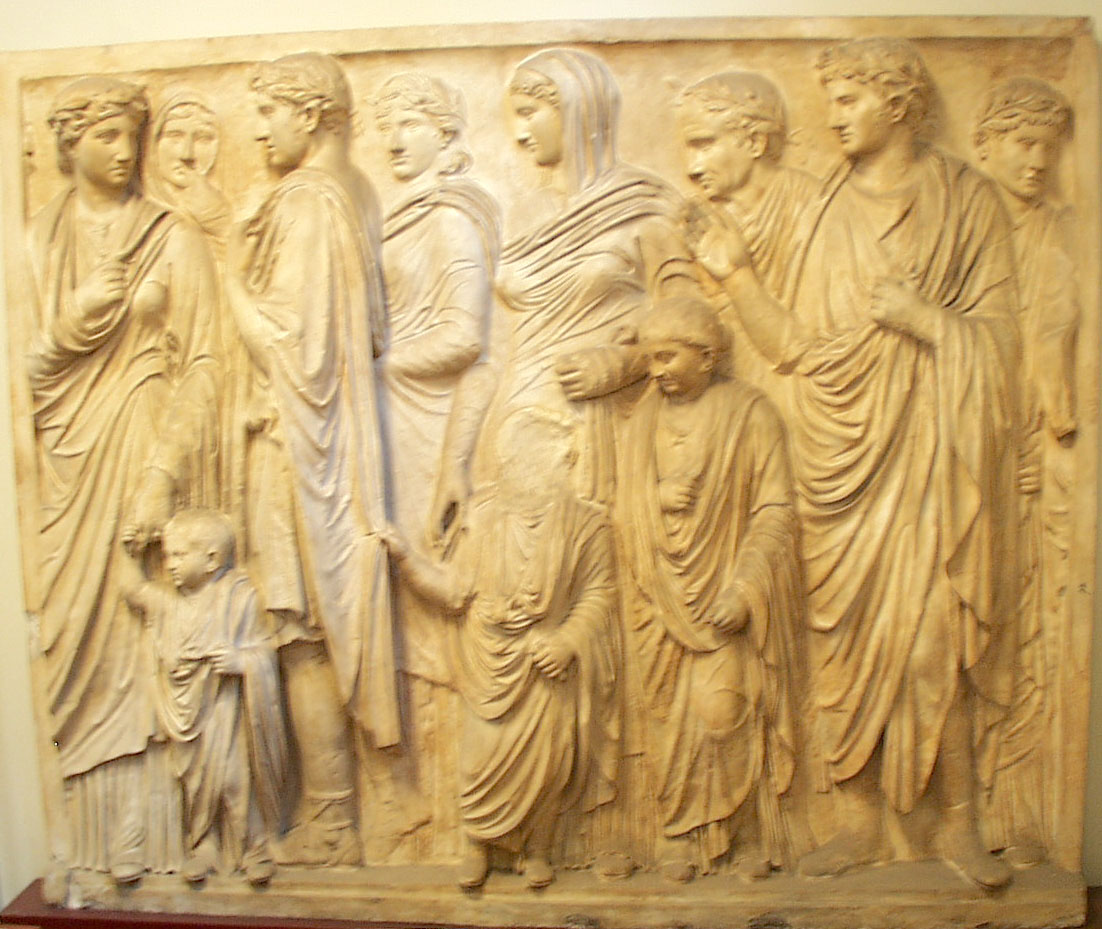
Portion of a frieze showing eleven figures of men, women and children.
Detailed Record
Commentary Prepared by Dr. Julia Lenaghan, Ashmolean Museum
Slab from the rear portion of the south frieze of the Ara Pacis, Altar of Peace, erected between 13 and 9 BC in the Campus Martius in Rome. Depicting members of Augustus’ family in procession, among those shown are probably Drusus, Antonia Minor, and the baby Germanicus.
Marble
The twelve figures have been labelled nos. 36-47 from left to right. No. 36 is a woman whose body appears almost frontally to the viewer but whose head is in profile since she turns back to look at the man behind her. She wears two garments and a laurel wreath. Her hair is simply pulled back and gathered in a bun wrapped with braids at the nape of her neck. The face has regular features without any sign of age or specific detail. Her weight rests on the left leg. The right arm is bent across the body at a 45 degree angle. The left arm remains along the side of the body. The right hand with its palm to the viewer rests over the left breast. It holds the outer garment in place. The left hand, resting near the left thigh, holds the hand of an accompanying child. No. 37 behind her is a woman in the background. Primarily only the head of this figure, facing forward, is visible. The head is covered by a mantle, and she holds her hand to her mouth as if asking for quiet. No. 38 is a small boy who raises his right arm to hold the left hand of no. 36. He wears a toga and a bulla (a round object suspended on a cord). Behind the boy is a man who stands in profile, facing forward. He has medium-length hair cut around his ears, wears a laurel wreath, and has a young regular face. He is dressed in a short tunic that reaches his knees and a long cloak that once extended to his feet. His feet seem to wear sandals; however, there is much restoration in this area. Behind him and set back in space from him is no. 40, a female figure dressed in two garments. The figure stands in profile but the head looks out toward the viewer. Again a laurel wreath is worn, and here long locks of hair fall loose on to the shoulders. No. 41 is another female figure who wears an outer garment that is pulled over her head. It is also wrapped tightly around her body and arms, particularly revealing her breasts. The woman is positioned so that the viewer sees her in three-quarter view. The face is again without distinctive detail and the hair is pulled neatly back off the face. The weight appears to be on the right leg and the figure seems to step forward since the right side of the body is in front of the left side. The left arm is bent at an approximately 90 degree angle. The upper arm remains next to the body and withdraws slightly; the lower arm comes forward. The left hand, resting near the hip, firmly grasps an end of the garment. The right arm rests by the side. The right hand, placed near the right thigh, is empty. The right hand rests over the shoulder of a frontally positioned boy, no. 42, who is slightly large the boy, no. 38. This boy, whose head is no longer preserved, wears a toga and bulla. He grasps with his right hand the cloak of the man, no. 39. Standing behind him and looking down at him is a slightly larger girl, no. 43. She stands in three-quarter view with her left arm at her side and her right arm folded across her chest. She wears a heavier garment draped over a lighter garment. In addition she wears a crescent-shaped pendant on a cord around her neck. In the background and slightly behind her is a hunched old man, no. 44. Only his shoulders and head, both in profile, are visible. He wears a laurel wreath, and the face is distinctly marked with signs of age, particularly hanging jowls. The neck cranes forward and the shoulders are rounded. Upright behind him is a man wearing a toga and standing almost frontally to the viewer. Slightly more than just the profile of the face is visible. The head wears a laurel wreath and has medium length hair that is cut around the ears. The face is young and has regular features. His left arm crosses the chest and the right forearm is raised above the head of the girl, no. 43, in front of him. Behind this figure in the background the head and chest area of another figure, no. 46, is visible. This head, again wearing a laurel wreath, looks slightly backwards. The gender of the figure is difficult to distinguish. Of the next figure, no. 47, who stands in the foreground, little is preserved. The draped right shoulder and hip are all that remains. This may have been the last figure of the procession on the south side of the monument.
All the figures have some facial details in common. Engraved lines denote the pupils of all the figures, and shallow drill holes mark the irises. The eyebrows feature short, parallel, engraved lines indicating hairs. The drapery of the figures is also similarly handled. Long unbroken folds with rounded edges are typical, and depending on the weight of the garment they vary in density and depth.
Discussion:
The frieze is from the enclosure wall of the Ara Pacis. The Ara Pacis or Altar of Peace, known both from the textual and archaeological record, was erected between 13 and 9 BC to commemorate Augustus’ return to Rome from the provinces of Gaul and Spain. It was yet another reminder of the peaceful prosperity that Augustus had established. The monument, perhaps linked to Augustus’ enormous sundial, was located in the Campus Martius and faced the Via Flaminia. It consisted of an altar mounted on a podium and surrounded by an enclosure wall.
The interior and exterior of the enclosure wall were carved with two tiers of politically highly-charged relief decoration. The interior of the wall featured a representation of a wooden fence on the lower level and on the upper level garlands suspended from bucrania and hanging phialai. On the lower level of the outside of the wall was an ornate vegetal design punctuated with small animals. The upper frieze depicted mythological and allegorical figures on the short front and back sides (east and west) and on the long sides, (north and south) civic and religious officials as well as families processing ceremoniously from front to back. The procession of the south side is better preserved than that of the north side, and it includes the easily identifiable figures of Augustus and Agrippa. From left to right on the south side, are heralds and attendants; Augustus with priests (flamines and rex sacrorum); Agrippa with a small child who is thought either to be one of the princes Lucius or Gaius or a child of a foreign king; a prominent female figure, Livia or Julia; possibly Tiberius; and then the figures depicted on the slab in discussion.
These figures, numbered 36-47 by Koeppel and Conlin, have generally been identified as two young families related to Augustus; the families of his nieces, Antonia Minor and Antonia Maior,
the daughters of his sister Octavia and Mark Antony. The leftmost figure of the panel may represent Antonia Minor holding the hand of her young son Germanicus and turning to look backward toward her husband Drusus, the brother of Tiberius and son of Liva. Much scholarly discussion has focused on the dress of the Drusus figure; he is the only male not wearing a toga and this is thought to correspond to his position as commander of the armies in Germany. The family group immediately following that of Drusus’ features a boy and a girl. It is thought to be the family of Antonia Maior and L. Domitius Ahenobarbus, with their children, Cn. Domitius Ahenobarbus (future father of Nero) and Domitia. Whatever the specific identity of the figures, the scene represents desirable family values, that is, a close-knit group with all individuals fulfilling their proper roles as father, civic and military men, wife, mother, and bright young hopes for the future. These were the values and concepts both on which Roman success depended and which were fostered by Roman prosperity.
The procession on the Ara Pacis has created scholarly debate on three levels. First, many have been tempted to identify all of the individuals represented with actual historic figures. Second, scholars have debated about the historic occasion of the event depicted; that is, was the procession a depiction of the inauguration of the altar, was it a commemoration of Augustus’ promotion to Pontifex Maximus, was it merely an informal festive supplicatio of which Augustus performed many, or was it an imaginary pseudo-historic scene? Finally, scholars have focused on the connection between the Ara Pacis procession and the Panathenaic frieze of the Parthenon. There is probably no intended relationship and the seeming similarity stems from the fact that both monuments represent their culture’s highest point in history and are well preserved.
Already in the second century AD, the ground level in the Campus Martius rose 3 meters, and the Ara Pacis and its reliefs may have been restored. Many figures have drilled pupils and incised eyes that do not belong either to the original work or seemingly to the modern restoration. The monument was excavated unsystematically over a long period of time. The first elements were found in 1568 and then more work around the same palazzo yielded further fragments in 1859. In 1879 F. von Duhn identified the relief sculpture and the structure as the Ara Pacis. The twentieth century saw the culmination of the study and excavation of the altar. In 1903 Petersen and Pasqui were able to clarify the ground plan of the building as well as find more elements. In 1937 Mussolini and the fascist party used the bi-millenium celebration of Augustus as the impetus for a total reconstruction and reintegration of the various fragments that had been found and scattered throughout museums in Italy and abroad. The work, overseen by G. Moretti, brought to light still more pieces and succeeded in reconstructing the monument several hundred yards from where it originally stood. A glass structure in "fascist style" was built around the altar and the base of this building was appropriately adorned with Augustus’ Res Gestae spelled out in bronze letters. Now at the beginning of the 21st century, the Romans no longer want the Mussolini structure and have begun to dismantle it. Not without controversy, the American architect Richard Meier has been commissioned to construct a new home for the Ara Pacis.
J. Lenaghan
Bibliography:
G. Moretti, Ara Pacis Augustae (Rome 1948) first full discussion of the monument and its excavation history after its total reconstruction
F. Coarelli, Guida archeologica di Roma (Rome 1975) 270-274 summary description of monument in Italian
E. La Rocca, Ara Pacis Augustae in occasione del restauro della fronte orientale (Rome 1983) 24-39 discussion of south side in summarizing account of monument
R. Syme, "Neglected Children on the Ara Pacis" (AJA 88 1984) 583-589 discussion of the last two children on this panel, argues that represent children of Antonia Maior but not Domitia and Cn. Domitius Ahenobarbus
G. Koeppel, "Die historischen Reliefs der römischen Kaiserzeit V: Ara Pacis Teil I" (BJB 187 1987) 102-108, 115-118, 125-126, 152-156, cat. 5, figs.14-15 good discussion of all aspects of friezes with long bibliography
P. Zanker, The Power of Images in the Age of Augustus (Ann Arbor 1988) 121-125 discussion of procession
D. Conlin, "The Reconstruction of Antonia Minor on the Ara Pacis" (JRA 5 1992) 209-215 discussion of the slab’s leftmost edge and completion of Antonia Minor
D. Kleiner, Roman Sculpture (New Haven 1992) 90-99 standard account of the monument
R. Billows, "The Religious Procession of the Ara Pacis Augustae: Augustus’ supplicatio in 13 BC" (JRA 6 1993) 80-92 attempt to identify the reason for the procession with an occasion of a supplicatio
D. Conlin, The Artists of the Ara Pacis (Chapel Hill, NC 1997) study of the sculptural technique with special attention given to figures of the processional frieze and interesting photographic details
A. Claridge, Rome: An Oxford Archaeological Guide (Oxford 1998) 184-190 summary discussion of the monument in English, assumes Billows’ ideas