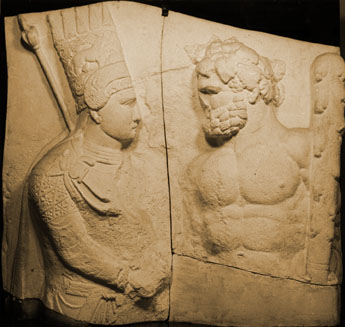
Herakles and Antiochos I of Kommagene.
Detailed Record
Commentary Prepared by Dr. Julia Lenaghan, Ashmolean Museum
To the right stands a mature and bearded male. He is nude with a heavily muscled body, and wears a vegetal wreath in his hair. In his left he holds a large club and has a lion skin flung around his lower arm.
Opposite stands a clean-shaven man in an elaborate Persian-style costume. This consists of long trousers and a soft garment with long sleeves that reaches down to the ankles. In front two strings that are fastened to a belt pull this cloth up. On top of this he wears another short-sleeved garment that is decorated with a deeply carved geometrical pattern broken by stars. Over the shoulders is draped a long mantle. On his head the figure wears an elaborate tiara with five points in a feathery pattern. A large lion framed by vegetal ornaments (of the same type as the wreath in the other figure’s hair) decorates the main part of the tiara. Over its lower rim is fastened a diadem with three smaller lions on it. A wide, torque-like ring is visible around the neck. Behind the figure is the upper part of a long sceptre.
Discussion:
Unpretentious in artistic terms, this stele provides a fascinating insight into the fusion of Greek and oriental art on the eastern fringes of the Mediterranean world in the late Hellenistic period.
It illustrates a carefully thought-out iconographic program that centred on King Antiochos I. of Commagene, depicted on the left. Commagene was a small, but strategically important and economically powerful kingdom that controlled the trade routes between the Roman and Parthian empires along the Euphrates river in southeastern Anatolia. Antiochus I. ruled Commagene c. 69-36 BC, in a politically volatile and sensitive period. After the defeat of his nominal overlord, the Armenian king Tigranes the Great by the Roman generals Lucullus and Pompey, Antiochus was recognized by the Romans in 65/65 BC as a nominally independent client king. The increasingly imperialist policies of the expanding Roman empire, however, rendered his position most precarious. Possibly to counter this external threat, Antiochus devised an elaborate state and ruler cult that united the people of Commagene around his person.
This cult had at its core a religious construct that mixed Greek and Iranian elements and, based on astrological events, proclaimed that Antiochus had been received among the gods themselves. This event was propagated on numerous sculptured monuments in small sanctuaries (hierothesia) throughout Commagene.
The tomb of Antiochus I. on mount Nemrud formed the centrepiece of this network of cult places. On top of the mountain was a great tumulus with interconnected terraces on three sides. While the north terrace remained unfinished, much of the sculptural decoration of the east and west terraces survives.
Image from www.nemrud.nl
The west terrace, from which this stele originates, had at its centre five monumental seated statues of King Antiochus I. himself, the country’s patron goddess Commagene, Zeus-Oromasdes, Apollon-Mithras-Helios-Hermes, and Artagnes-Heracles-Ares. The hybrid nature of the gods is evident from their combined names. Monumental eagles and lions flanked these statues on either side.
At a right angle to the right, and in a second row opposite the seated statues, followed two long rows of stelae that depicted Antiochus’ ancestors. On his father’s side he proclaimed descent via the Persian Orontids from the Great King Darius I., and on his mother’s via the Seleucids from Alexander the Great, thus illustrating the mixed nature and double legitimacy of his reign. To the left of the seated gods followed another row of stelae. Closest to the statues was a relief that in the form of a lion-horoscope depicted a particular stellar constellation that had occurred early during Antiochus’ reign. It showed the stars associated with the aforementioned gods passing through the star sign of Antiochus himself, as if paying him tribute, and was conceived to signify his reception among them. Further to the left stood four almost identical stelae that translated this event into more conventional iconographic terms: They show Antiochus I. being greeted individually by the four gods.
This particular stele depicts Antiochus together with Heracles (or Artagnes-Heracles-Ares as he is called in the dedicatory inscription carved on the back of the stele). They are united in a dexiosis or handshake, a powerful symbol of harmony. While Heracles is represented nude, entirely in the Greek fashion, Antiochus is clad in a refined oriental costume. On his head he wears a kitaris, an elaborate headdress with five spikes (possibly feathers) decorated with a lion. This closely resembles the tiara worn by Tigranes the Great and was adopted by Antiochus after he had gained his independence from the Armenian.
Similar reliefs with the dexiosis between Antiochus I. and Heracles were found in the hierothesia of Seleukeia/Zeugma and Arsameia on the Nymphaios. The latter example due to its excellent state of preservation is of particular importance.
The stele on the Nemrud unfortunately has suffered severe damage in recent years, and most of what is preserved on the cast has since been lost.
On the back of the stele is carved the following inscription:
BasileuV megaV AntiocoV QeoV DikaioV EpifanhV FilorwmaioV kai Filellhn o eg basilewV Miqradatou Kallinikou kai basilisshV LaodikhV QeaV Filadelfou Artagnhn Hraklea Arh
The Great King Antiochus, the God, the Just, the Manifest, Friend of the Romans and Friend of the Greeks, Son of King Mithradates Kallinikos and Queen Laodike, the brother-loving Goddess, (dedicated it to) Artagnes Heracles Ares.
Due to the massive damage to the stele today, the cast (that preserves its far better condition in 1883) is of great importance. The original report contains the following account of how the mould was made:
"In the night to Tuesday, June 19th [1883], there blew a violent storm from the north that continued throughout the day. Nevertheless I did some drawings up there, while close to my head the clouds rushed past, so that the eye could hardly follow. As a result of our uninterrupted exertions, particularly the daily ascent and descent, all, by the way, showed great fatigue. Despite the still continuing northerly gale it was warm on Wednesday. Puchstein collected on the western terrace the scattered fragments of [...] two reliefs and I drew them, as well as one other. With the upper half of the relief slab with Heracles and Antiochus [...] we unfortunately had to finish taking casts, since all the plaster was used up, and it was too time-consuming to get new one. Hassan-Bey had fever. I therefore sent Bogos the Armenian to a Kurdish village, in order to summon for Sunday morning eight mules that should take the crates to Adiyaman."
Humann-Puchstein 192 (transl. T. Opper)
For further information see nemrud.nl (Official site of the International Nemrud Foundation. Offers history, images, and recent news).
learningsites.com/NemrudDagi/nemdagi-2.htm(Commercial site with information on history and reconstruction)
Bibliography:
C. Humann and O. Puchstein, Reisen in Kleinasien und Nordsyrien (Berlin 1890) 192; 327 pl. 39.2 Detailed report on the first expedition to Nimrud Dagi; contains good maps and illustrations.
J. Wagner, "Dynastie und Herrscherkult in Kommagene. Forschungsgeschichte und neuere Funde." (1983) 177-224 pls. 45-53 Detailed study on the cult initiated by Antiochus I.
T. B. Goell, Nemrud Dagi: The Hierothesion of Antiochus I. of Commagene [ed. by D. H. Sanders] (Winona Lake 1996) esp. pp. 243-245 figs. 293-296 Well-illustrated official report on the Nemrud Dagi material; unfortunately published with great delay and therefore not up to date.
J. Wagner (ed.), Gottkönige am Euphrat. Neue Ausgrabungen und Forschungen in Kommagene (Mainz 2000) passim Well-illustrated volume presenting the latest research on Commagene and the sculptures from Nemrud Dagi; extensive bibliography.