Cast Gallery catalogue number: A141n
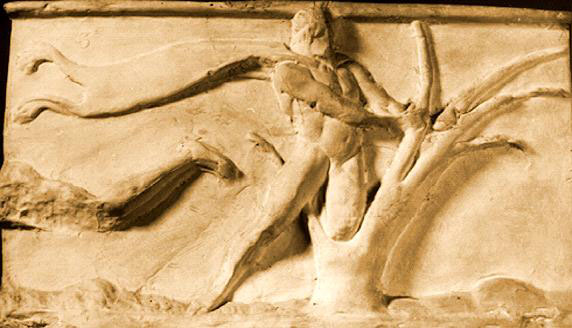
Satyr, wearing a panther skin, tearing a branch from a tree.
The rear end of a dolphinman is shown to the left.
- Plaster cast: Height: 27cm.
- Copy of part of a marble frieze.
- The frieze:
- is from the Lysikrates Monument in Athens.
- was made about 330 BC.
- is still in situ.
Detailed Record
Commentary Prepared by Dr. Julia Lenaghan, Ashmolean Museum
A 141 N
Satyr and Dolphin; Lysikrates Monument
Marble (Pentelic)
Frieze
H 25.4 cm
Greece, Athens, in situ
After 335/34 BC; Late Classical
Preservation:The surface of the relief is heavily worn, especially in the satyr’s face. The thighs of the pirate are scored.
Description:The scene shows two figures and a tree. To the left is a pair of human legs suspended horizontally in mid-air, in the center a satyr. The satyr is depicted frontally, his torso turned slightly to the left. He leans with his left leg against a tree with many branches, one of which he holds with both hands. A panther skin is tied around his neck and flows behind him.
Discussion:The scene depicted here has an equivalent on the opposite section of the frieze (A 141f). An elderly, bearded satyr is about to break off a branch from a tree, in order to use it as a makeshift weapon. Further to the left, a pirate tries to escape, but at that very moment is being transformed into a dolphin.
For a full discussion of the monument see A 141a.
Bibliography:H. F. de Cou,
"The Frieze of the Choregic Monument of Lysicrates at Athens." (AJA 8 1893) 42-55
Discusses earlier studies and drawings of the monument and the composition of the frieze.W. Erhardt,
"Der Fries des Lysikratesmonuments" (Antike Plastik 22 1993) 18-20 figs. 18-20 pl. 10
The most thorough discussion of the frieze so far. Excellent photographs of the original frieze, as well as documentation of early drawings and casts documenting a much better state of preservation. Extensive bibliography.