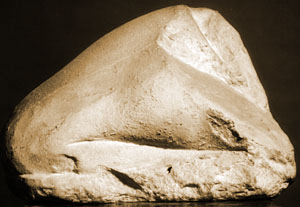
Bent knee and part of leg.
Commentary Prepared by Dr. Julia Lenaghan, Ashmolean Museum
A 134
Bent right leg from Tegea. Athens
Fragment of a bare, kneeling right thigh and knee from a life-size figure. From a pediment of the Temple of Athena Alea at Tegea. The temple was constructed by Scopas of Paros in ca. 350 BC.
Marble
Pedimental Figure
L 37.3 cm, H 29.5 cm
From the Temple of Athena Alea at Tegea.
Greece, Athens, National Museum, 180a
Ca. 350-340 BC
Preservation: The fragment is broken through the upper thigh. The break has three principal planes. There is a smooth vertical surface at the lower, back of the thigh. This surface, however, is disrupted. On the exterior side of the knee the break slants only slightly upward into the thigh. On the interior of the thigh the break plan is more horizontal and cuts further into the thigh. The front of the knee, top, bottom, and sides are complete. The underside of the plinth is smooth.
Description:The fragment depicts a portion of a bare, kneeling right leg that rests on a thin plinth. The upper thigh is fully depicted, and its inner and front side are carefully worked. The forms are flowing and broad. The outer side of the thigh, in contrast, is flat and more schematically defined. The lower leg disappears beneath the thigh, which presses down upon it, into the plinth. Since it would not have been visible, it was never fully modelled. On the inner side of the leg a flat channel, possibly created by the running drill, indicates the separation between the flesh of the thigh and that of the lower leg.
Discussion:The kneeling and nude right leg was found in the area of the Temple of Athena Alea at Tegea. Its technical details, marble, and size ensure that it belonged to the pedimental sculpture from the Temple. This Temple is best known from Pausanias’ description (8.45). For more general information on it and a discussion of other sculptural fragments from it, see cat.no. A 132-A 133 and A 135-137.
Pausanias informs us that the east pediment was decorated with the Calydonian boar hunt and the west pediment with the battle between Telephus and Achilles on the plain of Kaikos. It is impossible to assign this leg with certainty to either one or the other of the pediments. The themes of both pediments might have called for a kneeling male. The figure, to which this leg belonged, was not upright and, consequently, was probably located near a corner of the pediment.
Because the outer side of the thigh is only schematically worked, it is clear that only the interior side of the leg and the front of the knee were visible. This detail as well as the nonexistent lower leg (its folded position below the thigh and adjacent to the ground meant that it would never be visible) are indications of the practical and economical stone-carving that characterize all of the pedimental sculpture from Tegea. In addition, the small channel used to separate the thigh from the calf reappears on other of the sculptures (cf. cat.no. A 135). A final technical detail, again typical of the Tegea pediments, is that the plinth is thin (in this case only 3.8 cm) and its bottom surface is even. It would have been set directly on the floor rather than embedded into the floor.
J. Lenaghan
Bibliography:C. Dugas, J. Berchmans, and M. Clemmensen,
La sanctuaire d’Aléa Athèna à Tégée au IVe siècle (Paris 1924) 100, no. 53, pl. 98 b
first and fullest catalogue entryA. Stewart,
Skopas of Paros (Park Ridge, NJ 1977) 38, 41, 45, pl. 21a-c
discussed in section on technique