Commentary Prepared by Dr. Julia Lenaghan, Ashmolean Museum
A 126
Nike with partridge from Epidauros. Athens
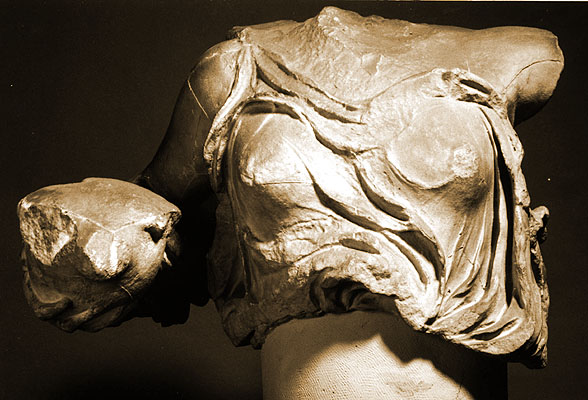
Torso from a statue of Nike coming forward and holding a partridge. The statue was the central acroterion over the west pediment of the Temple of Asklepios at Epidauros, ca. 375 BC.
Marble (Pentelic)
Acroterion
H total 85 cm
From the Temple of Asklepios at Epidauros. Found in the late wall between the tholos and the temple.
Greece, Athens, National Museum, 155
Ca. 375-370 BC
Preservation:The torso is broken through the base of the neck, through the beginning of the left arm, and through the waist. The neck, head, and tips of the wings of the bird carried in the right hand are missing. There is distinct weathering on the chest around the center of the neckline and base of the neck. The torso connects to a large fragment that depicts the lower body. In addition, there are numerous other body and drapery fragments that have been reattached to the figure. Nonetheless, the head, neck, left arm, left leg from the knee down, the right foot, most of both wings, large potions of the mantle, and the above noted pieces of the bird, are still missing. On each shoulder blade is a rectangular dowel hole. Between these dowel holes is a modern cutting, below which are two ancient round holes. Under the round holes is another ancient rectangular dowel hole. The ancient dowel holes and round holes were for the attachment of the wings. The modern cutting was made for the piece’s first museum installation.
Description:The torso shows a female holding a bird in her right hand and raising her left arm. Her two copious garments blow off and swirl around her body. The back of the body is only schematically worked and features cuttings for the insertion of wings.
The right arm is bent at a 90 degree angle and held slightly out to the right side of the body. A portion of heavy drapery is wound around the forearm-- from the elbow to the middle of the forearm. The body of a large round bird sits in the open and upward facing palm of the right hand. The wings of the bird, now broken, were once stretched open, and the bird’s head and neck, also no longer preserved, came forward. The female figure’s left shoulder and immediately contiguous area of the left arm are raised and extend to the left of the body. The left hand must have been held high and must have held an edge of the heavy garment, the other end of which is wrapped around the right arm.
The torso wears two garments. A sleeveless inner garment is fastened on the right shoulder and belted at the waist. The upper edge of the garment is not fastened on the left shoulder. Nonetheless the upper edge dips between the breasts and rises over the left breast before falling down along the left side. The material blouses abundantly over the belt at the waist. It is blown upward and backward. Over the body the material appears fine. The breasts push through the material, and the folds on the body are not thick. Below the left breast there are particularly shallow folds that stick to the body. Between the breasts the blown folds are artfully and decorously conceived in curving patterns. Off the body the folds are considerably thicker and blown vigorously backward. The second garment is a mantle wrapped around the right arm and held aloft by the left arm. This material appears thicker than that of the inner garment.
Discussion:The figure of Nike holding a partridge was the central acroterion of the west façade of the Temple of Asklepios at Epidauros. The temple was constructed ca. 380-370 BC, and, though small, was richly adorned with sculpted elements. Significant fragments of the all of the temple’s marble acroteria as well as numerous fragments of the figures that once decorated the pediments are preserved. For general information on the temple, see cat. no. A 121 and for other sculpted fragments from the pediments and acroteria, see cat. nos. A 122, 123, 124, 125, 127, 168, and 169.
The identity of both the figure and the bird have until recently been controversial. Crome, for instance, identified the figure as Epione, the wife of Asklepios, for thematic (appropriate for a temple of Asklepios) and for iconographic (possibly holding a partridge) reasons. Yet, wing fragments, recently shown to join the body, as well as the cuttings at the back of the figure make the identification of Nike secure. Although figures of Nikes usually do not hold birds, the suggestion that the bird held by this figure is a partridge is suitable given the size and shape of the bird. Moreover, the partridge was especially sacred to Asklepios; it ate particular types of grasses that were associated with healing, and in addition, eating the bird itself was considered medicinal. In this case, the Nike figure is not related to the amazonomachy scene depicted below it in the temple’s west pediment but rather relates to the temple’s cult and honorand, Asklepios.
The figure itself follows an established tradition for Nike figures. A comparison with the later fifth century Nike of Paionios at Olympia (cat. no. B 186) demonstrates this. Compositionally they are almost the same; left leg comes forward, the mantle is held in the raised left hand; and drapery is blown back off the figure. Stylistically, however, the Nike with partridge from Epidauros is notably different from that of Paionios. This Nike features a more baroque and exaggeratedly elegant arrangement of folds and a softer presentation of material. A similar style is visible in the pedimental figures from the second temple of the Argive Heraion (cat. no. A 110) and in the figures of the parapet of the Temple of Athena Nike on the acropolis (cf. cat. nos. A 103 and 104).
J. Lenaghan
Bibliography:J. Crome,
Die Skulpturen des Asklepiostempels von Epidauros (Berlin 1951) 20-22, no. 1, pls. 1-3
brief catalogue entry, identifies as EpioneN. Yalouris,
"Die Skulpturen des Asklepiostempels von Epidauros" Archaische und klassische griechische Plastik II (Mainz 1986) 180, pl. 151.1
notice of wing fragments that make Epione identification impossibleN. Yalouris,
Die Skulpturen des Asklepiostempels in Epidauros (AntPl 21 1992) 30-31, no. 25, pls. 24-26
full new catalogue entry, noting all joining fragments, and with discussion of identity of figure