Commentary Prepared by Dr. Julia Lenaghan, Ashmolean Museum
A 124
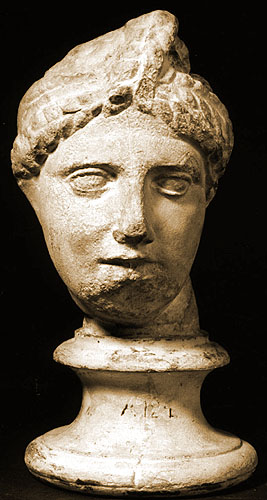
Head of amazon with plaits from Epidauros. Athens
Under life-size female head with plaits and once adorned with earrings and headdress. From a kneeling figure of an amazon fighting with a nude male warrior who pulls her head backward by the hair. From the west pediment (depicting an Amazonomachy) of the Temple of Asklepios at Epidauros ca. 375 BC.
Marble (Pentelic)
Pedimental Figure
H (of figure) 64.8 cm, (of head) 11 cm
From the Temple of Asklepios at Epidauros. Found on the west side of the temple. Another fragment of the same figure was found built into a later wall between the Tholos and the west front of the temple.
Greece, Athens, National Museum, 140
Ca. 375-370 BC
Preservation:The head is broken through the neck and at the top of the head. The chin and mouth are badly damaged, and the right side of the face and the forehead are weathered. There is a hole in the left earlobe and about twenty holes in the hair-- two on each side of the central plait, at least eight above the horizontal plait on the left side of the head, another three moving backward on the left side of the head, as well as others in the left side of the head—for the insertion of metal ornaments. The head joins a figure recomposed of four other pieces: an upper body (NM 149), a lower body with right leg (NM 139), the upper part of the left leg (Epidauros Museum), and the left leg from the thigh to below the knee (Arch. Ges. 3939 and Epidauros Msueum 67). Another fragment of a shoulder probably also belongs to the figure. The figure and its male opponent were made from piece of marble; originally the right arm of the man and the left of the woman connected the two figures.
Description:The head depicts a woman with long hair arranged in plaits around her head. There are holes in the left ear and near the top of the head for the insertion of metal ornaments. The head is tilted sharply to the left, and the right side of the head is barely worked. It was clearly not visible to the viewer.
The hair is worn in two plaits that wrap twice around the head. On each side of the head a double row of plaits is visible. These are then tied by a plait, perpendicular to them, which begins at the center of the brow and goes back toward the crown. This vertical plait pulls the other plaits upward off the brow. Thus, the portion of the brow visible has a triangular shape. On the right side of the head, only the lowest row of the plaits is articulated with detail. The upper part of the hair is roughly picked on the right side, broken around the crown, and lumpy on the left side. The unevenness of the left surface is partially the result of the holes for the insertion of the metal headdress. The hair leaves the left ear uncovered, and it features a hole for the insertion of an earring. The form of the right ear is defined but no attempt has been made to sculpt it further.
The face is a long oval. The forehead appears tall since the hair is pulled well off it at the center. A horizontal crease crosses the brow. The eyebrows are sharply defined ridges with no arch. The eyeballs are convex surfaces surrounded by the projecting rims of the eyelids. The upper eyelids are separated from the eyebrows by very little space; on the left side, there is merely an engraved line between them. The nose is small and straight. There is some modelling, dimpling of the skin of the cheeks, around the outer sides of the nostrils. The mouth is open, and the general shape of teeth appears behind the upper lip. The extant portion of the neck at the left side juts out at an angle from the head, indicating that the head leaned to the left.
Discussion:This female head belongs to an under life-size figure of a fighting amazon that formed part of the sculptural decoration of the west pediment of the Temple of Asklepios at Epidauros. The temple was constructed ca. 380-370 BC, and its sculpted pediments featured an amazonomachy (on the west side) and the sack of Troy (on the east side). The amazonomachy on the west side was composed of seventeen figures which showed amazons in short dresses, often on horseback, fighting against nude male warriors. For general information on the temple, see cat. no. A 121; for more information on the west pediment, see cat. no. A 169; and for other fragments from the pediments, see cat. nos. A 122, 123, 125, 126, 127, and 168.
This head joins the body of a kneeling figure of an amazon whose upper body turns toward the center of the pediment and is visible to the viewer in a three-quarter view. A male warrior behind her, also on his knees, pulls her back by the hair with his right hand. His body, facing outward to the viewer, strains to his left. Her head, gripped by his hand, bends backward and turns to the left. This position explains why the right side of the head, which faced the back wall of the pediment, was not carefully worked. The amazon reaches back with her left hand to push the warrior’s body away from her; her left hand is visible on the right side of his torso. Because of its height and movement, the group can be assuredly located near the right corner of the west pediment. As was the case of the central group of the west pediment (cf. cat. no. A 169), this group is impressively worked from one piece of marble. The two figures, resting on one plinth, were connected by their arms.
Crome, noting the head’s fashionable hairstyle and earrings, deemed the head unlikely to represent an amazon and concluded that the head must have been part of an acroterion statue. The horizontal plaits of the hairstyle are like those of one of the Trojan women depicted on the east pediment of the temple (cat. no. A 125) and the vertical plait is vaguely similar to that worn by the Erechtheion caryatids (cat. no. A 105). This hairstyle may have been a real fashion that could have been incorporated into the depiction of any female. Moreover, evidence for the addition of an elaborate diadem or crown also occurs on another amazon head fragment from the pediment, that assigned to the central amazon of the pediment (cat. no. A 169).
Julia Lenaghan
Bibliography:J. Crome,
Die Skulpturen des Asklepiostempels von Epidauros (Berlin 1951) 22-23, no. 2, pls. 4-5
brief catalogue entry, ascribes to central acroterion figureN. Yalouris,
"Die Skulpturen des Asklepiostempels von Epidauros" Archaische und klassische griechische Plastik II (Mainz 1986) 179, pl. 150.2
corrects Crome, associates head with group on right side of west pedimentN. Yalouris,
Die Skulpturen des Asklepiostempels in Epidauros (AntPl 21 1992) 42-44, no. 39, pls. 47e, 48, 49a, 50a
full new catalogue entry, with careful publication of all fragments pertinent to figure