Commentary Prepared by Dr. Julia Lenaghan, Ashmolean Museum
A 123
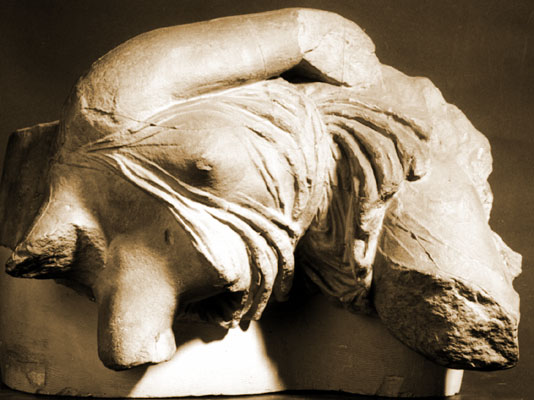
Wounded amazon slumped on horse from Epidauros. Athens
Under life-size figure of a wounded Amazon, falling lifelessly off her horse. From the west pediment (depicting an Amazonomachy) of the Temple of Asklepios at Epidauros, ca. 375 BC.
Marble (Pentelic)
Pedimental Figure
H (with arm) 44.5 cm, W 47.5 cm
From the Temple of Asklepios at Epidauros. Found on the west side of the temple.
Greece, Athens, National Museum, 137
Ca. 375-370 BC
Preservation:The torso is broken at the neck, the right upper arm, the left elbow, and left thigh. Of the horse only a portion of the neck is extant. Three fragments have been discovered to join directly to the torso; they are not included in the Ashmolean cast. These include a fragment showing the lower portion of the neck and chest of the horse and two fragments of the right arm of the amazon which show the arm until the wrist. There is a hole in the right breast of the amazon; this is for the insertion of an arrow or spear. A formless blob of marble on the back of the right lower arm shows where the arm was once connected to the horse. On the small of the back of the amazon is a large rectangular dowel hole by means of which the figure was attached to the wall of the tympanum. A small hole on the left side of the neck of the horse as well as another on the lower part of the right side of the horse were for metal ornaments. There are two larger holes in the break surface through the horse’s body (the bottom of the fragment). Four other fragments probably belong to the figure but do not join directly. These include the face of the amazon without the neck, a fragment of the left leg wearing a boot, a plinth fragment with a portion of a right hand, and a plinth fragment with the front left hoof of a horse.
Description:The fragment depicts an under life-size figure of a woman in a single garment. The figure has an arrow wound in one breast and falls forward off her horse, only the neck of which is preserved. The horse moves from the viewer’s right to left.
The left side of the horse faced the viewer; the right side faced the back wall of the pediment. Whereas the woman covers most of the extant portion of the horse’s left side, on the right side of the horse, against the wall, a portion of sketchily outlined mane is visible. The female figure astride the horse falls forward onto the neck of the horse and turns so that the upper body faces the viewer frontally. The neck and right arm, actually almost perpendicular to the ground, fall forward. The left thigh falls, still astride the horse, follows a downward path like that of the right arm. The left arm lies against the body. The woman’s right leg is invisible and was possibly intended to be thrown over the horse’s body. The body of the woman is softly modelled without crisp articulation or definition.
The figure wears a single garment, the top of which is folded down. Over the left shoulder the edges of the crease of the fold are brought together and fastened with a round button. The upper edge of material slants diagonally from the left shoulder to the top of the right breast. Above it, near the center of the chest, is a hole, a wound made by an arrow or spear which would have been made of metal. Around the waist the garment is belted. The belt goes over the overfold of the garment. The overfold ends near the upper thigh. The bottom edge of the overfold is visible also on the right side (wall side) of the horse. Beneath the bottom border of the overfold, the garment appears thinner since it is only one layer deep.
The folds are curving and rounded. Over the left breast and thighs the material appears thin and around the sides of the body and at the bottom edge of the overfold the material is more substantial with thick round folds. The left breast pushes distinctly through the material which has copious folds on either side of the breast. The thinness of material over the breast seems illogical since the area was covered by the garment’s overfold.
Discussion:This figure of a wounded amazon falling off her horse comes from the west pediment of the Temple of Asklepios at Epidauros. The temple was constructed ca. 380-370 BC, and its sculpted pediments featured an amazonomachy (on the west side) and the sack of Troy (on the east side). The amazonomachy on the west side was composed of seventeen figures which showed amazons in short dresses, often on horseback, fighting against nude male warriors. For general information on the temple, see cat. no. A 121; for more information on the west pediment, see cat. no. A 169; and for other fragments from the pediments, see cat. nos. A 122, 124, 125, 126, 127, and 168.
This is one of four amazons shown on horseback in the pediment (cf. cat. no. A 169). Here, the horse moves to the viewer’s left; its upper outline would thus have slanted from a high point of its head on the left downward to a low point, its tail, on the right. Moreover, it is clear that the left side of the horse was meant to face outward since it is onto the left side of the horse that the body of the amazon falls. This horse and rider were therefore located on the right side of the pediment, moving toward the left. Yalouris places the figure immediately in front of the kneeling group that shows a warrior pulling an amazon by the hair (cf. cat. no. A 124).
Yalouris’ location of new fragments that directly join the piece as well as his association of fragments that probably join the piece allow for an almost complete reconstruction of the figure. This includes even the head with eyes that are beginning to close. Stylistically the rendering of the drapery is similar to that of the better preserved central amazon, cat. no. A 169, and is considered typical of the west pediment at Epidauros.
J. Lenaghan
Bibliography:J. Crome,
Die Skulpturen des Asklepiostempels von Epidauros (Berlin 1951) 33-34, no. 10, pls. 16-17
brief catalogue entryN. Yalouris,
Die Skulpturen des Asklepiostempels in Epidauros (AntPl 21 1992) 42 , no. 37, pls. 46a-b, 47a-c
full new catalogue entry with notice of new joins, fragments from same figure, and placement in pediment