Commentary Prepared by Dr. Julia Lenaghan, Ashmolean Museum
A 121
Priam from Epidauros. Athens
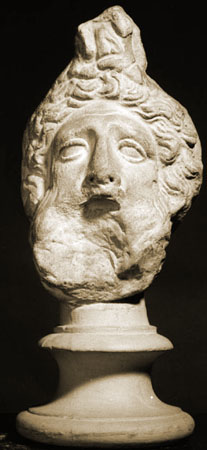
Small head of old bearded man, Priam, with pained expression and soft conical oriental hat. Hair and hat pulled by the left hand of another male figure, Neoptolemos. From the east pediment (depicting the Sack of Troy) of the Temple of Asklepios at Epidauros ca. 375 BC.
Marble (Pentelic)
Pedimental Figure
23 cm
From the Temple of Asklepios at Epidauros. Found in front of the east side.
Greece, Athens, National Museum, 144
ca. 375-370 BC
Preservation:The head is broken through the back and through the lower portion of the beard and neck. At the top of the piece, the left hand which holds the top of the head is broken through. The lower lip and front portion of the beard have broken off. The hair at the right side is less carefully worked than that of the left side. Two fragments, which give the back of the head, have been located in the Epidauros museum.
Description:The under life-size head depicts a man with long hair, a beard, and a soft cap. His face is distorted in a moment of pain since another figure pulls his hair and head. The head is pulled towards its right.
The face is framed by long wavy locks of hair that are brushed off the face and cover the ears. The hair is rendered impressionistically in coarse strands. On the right side of the head the hair is flatter and less carefully delineated than that on the left side. Covering most of the hair, all except for that around the face, is a cap. The cap has broad flat folds, indicated by an occasional vertical engraved line. A left hand grabs both the hat and the hair above the center of the brow.
The brow is deeply creased. Below the crease, the lower brow bulges. The eyebrows start high near the bridge of the nose but drop heavily downwards towards the outer corners of the eyes. Their descent is not a straight diagonal line but a wavy line. The eyes also droop downwards. Small projecting rolls of marble around the eyeballs denote the eyelids. The nose is straight but also seems pulled downwards with taut and extended nostrils. The beard was clearly once full. Little of it is still extant.
Discussion:The small head of Priam comes from the east pediment of the Temple of Asklepios at Epidauros. This temple was a highly ornate, small Doric temple (6 x 11 columns) erected in the early fourth century BC. Although the literary record provides no details about the building itself, excavations carried out primarily between 1882 and 1886 have produced the plan, architectural elements, hundreds of sculpture fragments, as well as a limestone block inscribed with the building accounts.
The building accounts are particularly interesting since they cite prices paid for various elements and show that the work stretched over approximately four years, eight months, and ten days. According to the account, the sculptor Hektoridas was commissioned to do first one half of the sculptures for a pediment and then after a pause of a year the rest of the sculptures for that pediment; the sculptor Timotheos did the acroteria on one side in addition to some reliefs; a sculptor Theo…. did the acroteria of the other side; and Thrasymedes, to whom Pausanias (2.27.2) assigns the cult statue, made the chryselephantine doors. Unfortunately, it is impossible to identify securely which pediment and which acroteria were done by which sculptor, and only Timotheos is known in other sources. N. Yalouris, who has produced the definitive catalogue of all sculptural fragments, believes that the Hektoridas was responsible for the east pediment since stylistic variation among the figures suggests that they were possibly done in two stages. Thus, since the inscription says that Timotheos did the acroteria of the other side, Yalouris concludes that Timotheos was responsible for the west acroteria (cat. nos. A 126-127)
Scholars have dated the temple variously between 394 and 353 BC. Yalouris suggests that a date between 380 and 370, particularly 375-370 BC, is most probable. His main reasons are that the letter forms of the building accounts inscription should fall within this period, that this is appropriate for the style of the architecture and sculpture, and that Cicero notes a tyrant of Syracuse who died in 367 BC as having made a dedication at the temple.
The pediments of the temple featured almost eleven meters of width available for figures. Twenty-one figures are hypothesized for the east pediment and seventeen for the west pediment. The central figures of the pediments were approximately 10 1.25-1.15 m tall. The sculptural fragments from the pediments depict two different stories; the Ilioupersis and the Amazonomachy. The find locations of the pieces show that the Ilioupersis was located on the east side and the Amazonmachy on the west side. The sculpture of the two pediments differs stylistically and technically; therefore, even fragments without recorded find locations can be ascribed with some certainty to the correct pediments. The sculpture of the east pediment (cf. cat. nos. A 125 and 168) generally shows harder sharper fold patterns, more powerful bodies, and a greater play of light and shadow. The figures are larger than those of the west pediment (cf. cat. nos. A 122, 123, 124, and 169) and rest directly on the floor of the pediment unlike the figures of the west pediment which rest on plinths. Also the compositional arrangement of the figures within the pediment differs; that on the east is more complex and less symmetrical.
The head of the distressed Priam in discussion here follows a well-established motif. Neoptolemos grabs the old man, who has sought protection at an altar, by the hair. For instance, a relief from Taranto reproduces the same image. The tilt of the head and neck of the Priam figure allow Yalouris to suppose that Priam’s left arm reached over his head vainly in self-defense. Yalouris also found two pieces that joined the back of the head. These show that the head was connected to a figure, made from the same block of marble, that stood behind Priam; a fragment of this figure is still preserved. The figure was probably his wife Hekabe or a daughter; again the Taranto relief shows the same motif. This group must have been located, given its size, near the center of the pediment and, because of the slope of the outline of the group, it would have been located to the right of center.
J. Lenaghan
Bibliography:J. Crome,
Die Skulpturen des Asklepiostempels von Epidauros (Berlin 1951) 45-46, no. 34 pls. 40-41
catalogue entry without latest joinsB. Schlörb,
Timotheos (Berlin 1965) 1-39, pl. 2
out-dated discussion of authorship of sculptures and reconstruction of temple with some valid stylistic comparisonsN. Yalouris,
"Die Skulpturen des Asklepiostempels von Epidauros" Archaische und klassische griechische Plastik II (Mainz 1986) 175-186
discussion of templeN. Yalouris,
Die Skulpturen des Asklepiostempels in Epidauros (AntPl 21 1992) 26-27, no. 16, pls. 16d-17b
full new catalogue entry, publication of new joins, with text discussing all aspects of the pedimentsB. S. Ridgway,
Fourth-Century Styles in Greek Sculpture (London 1997) 34-41
summary of temple decoration and Yalouris in English