Cast Gallery catalogue number: A120g
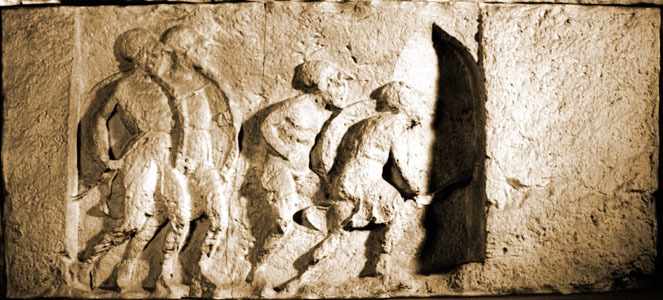
Warriors laying siege to a city. They try to enter a gateway in the city wall.
- Plaster cast: Height: 61cm, Width: 1.35m.
- Copy of part of a limestone frieze.
- The frieze:
- is from the interior of the west wall of the Heroon at Trysa (in Lycia).
- was made about 390-380 BC.
- was taken to Vienna in 1883.
- is now in Vienna, Kunsthistorisches Museum.
Detailed Record
Commentary Prepared by Dr. Julia Lenaghan, Ashmolean Museum
A 120 G
City Siege; Trysa Heroon West Wall
Limestone
Architectural Relief
W (total) 618 cm
First discovered in 1841 but soon forgotten, the Trysa heroon was rediscovered in 1881 by Otto Benndorf, then Professor of Classical Archaeology in Vienna. In 1882/83 the friezes of the heroon were transferred to Vienna.
Austria, Vienna, Kunsthistorisches Museum
Late Classical, ca. 370 BC
Preservation:The entire surface of the relief is heavily weathered, many figures are greatly worn and abraded.
Description:The relief depicts a group of four warriors moving along a wall towards a small gate to the right. The first two appear to be marching in file. They wear short chlamydes and Corinthian helmets and carry a round hoplite shield in their left and spears in their right hands. Further to the right another pair, dressed like the first but armed with swords instead of spears, approach the gate in a crouching position.
Discussion:A small force of attackers tries to break through one of the city’s sally ports; a similar assault is under way further to the right.
For the Trysa heroon in general see also A 119a and A 120a.
Bibliography:O. Benndorf and G. Niemann,
Das Heroon von Gjölbaschi-Trysa (Vienna 1889) esp. 51; 123-129 pls. 11; 112-113
The basic first publication of the monument.F. Eichler,
Die Reliefs des Heroon von Gjölbaschi-Trysa (Vienna 1950) esp. 61-63 pls. 18-21
Detailed guide with a description of the monument and the individual reliefs.R. Noll,
Das Heroon von Gjölbaschi-Trysa. Ein fürstlicher Grabbezikr griechischer Zeit in Kleinasien [= Führer durch das Kunsthistorische Museum Nr. 16] (Vienna 1971) esp. p. 5
A short guide with a detailed description of the various reliefs.W. A. P. Childs,
"Prolegomena to a Lycian Chronology, II: The Heroon from Trysa" (RA 2 1976) 281-316
Gives a detailed stylistic comparison between the reliefs from Trysa and sculptures from the Greek mainland and the rest of Lycia. The Heroon at Trysa is dated to ca. 370 BC.W. A. P. Childs,
The City-Reliefs of Lycia [= Princeton Monographs in Art and Archaeology XLII] (Princeton N. J. 1978) esp. 13-14; 31-36; 78 pls. 1.2; 13.2-17
Shows that the siege scene from Trysa forms part of the typical iconography of Lycian reliefs and ultimately derives from Near Eastern, particularly Assyrian sources that were slightly adapted under Greek influence.C. Bruns-Özgan,
Lykische Grabreliefs des 5. Und 4. Jahrhunderts v. Chr. [= IstMitt Beiheft 33] (Tübingen 1987) 56-81; 256-257 pls. 9-11.2; 12-13.2
Argues that the friezes from Trysa show an advanced style of ca. 370 BC and are influenced by the iconography of Greek paintings of the Classical period, probably through the use of established pattern books.B. S. Ridgway,
Fourth-Century Styles in Greek Sculpture (London 1997) esp. 88-94 pls. 24-25
Good summary and bibliography of previous research on the heroon.